

Square reseller residual payment types include recurring processing residuals, agreement-specific revenue shares, and referral bonuses, not a universal commission on restaurant card sales. Advice to forecast earnings from sales volume alone misses the deciding detail: what revenue remains eligible after processing fees and contractual adjustments.
For restaurant-focused ISOs and agents, the payment method matters too. Tap, chip, swipe, online, card-on-file, and keyed-in transactions can land on different processing-fee lines. Start with the signed agreement and Square’s report, not a headline rate or an AI-generated estimate.
Square Reseller Residual Payment Types at a Glance
Separate the general ISO model from Square’s specific partner programs. An ISO-style processing residual describes ongoing compensation tied to merchant processing economics. It doesn’t establish eligibility for a Square referral bonus, an API implementation revenue share, or a Square Online software revenue share.
Industry guidance from RelyOn on ISO payment arrangements describes the residual pool as processor markup and service revenue after network-related costs. That’s different from treating gross restaurant card sales or interchange itself as the partner’s compensation base.
Residual payment types by trigger, recurrence and basis
| Payment type | Trigger | Recurring | Basis |
|---|---|---|---|
| Processing residual | Merchant keeps processing card payments through Square under an eligible agreement | Yes, while processing continues and contractual eligibility remains | Adjusted payment-processing revenue from that merchant |
| Referral bonus | Referred business adopts Square under a written agreement | Usually one-time; some agreements add a recurring part | Terms of the written agreement |
| Solutions partner revenue share | Partner implements Square through POS or e-commerce APIs | Time-limited under Square’s partner terms | Adjusted payment-processing revenue |
| Square Online referral revenue share | Eligible Square Online referral on paid plans | Ongoing on eligible paid plans | Eligible paid-plan subscription revenue |
The processing row describes an ongoing revenue relationship. The referral row monetizes an eligible introduction, while the implementation and software rows attach compensation to different activities. Don’t combine these categories in a forecast merely because they involve the same merchant.
Square’s general partnership terms state that referral fees, commissions, or other compensation aren’t automatic without a separate written agreement signed by an authorized Square representative. That agreement controls the trigger, duration, and basis.
For sales positioning, our guide to reselling Square POS provides related channel context. If your agency also evaluates opportunities to become a dark web monitoring reseller, keep that separate from payments underwriting: a reseller label alone never establishes comparable compensation terms.
How the Processing Residual Base Is Calculated
A processing residual works like a royalty on the flow of eligible card transactions, not a bonus paid at signup. The important distinction is between sales volume, processing revenue, and the contractual residual base.
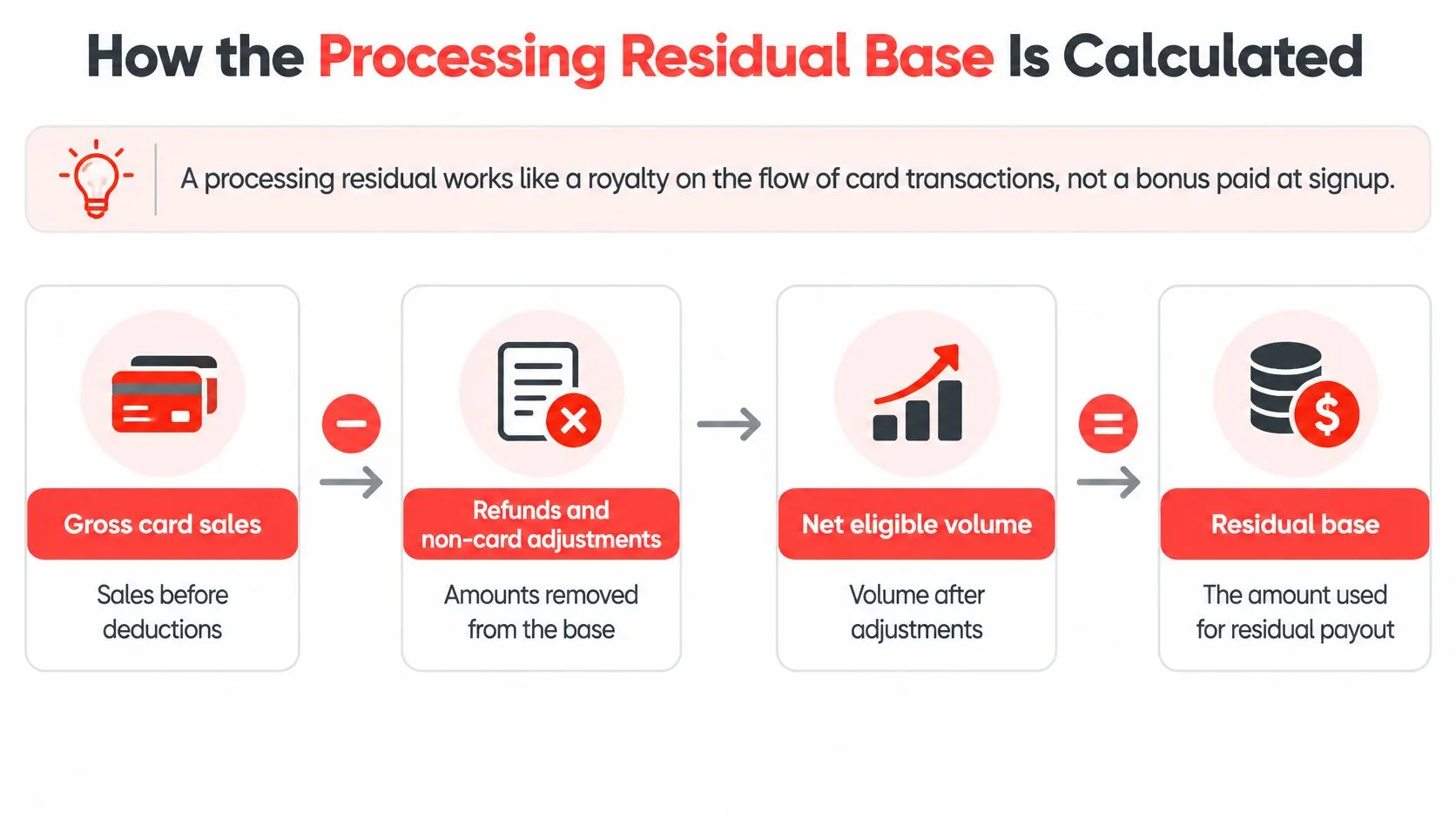
Start with recorded sales, separate non-card tenders, and reconcile refunds to eligible card volume. Then identify the processing revenue associated with that volume and apply only the exclusions, cost deductions, and intermediary arrangements specified by the agreement. A pricing concession may reduce processing revenue without reducing the restaurant’s sales.
NMI’s explanation of payment-facilitator economics helps distinguish the economic roles involved. Industry arrangements can recover chargeback balances from merchant margins before residual payment, and sub-agent arrangements can reduce what ultimately reaches an agent. Don’t assume those deductions apply to OrderOut or Square unless the governing terms establish them.
Practical rule: Compare the revenue base before comparing the advertised compensation rate.
Say fictional merchant Juniper Street Cafe maintains steady counter sales but issues refunds after a menu change. Its hypothetical residual follows the adjusted eligible base, not the till total alone. Whether disputes create a further deduction requires a separate contractual check.
Our ISO merchant-services guide provides context for identifying which party performs each channel role. For reconciliation, request:
- Definitions: Eligible volume, adjusted revenue, and excluded products.
- Adjustments: Refunds, chargebacks, pricing concessions, and applicable offsets.
- Rights: Reporting access, audit provisions, and post-termination merchant attribution.
A lower contractual rate on a transparent base can be easier to forecast than a higher rate on an undefined net figure. Map every permitted deduction to a report line before treating a residual as predictable income.
How Tap, Chip, Swipe and Keyed-In Payments Change the Residual
The same amount of restaurant sales can sit on different processing-fee lines depending on how customers pay. Entry method can change the processing economics, but it doesn’t by itself reveal the partner’s residual.
Tap and chip involve a card or payment device at the terminal. Swipe reads the magnetic stripe, online and card-on-file transactions use remotely entered or stored credentials, and keyed-in payments involve staff typing card details. Use the merchant’s actual Square classification and pricing option rather than assuming every category carries the same fee.
Card-entry methods and what to check on the residual
| Entry method | How the card is read | Fee category | What to check on the residual |
|---|---|---|---|
| Tap | Card or payment device read at the terminal, card present | Card-present rate set by Square | Confirm eligible volume and the rate line on Square’s report |
| Chip (insert) | Card read from its chip, card present | Card-present rate set by Square | Reconcile alongside tap where Square groups them |
| Swipe | Magstripe read at the terminal | Applicable swiped-payment classification on Square’s report | Check whether swiped volume has a separate rate line |
| Online and card on file | Card entered online or stored for later charges | Applicable card-not-present rate set by Square | Check the relevant online or stored-card report line |
| Keyed-in | Card number typed into the POS by staff | Applicable manually entered payment classification | Confirm how Square classifies manual entry |
Square’s Payments API application-fee documentation states that processing fees, including international transaction fees, are deducted before the application fee is calculated. That’s evidence about application-fee mechanics, not proof that a reseller residual uses the identical formula.
At fictional Juniper Street Cafe, counter transactions might be mostly tap and chip, while direct online orders add card-not-present activity. Restaurants link their payment processor so direct online orders are paid online and deposited to their account, and connect Clover or Square so orders enter the same workflow as in-store sales.
For marketplace operations, our delivery-to-POS integration maps Uber Eats, DoorDash, and Grubhub menus to a normalized POS schema, removing extra tablets and manual re-keying. That order routing doesn’t prove the marketplace payment created eligible Square processing volume. For a merchant evaluating the workflow, start with the OrderOut listing in Square’s App Marketplace.
Check whether the report separates entry methods. If it doesn’t, don’t manufacture a method-level residual allocation from order counts.
How Agreement Terms Decide How Long Residuals Last
Duration belongs to the agreement, not the word residual. Square’s Solutions Partner Program distinguishes time-limited processing revenue share for eligible POS or e-commerce API implementations from perpetual revenue share on eligible Square Online paid-plan referrals.
Those are program-specific provisions. Don’t apply the Solutions Partner term to an OrderOut reseller relationship, or apply a software referral provision to processing income.
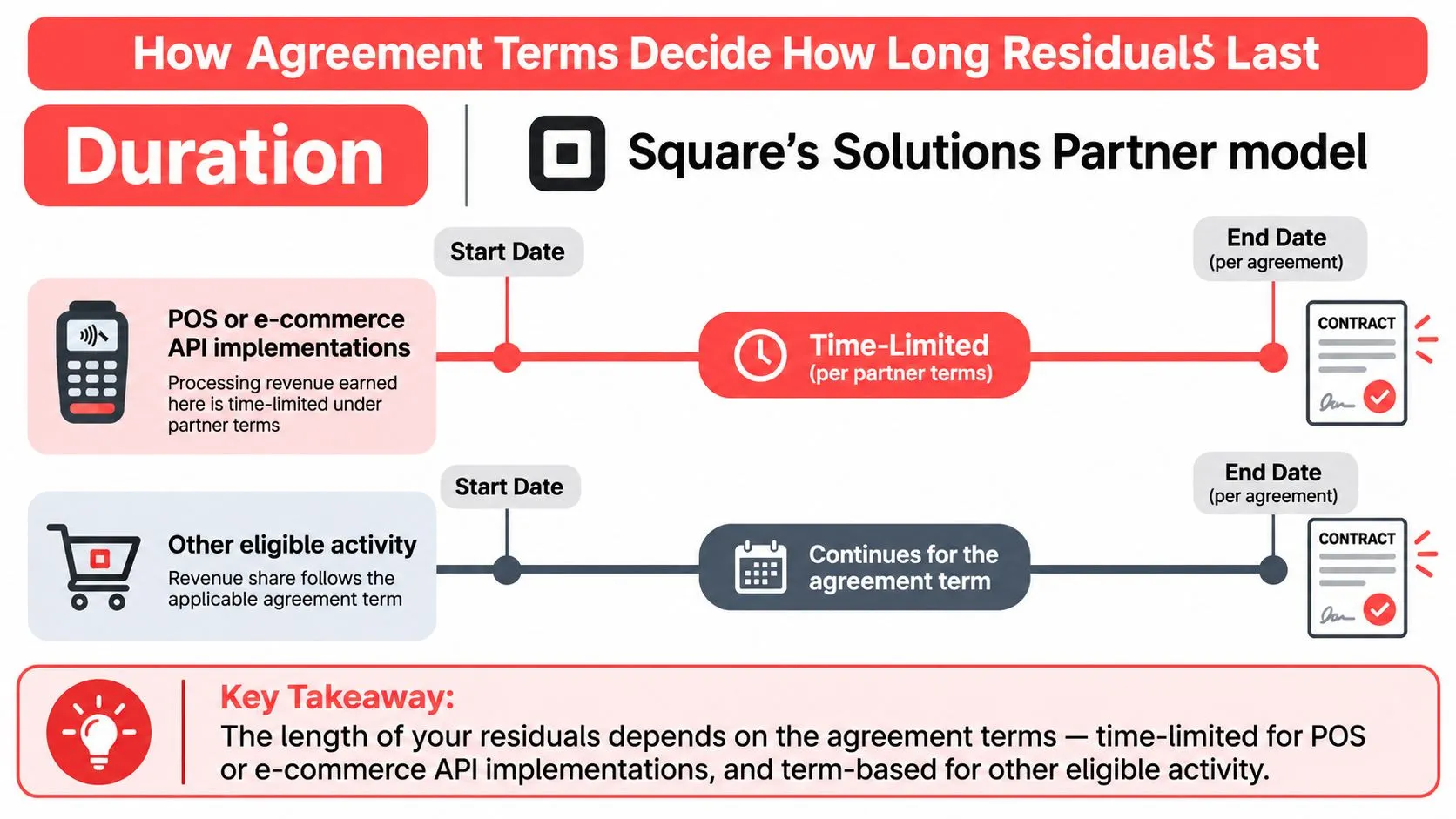
Treat attribution and duration as a sequence, not a promised onboarding schedule:
- Referral recorded: Preserve the merchant’s referral date and the applicable program.
- Account created: Verify that account creation falls inside the agreement’s attribution window.
- Eligible processing starts: Confirm when activity qualifies for compensation.
- Contractual term runs: Monitor any continuing eligibility conditions.
- Term ends or terms change: Apply the agreement’s renewal, amendment, and termination provisions.
The account-creation window matters independently of sales performance. A merchant can process substantial volume without creating an eligible referral if the attribution conditions weren’t met.
A continuing merchant relationship and a continuing contractual payment right aren’t interchangeable.
Use our Square ISO program guide to distinguish the channel relationship you’re evaluating. In your merchant tracker, record the referral date, attribution-window boundaries, processing start, and any contractual end date.
Where the agreement provides continued compensation while the merchant processes, preserve that language with the merchant file. Don’t replace it with an informal lifetime label that omits the conditions.
US and Canada Pricing Options That Shape Residuals
A Square residual forecast should start from the merchant’s signed agreement and Square account; country labels alone are not enough. The same tender mix can produce different economics when tap, chip, swipe, online, card-on-file and keyed-in payments post under different fee treatment, so the pricing option matters through the eligible revenue base rather than through the map.
Confirm three fields before you model a merchant: country, the Square pricing option attached to the account, and the contract definition of adjusted revenue. Square reporting can show volume, tenders, refunds and processing fees; it does not prove referral attribution or the reseller percentage. Resellers earn residuals on the merchants they bring to OrderOut, so the forecast should reconcile the merchant-facing processing price to the compensation terms separately.
If a cafe forecasts mostly card-present volume but the account later shows more keyed-in or online volume, the residual base can shift even when gross sales hold steady. Keep tender mix, pricing option and country in the merchant tracker, and update the model when any one changes.
Our Square reseller program covers the Square offering, how the reseller program works explains the broader OrderOut structure, and the Square partner program guide provides channel context.
Residual Statements to Request Before You Forecast
Request the reporting and contract definitions together. A statement without definitions leaves you guessing about its columns; an agreement without a sample statement leaves you guessing about reconciliation.
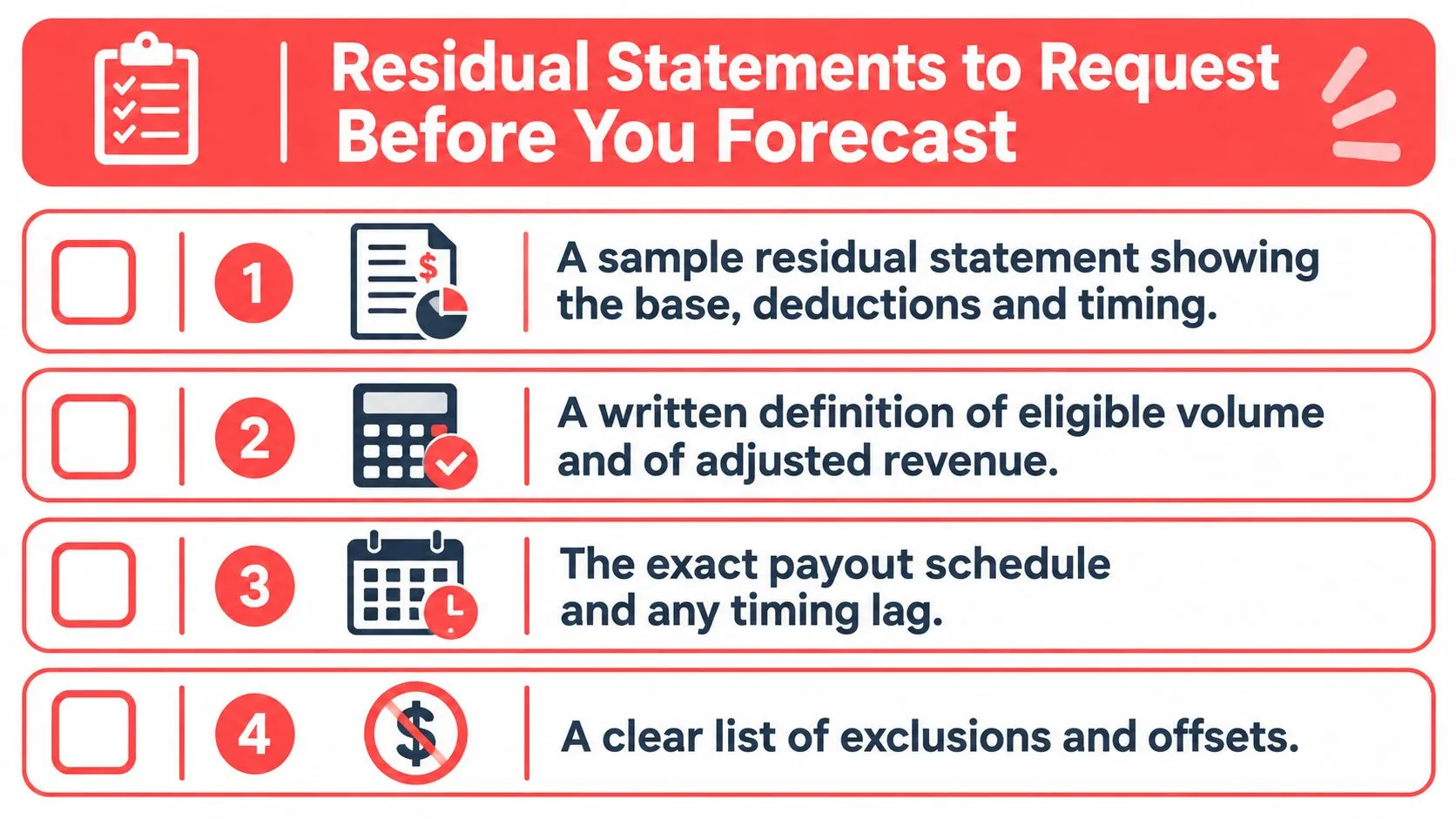
Use this request list in your partner correspondence:
- Sample residual statement: Show the base, deductions, reporting period, and timing.
- Written definitions: Establish eligible volume and adjusted revenue.
- Refund and chargeback treatment: Specify whether balances are recovered before compensation is paid.
- Payment timing: Confirm frequency, timing lag, and applicable reconciliation procedures.
- Attribution rules: Document the referral date and account-creation window.
- Duration: Identify the term for each compensation category.
- Contractual rights: Clarify audit access and post-termination payment and attribution provisions.
- Separate categories: Confirm whether referral bonuses, processing residuals, and software revenue shares have distinct lines.
What the reseller portal actually shows
Merchant residuals are live in the OrderOut reseller portal by merchant and month, with Explain available to help interpret them. Follow how to explain a residual in the reseller portal and the release note for Explain in the AI assistant.
Figures come from Square’s report and the payments OrderOut collects from Square, never from the AI. The portal doesn’t calculate splits or track payouts, so a displayed residual isn’t a payout schedule.
Reporting boundary: Explaining a reported figure doesn’t authorize an assistant to create a missing figure.
Once those inputs are reconciled, guidance on how to build a practical revenue forecast can help organize assumptions separately from reported results. Keep the signed agreement, checklist, and sample statement together, and attach the relevant reporting evidence to each merchant file.
Frequently Asked Questions
Does every merchant I refer create a residual?
No. A referral alone doesn’t establish recurring compensation; the written agreement determines eligibility, payment type, and duration. Before forecasting, confirm that the merchant was attributed through the applicable partner relationship and met its conditions. A merchant that signs up outside that attribution window may process normally while producing nothing for the partner.
Why can the same sale produce a different residual?
Tap, chip, swipe, online, card-on-file, and keyed-in payments can carry different processing fees on Square, so two identical ticket totals can generate different processing revenue. The contractual base then determines the residual, which means the sale amount alone never sets the earning. Reconcile the actual Square report for the merchant before attributing a figure, and expect a card-present-heavy restaurant to yield a different residual than a keyed-in-heavy one at the same volume.
Can the reseller portal tell me when I get paid?
The portal reports residual figures, but a reported month is reporting activity, and the agreement controls timing. Check your signed agreement and OrderOut’s reseller reporting for how residuals appear and when they’re paid rather than reading any displayed figure as a promised payment date.
Which countries can I forecast?
Confirm each merchant’s country and account pricing option with OrderOut before forecasting, because coverage and pricing terms are set per account rather than assumed. Keep any merchant whose terms you haven’t confirmed out of a live portfolio forecast.
Confirm Your Residual Terms Before You Sell
Confirm the payment type, trigger, duration, basis, attribution window, country, and pricing option before presenting merchant economics to any prospect.
Resellers don’t buy a plan; they earn residuals on the merchants they bring to OrderOut. The Reseller Program lets partners resell Square, Clover, and Online Ordering, and each opportunity still needs its own contractual and reporting checks. Two merchants with identical monthly volume can produce different residuals once their mix of tap, chip, swipe, online, and keyed-in payments enters the calculation.
The Square reseller program page covers the Square offering, and how the reseller program works gives the informational companion. If your responsibilities span software and payments, the ISV versus ISO guide helps distinguish those roles before you assign reporting responsibilities.
Visit OrderOut to review the restaurant partner offering, then request access to the Reseller Portal to review merchant residual reporting. Check your signed agreement and the Explain help article before forecasting any residual.