

What if the confusing part of restaurant payments isn’t the rate, but who’s responsible when something breaks? ISO merchant services sit at the center of that confusion, because the sales brand, the acquiring bank, the processor, the POS vendor, and the delivery integration can all touch the same restaurant account.
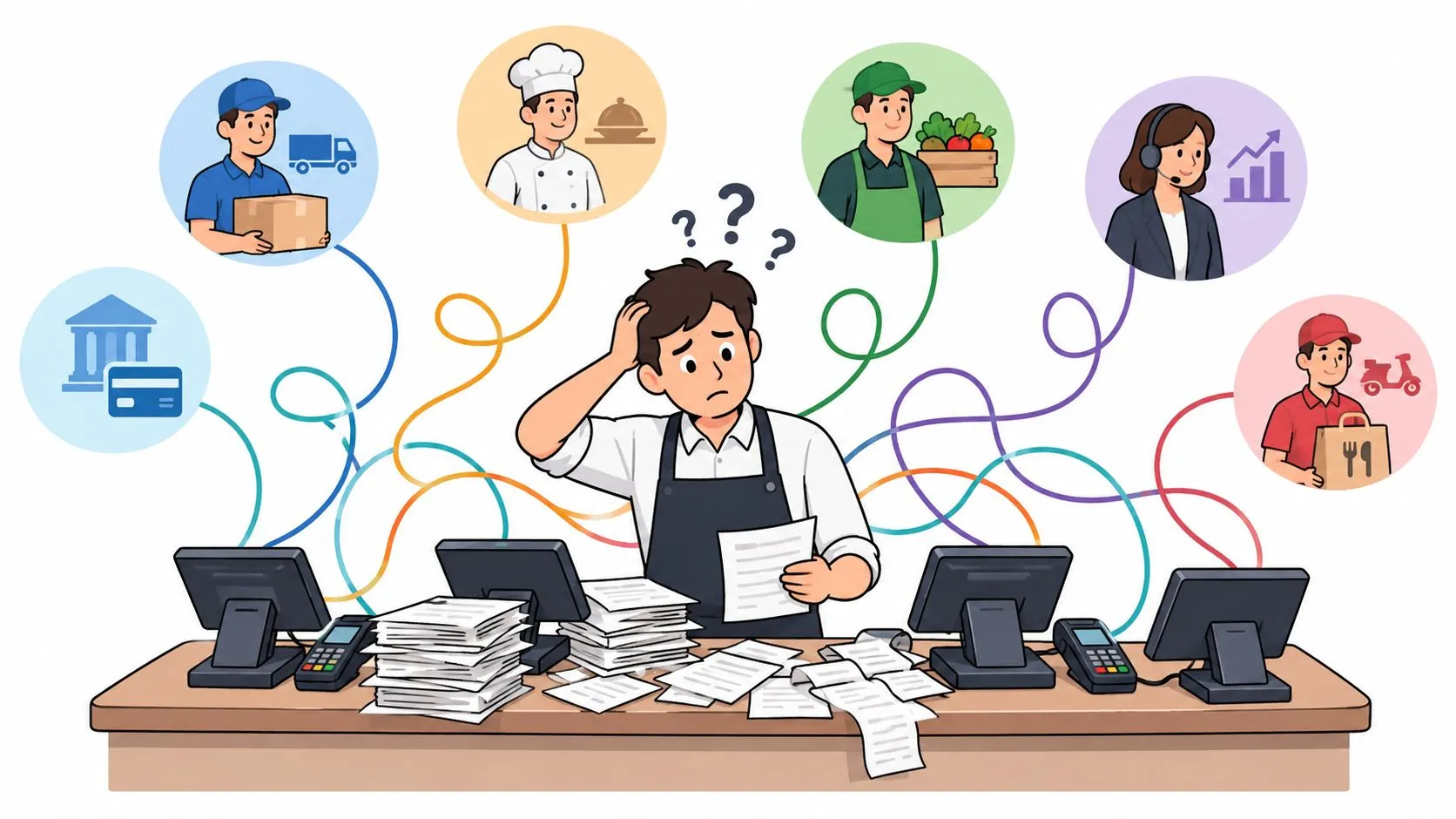
A restaurateur can hear an agent talk about ** ISO merchant services**, residuals, or a Square reseller relationship and walk away thinking they’re all the same offer. They’re not. For a restaurant operator, the central question is simple: who underwrites the account, who handles chargebacks, who can see card data, and who provides support for the integration when Uber Eats, DoorDash, or Grubhub orders have to land cleanly in Clover or Square?
If you’re sorting through delivery workflows alongside payment partnerships, this overview of payment processing integration helps frame the operational side before the contract language takes over.
Why Restaurant Payment Relationships Are Confusing
Why does one restaurant account involve an ISO, a processor, a reseller, and a POS partner at the same time?
A lot of owners meet payments through a problem they need solved fast. One vendor says they handle the ISO relationship, another says they process cards, a third says they support a Clover setup, and someone else packages hardware, onboarding, and residuals into one offer. The result is a stack of labels that sound interchangeable, even though the contracts underneath are not.
The practical issue is responsibility. Who underwrites the account, who handles chargebacks, who can access card data, and who supports the integration when delivery orders need to land cleanly in Clover or Square are separate questions. A restaurant can get strong onboarding help from one partner and still have that partner with no control over settlement, dispute handling, or PCI scope.
That confusion gets sharper once delivery and ordering are part of the workflow. A restaurant may use payment processing integration to connect online ordering, delivery apps, and card acceptance, while still relying on a different party for the merchant account itself. The operational flow can look unified on the screen and still be split across multiple legal relationships behind it.
The roles a restaurant should separate
A restaurant does not need to memorize industry jargon. It does need to separate who is doing what.
- Sales intermediary: the party introducing the account and helping with onboarding.
- Acquiring bank: the institution that carries authorization, settlement, risk controls, and network compliance.
- Processor: the backend that routes and settles transactions.
- Technology partner: the company connecting delivery, POS, online ordering, or phone ordering into the workflow.
That distinction prevents a common mistake. A company can be strong at onboarding and still have no control over the underlying settlement process. The same issue shows up when comparing OrderOut’s Clover delivery integration to a traditional merchant account, or when a Square reseller bundles software with payment services. The integration layer and the merchant account are related, but they do different jobs, and the contract should make that plain.
A useful reference for sales teams and operators is the guide to ISO roles for retailers, because it lays out the role split in plain language. The point is not to praise the ISO model. It is to know where the contract begins, where service ends, and who carries the operational risk when an order fails.
Practical rule: if a vendor cannot explain who underwrites, who settles, and who supports the restaurant when an order fails, the relationship is not clear enough yet.
For restaurant operators, that clarity matters even more when delivery apps are involved. The account, the integration, and the support path can be separate, and that separation is where many common problems start.
What ISO Merchant Services Actually Are
Restaurant payment setups often look simpler on the surface than they are. The rep who sells the account may not be the party that underwrites it, the bank that settles it, or the team that can approve changes to reserves, chargeback handling, or data access.
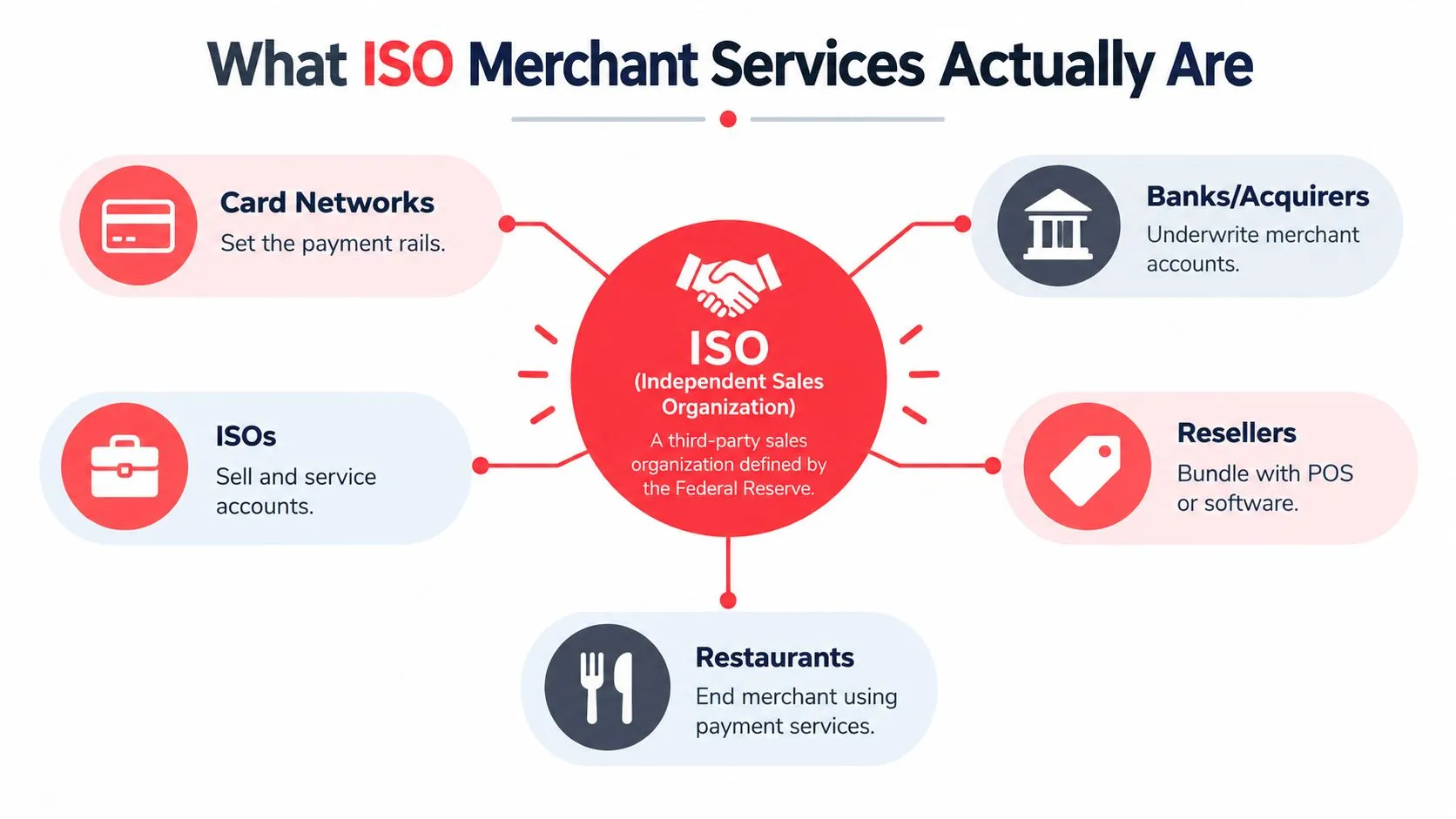
An ISO sits in that middle layer. It sells and services merchant accounts, while the sponsor bank and processor keep control of the regulated payment functions. That split matters in day-to-day operations, because a restaurant can keep the same rep and the same Clover terminal while the sponsor bank changes underneath. If that happens, rates, reserve terms, and support paths can change even though the front-end tools look unchanged.
The practical question is who controls which part of the stack. Underwriting belongs to the acquiring side. PCI scope follows the way card data is stored, transmitted, and accessed. Chargebacks move through the merchant agreement and the network rules, not through the sales pitch. Data access depends on the contracts around the merchant account, the POS, and any connected software.
That is why partner structures matter as much as pricing. A company can resell a payment integration alongside Clover or Square, yet still have only limited control over the actual merchant account. The integration layer may manage ordering, menu sync, or delivery routing, while the payment partner handles the account itself. In restaurant tech, those are related jobs, but they are not the same job.
For sales teams and operators, the guide to ISO roles for retailers is useful because it keeps the role split clear. It shows where an ISO can help, where the acquirer takes over, and why a contract should name the party responsible for onboarding, support, and risk review.
A channel can also look broad while the economics stay concentrated. Visa’s registered list showed 1,253 merchant ISOs, and the revenue picture was highly concentrated, with 31 companies above $20 million in annual revenue accounting for 94% of merchant-ISO revenue. That is the main takeaway. Many firms can sell into the channel, but a small group still controls most of the business that matters. See the historical concentration analysis.
For restaurant operators comparing a traditional merchant account with a software bundle, the true test is not the brand on the proposal. It is whether the partner can explain who underwrites, who owns the data path, who answers chargeback questions, and what changes if the sponsor bank changes. That applies whether the account is tied to a countertop setup, a delivery workflow, or OrderOut’s 3rd-party order engine.
For teams that want a compact explainer on how the model works in practice, the Square ISO program guide is a useful cross-check for channel and platform roles.
How ISO Scale and Residual Economics Actually Work
The common sales story says the ISO model is all about recurring revenue. That’s incomplete. Recurring revenue can be real, but the contract terms determine whether the stream is stable, reduced by reserves, or changed by pricing updates after the deal is signed.
Gross, net, and who controls the split
The question to ask isn’t just “what’s the residual?” It’s what’s it based on. Some arrangements calculate a split before expenses, others after costs, and some allow the processor to change pricing or the split over time. Chargebacks, reserves, and merchant attrition can also reduce what reaches the partner.
That’s why partner economics should be read as contract mechanics, not marketing copy. A portfolio of restaurants can look attractive on paper and still produce uneven cash flow if delivery-heavy locations have more disputes, seasonal swings, or risk holds. Anyone comparing ISO opportunities with restaurant-tech reselling should ask whether the rights survive termination and whether the portfolio is portable if the merchant changes processor or POS.
A portfolio is only as durable as the contract behind it.
The revenue concentration data above also changes how to read the market. Many small firms exist, but the largest operators control the bulk of merchant-ISO economics. That tells you two things. First, there’s room for local distribution. Second, scale and sponsor-bank access still matter more than branding alone.
For restaurant-tech partners, reseller relationships become practical here. If you’re bundling payment relationships with delivery-to-POS software, you need to know whether you’re only referring the merchant, whether you’re servicing the account, or whether you’re touching any payment-data function. That matters for residuals, support, and liability alike. A good companion read is OrderOut’s Square partner program overview, because it shows how partner structures can sit next to payments without pretending they’re the same thing.
ISO Value Beyond Headline Processing Rates
The cheapest headline rate usually isn’t the right comparison. The U.S. Government Accountability Office notes that interchange commonly makes up the largest part of the merchant discount fee and that network-set rates vary by transaction factors, including card type and acceptance method, often within roughly 1% to 3% of purchase value. That means the true comparison is a fee stack, not a single percentage.
A restaurant should evaluate three things side by side: pass-through costs, provider markup, and operational fit. Pass-through items include interchange and network assessments. Markup includes the ISO’s own pricing, service charges, and any processor-side margin. Operational fit is everything that makes the account usable in practical settings, including chargeback handling, terminal compatibility, POS support, and settlement reliability. The GAO’s fee structure report is still useful because it keeps the fee conversation grounded in function instead of sales language.
What to compare in a restaurant environment
For delivery-heavy restaurants, the comparison should happen by channel.
- Card-present: in-store chip, tap, and terminal flows.
- Keyed transactions: staff-entered payments that usually carry different risk.
- Ecommerce: online checkout and embedded ordering.
- Mobile-wallet transactions: contactless payments that may qualify differently.
That lens matters because an ISO can look inexpensive on one channel and expensive on another. A clean merchant-services proposal should show how the restaurant is priced across those channels and how exceptions are handled when an order comes from Uber Eats, DoorDash, or Grubhub and still has to settle properly inside Clover or Square.
For operators trying to simplify the order side, OrderOut’s delivery API is the kind of integration layer that belongs in the discussion. It doesn’t replace the payment contract, but it can keep the order workflow from becoming a manual re-entry problem. The most useful ISO partner is the one that understands that distinction and doesn’t blur it.
Who Is Responsible for What in ISO Relationships
The biggest legal mistake in merchant-services conversations is assuming the word “partner” means shared responsibility. It usually doesn’t. An ISO can help with onboarding, sales, and support, but once a company starts performing additional functions, the compliance picture changes.
Visa’s public guidance distinguishes merchant solicitation and onboarding support from transaction processing, settlement, and access to card-account data, and it notes that performing additional functions can create different compliance and oversight implications for third-party agents. That matters for restaurant technology companies that connect payment acceptance with POS, delivery, loyalty, or ordering workflows. If the partner handles payment data, influences routing, or changes how orders are submitted, the role is no longer just referral.
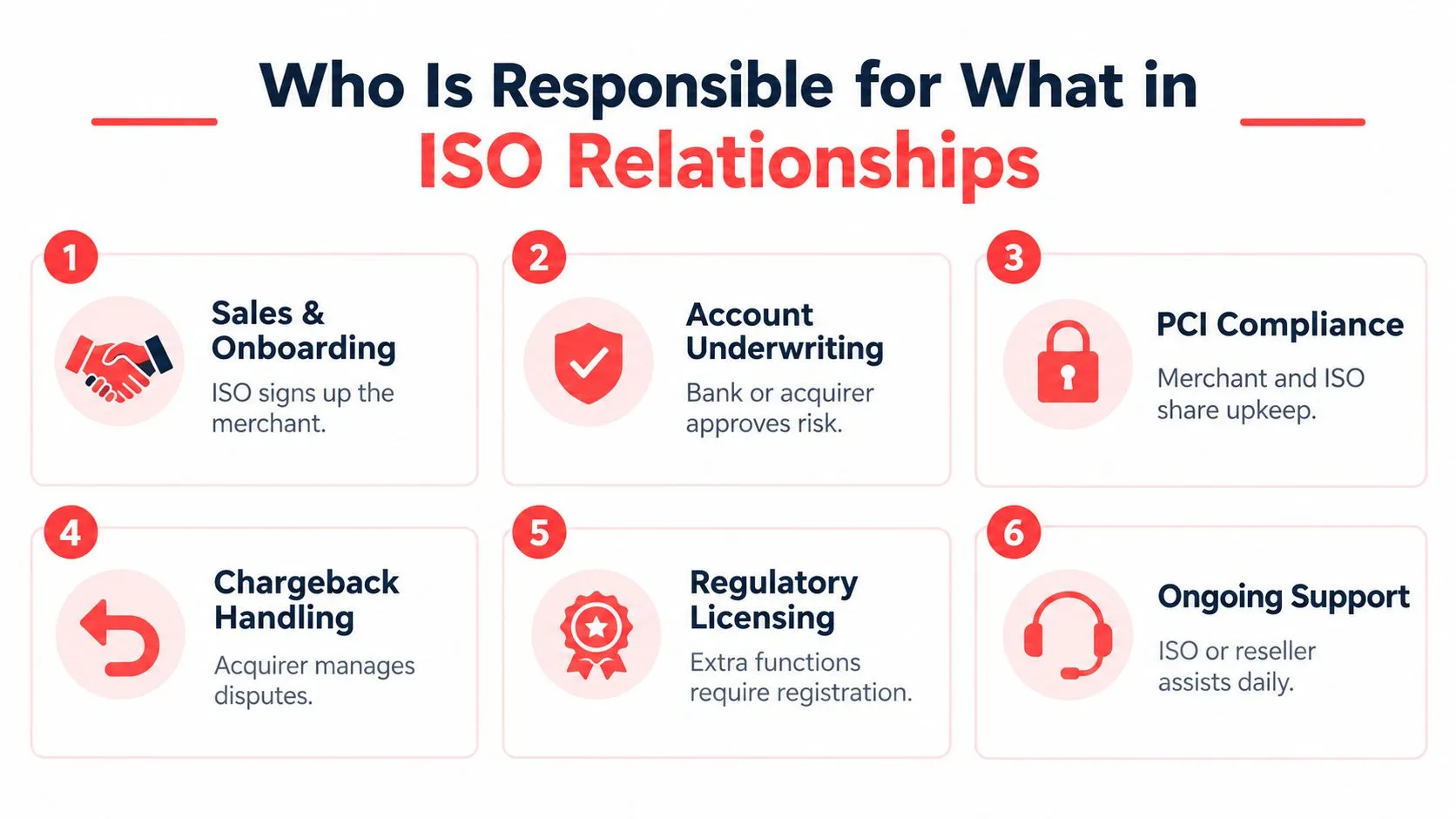
A practical responsibility matrix
Use this checklist when reviewing any ISO or reseller relationship.
- Sales and onboarding: Who signs up the merchant and collects the application?
- Underwriting: Which bank or acquirer approves the risk?
- PCI scope: Who touches cardholder data, and what systems are in scope?
- Chargebacks: Who manages the dispute workflow and customer response?
- Data access: Who can see payment data, and for what purpose?
- Outages and support: Who responds when the terminal, gateway, or POS fails?
The old claim that “all businesses must be PCI compliant” is too blunt. PCI obligations depend on how an organization handles cardholder data and what services it performs. A referral-only agent and a company handling payment-data workflows do not carry the same burden. That’s why contract language has to match the actual operating role.
If a partner says it “handles everything,” ask them to put each responsibility into a named box.
For restaurant operators, that box-by-box approach is especially useful when adding delivery-order integrations to Clover or Square. The POS may be the operational source of truth, but the ISO, processor, and software partner may each own a different slice of the workflow. This Clover reseller guide is a useful reference for understanding how channel partners can sit alongside the payment stack without confusing the roles.
Choosing ISO or Reseller Partners for Restaurant Tech
What matters more, the rate card or the control points behind it? In restaurant tech, the answer is usually the control points. Once a restaurant adds delivery-to-POS integration, online ordering, or phone ordering, the payment relationship and the software relationship overlap. That is where partner boundaries need to be explicit.
A reseller or ISO adds value when it ties merchant support to the systems restaurants run. That can mean a payment setup around Clover, a Square deployment connected to delivery routing, or a software layer that moves marketplace orders into the POS without staff retyping tickets. The goal is not to assemble the biggest package. It is to keep underwriting, support, data access, and order handling in the right hands.
For restaurant owners comparing partner models, three buckets help. Direct ISO partnership usually centers on account handling and payment support. Reseller partnership usually packages POS, delivery, and payments inside one commercial relationship. Hybrid approaches pair bank-led merchant services with restaurant software that manages the operational layer. If you also want to see how adjacent systems fit around ordering and loyalty, BonusQR for restaurants is a useful reference.
The next decision is practical: match the partner model to the workflow you need to fix. If delivery re-entry is the problem, review one delivery integration or the other, depending on the POS stack. If broader online ordering is the issue, the commission-free online ordering solution is the right place to look. For partners serving restaurant clients, OrderOut’s reseller pages cover the commercial path, and the POS system integrators page explains the technical side.
Operators should press on the legal lines, not just the feature list. Ask who underwrites the account, who stays in PCI scope, who handles chargebacks, and who can access payment data. If the partner is reselling a technology integration alongside the merchant account, those answers need to be written into the contract, not implied by the sales pitch.