
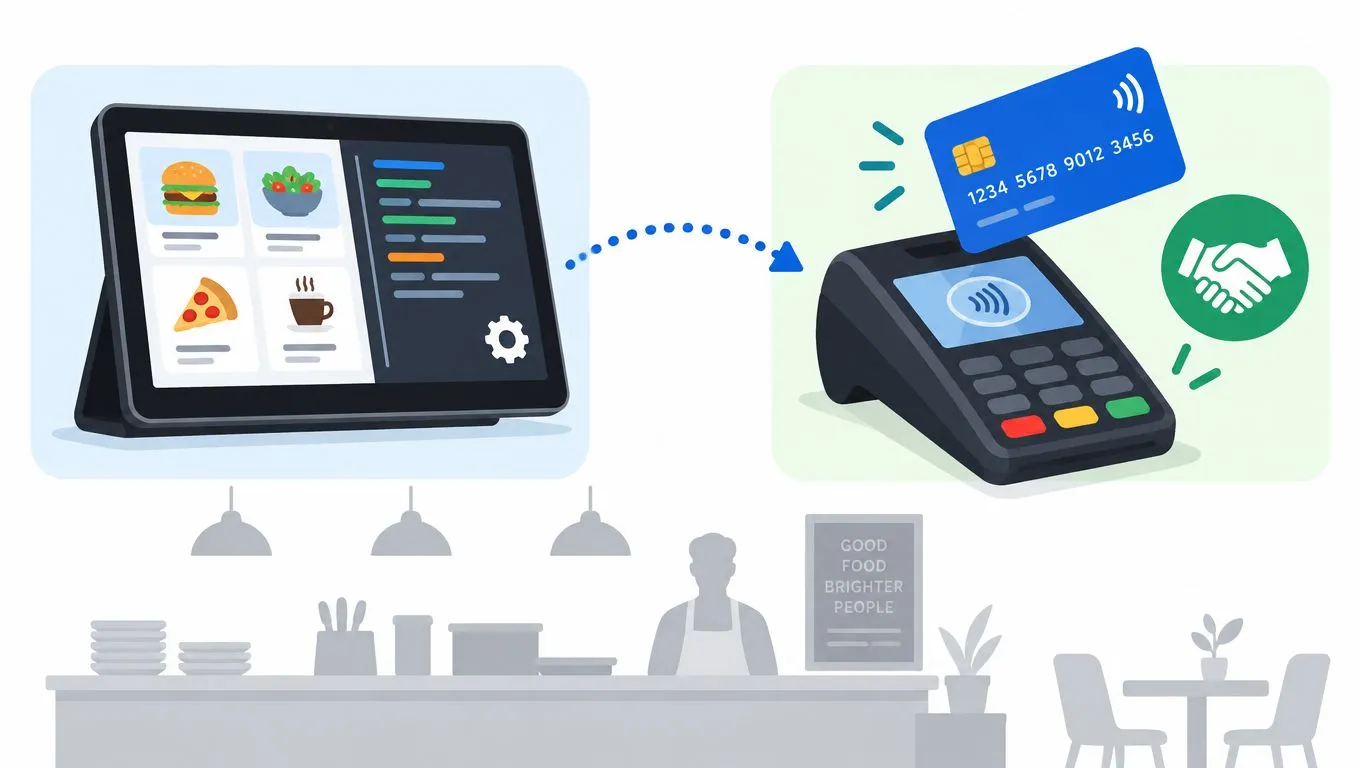
An ISV builds and owns the restaurant software that runs the workflow, while an ISO resells the merchant account and processing relationship behind it. For a Clover or Square reseller, the practical difference is who fixes a delivery order that never reaches the POS versus who resolves a payment-processing problem.
Your restaurant client might call you for both. That doesn’t mean the same company can resolve both, or that a discounted processing rate includes delivery integration support. ISV vs ISO is a responsibility question before it’s a pricing question. Sell the restaurant a working stack, not a collection of vendor introductions.
The Two Roles in Plain English
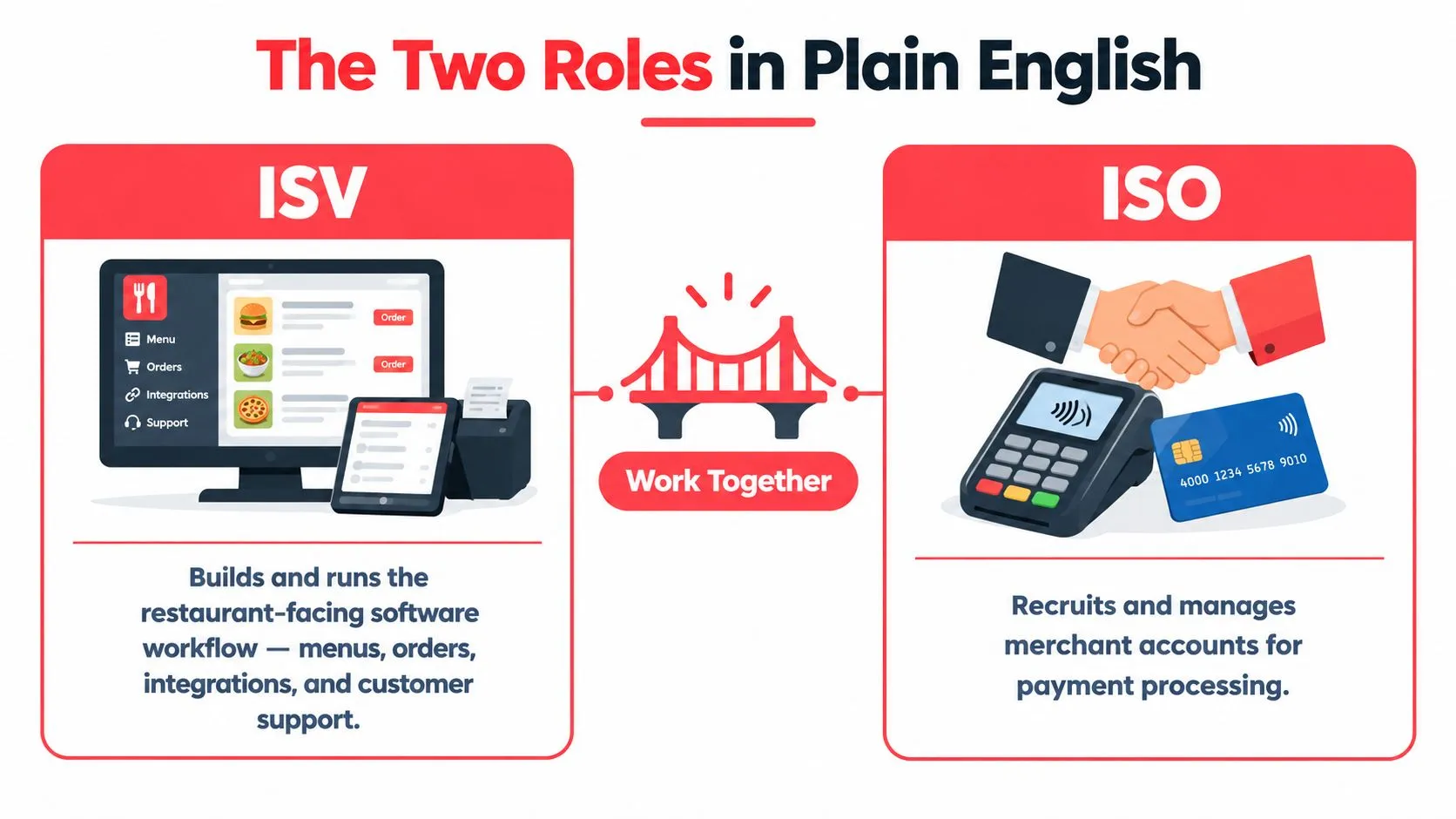
An independent software vendor, or ISV, develops the application a restaurant uses to manage a workflow. An independent sales organization, or ISO, sells and supports the merchant’s payment-processing relationship. Global Payments’ explanation of ISV partnerships distinguishes application ownership and embedded payments from the intermediary role of a payments reseller.
Think about a restaurant running Clover. The operator wants DoorDash orders to reach the POS without someone copying items and modifiers from a delivery tablet. That’s an application problem: connect the systems, translate the menu, route the order, and support the integration.
The same operator might ask why a card transaction failed or where a settlement went. That’s a payment-service problem. The ISO can be the merchant’s commercial contact and coordinate with the processor, but owning that relationship doesn’t mean it owns the delivery connector.
The restaurant software boundary
OrderOut sits in the ISV column for delivery-to-POS integration. It owns the application layer that maps marketplace menus and routes delivery orders into Clover or Square. Its customer-facing software support belongs with that workflow, not with acquiring-bank decisions.
The broader ISV definition matters here: these vendors build software that operates on third-party platforms rather than primarily manufacturing hardware or owning the underlying platform. Mordor Intelligence’s ISV market overview describes that software-first model. You don’t need to manufacture a POS terminal to own a valuable restaurant workflow.
Channel rule: Sell software responsibility and payment responsibility separately, even when the restaurant buys them through the same partner.
The merchant-services boundary
An ISO’s value is the processing relationship: merchant recruitment, account setup coordination, pricing discussions, and ongoing payment-service support. OrderOut’s guide to ISO merchant services for restaurant partners is a useful companion when that’s the part of the business you’re building.
Neither role replaces the other. A capable ISO can partner with an ISV, and an ISV can distribute through agents. For the operator, the useful vocabulary is simple: software owner, payments contact, and escalation owner. Ask a prospective partner to name all of them before signing.
Who Owns What Across the Restaurant Stack
A single sales contact isn’t the same thing as a single technical owner. A restaurant’s stack includes Clover or Square, delivery marketplaces such as Uber Eats, DoorDash, and Grubhub, an integration layer, and payment providers. Each controls a different part of the transaction.
In a typical reseller arrangement, the payment provider handles underwriting, risk, compliance, and processing, while the ISO recruits merchants and supports onboarding. An ISV with embedded payments takes on more application-level responsibilities, including payment-state handling and reconciliation logic. North’s discussion of ISV and payment-facilitator models explains why control and operational responsibility matter more than the label.
Responsibility Split Between ISV and ISO in Restaurant Tech
| Responsibility | ISV (OrderOut-style) | ISO (Reseller/Agent) |
|---|---|---|
| Merchant onboarding | Configures software access and integration permissions | Coordinates payment-account applications and provisioning |
| Underwriting | Works with the payment partner when payments are involved | Escalates to the processor or acquirer responsible for approval |
| Software support | Owns application behavior and integration troubleshooting | Supports products it sells and escalates software defects |
| Integration maintenance | Maintains schemas, API connections, and event handling | Relies on the software provider unless it owns a connector |
| Reconciliation | Supplies application records and mapping logic | Helps investigate processing statements and settlement questions |
| Chargebacks | Supplies relevant order evidence where available | Coordinates payment-dispute support with the provider |
| Outage response | Investigates application and routing failures | Coordinates payment-service escalation |
These are typical boundaries, not contractual guarantees. Put the actual responsibilities in your agreement. Aevi’s ISV-versus-ISO comparison describes the software-first and merchant-services-first roles, but a restaurant still needs named contacts for its particular stack.
Assign incidents before selling the stack
Use restaurant incidents to test the arrangement:
- Duplicate delivery order: Who checks the marketplace identifier, integration event, and POS record before anyone resends it?
- Cancellation after authorization: Who determines whether the order was canceled, the payment needs attention, or both?
- Partial refund: Who owns the order adjustment, and who owns the movement of funds?
- Payout mismatch: Who compares marketplace records with POS entries and distinguishes those from processor settlements?
For Square-focused partners, the Square partner program overview helps frame the channel relationship. It shouldn’t substitute for an incident-escalation agreement.
My recommendation: give the operator a first contact who owns the handoff. Don’t make restaurant staff diagnose which vendor failed before they can get help. Embedded payments, merchant sales, and shared platform operations are where that handoff needs the most attention.
Where the Labels Get Blurry
An ISV can sell payment services. An ISO can sell software. Neither activity erases the distinction between building the application and distributing the merchant account.
The trouble starts when a partner uses a broad label to imply responsibilities it hasn’t accepted. A branded payment screen doesn’t prove the software company controls settlement. A merchant-services representative selling an integration doesn’t prove the representative maintains its APIs.
Embedded payments aren’t automatically payment facilitation
Embedding payment acceptance inside software is an architectural choice. Becoming a payment facilitator involves defined contracting and settlement functions.
Under Visa’s Payment Facilitator model, a payment facilitator contracts with an acquirer, signs merchant-acceptance agreements on the acquirer’s behalf, receives transaction proceeds, and distributes settlement to sponsored merchants. Visa also keeps the acquiring bank responsible for the acts of the facilitator and its sponsored merchants.
Routing delivery orders doesn’t establish those obligations. A software provider that normalizes Uber Eats, DoorDash, or Grubhub orders into Clover or Square shouldn’t be treated as a payment facilitator merely because payment information appears in an order record.
OrderOut’s delivery integration belongs on the software side of that boundary. Its order-routing function alone isn’t evidence that it performs acquiring, merchant-of-record, or settlement functions.
Merchant solicitation changes the conversation
When a software partner recruits merchants, negotiates processing terms, or participates in payment distribution, it’s also doing payments-channel work. Ask which entity holds the relevant agreement and which provider handles approval, disputes, and settlement.
The practical test is useful, but not a legal classification:
- Building and routing workflows: You’re performing an ISV function.
- Selling merchant accounts and supporting processing relationships: You’re performing an ISO function.
- Contracting and distributing settlement: Examine the payment-facilitator responsibilities separately.
A shared brand can simplify the sale. It doesn’t remove the need to identify who controls the money and who controls the software.
Platform operations blur the boundary further. Authentication failures, payment events, and order-status updates can appear in the same interface while originating with different providers. The POS integration API guide provides context for the application side of those connections.
Don’t classify your business by its commission arrangement alone. Classify each function by its contract, technical control, and incident owner.
How an ISV Handles a Clover or Square x Delivery Integration
A delivery connector has to translate an order, not just pass along its text. The destination POS needs recognizable items, modifiers, quantities, and statuses. That’s why menu hygiene matters as much as connectivity.
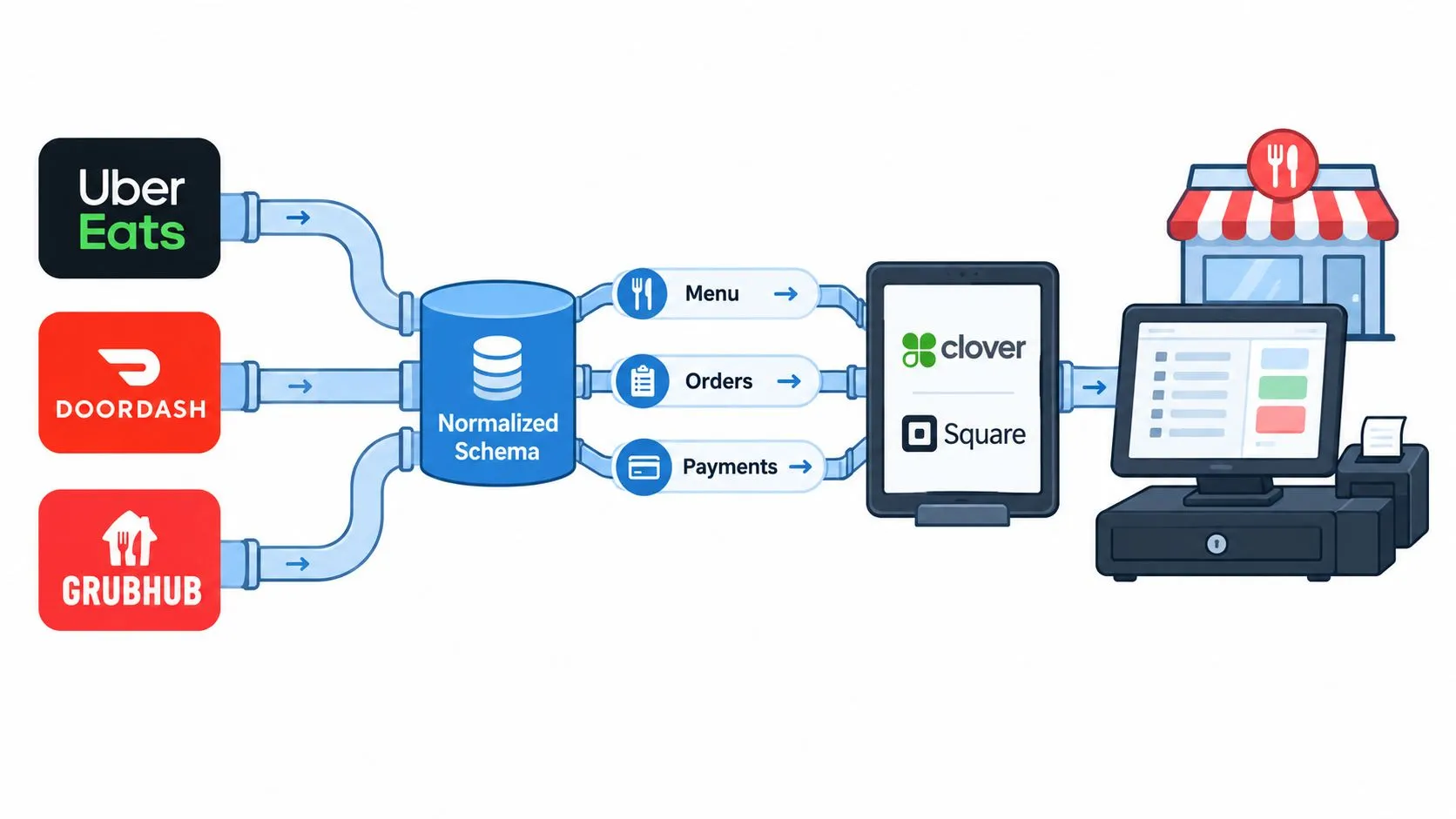
OrderOut’s Integration API documentation describes a REST-and-webhook model that normalizes Uber Eats, DoorDash, and Grubhub orders into one schema, routes them into Clover and Square, synchronizes menus and item availability, and uses signed webhooks. That hub-and-spoke architecture lets a normalized connection replace independent marketplace-specific implementations.
Map the menu before routing orders
Consider a DoorDash order destined for Clover. The integration needs to connect the marketplace item and its selected modifiers with the intended POS records. A modifier that staff understand by sight still needs an unambiguous technical mapping.
Clean up menu relationships before relying on automation. Review item identities, modifier choices, pricing, and availability across the connected systems. Don’t treat similarly named items as proof that their records match.
Clover’s e-commerce API documentation describes access to merchant data through REST APIs and payment-flow functions including charges, customers, refunds, and orders. Browser-based integrations also use OAuth. Those capabilities explain why an integration must handle merchant authorization and structured data, rather than merely forward a delivery notification.
The Clover API integration guide provides additional context for partners evaluating that connection.
Handle events without creating new problems
The integration design should answer operational questions:
- Authorization: Can the connector access the correct merchant account?
- Duplicate handling: Can the application recognize an order it has already processed?
- Failure recovery: Can support determine whether the POS accepted an order before attempting another submission?
- Status mapping: Can staff distinguish an order event from a payment or refund event?
These are design and acceptance-test questions, not promises that every connected platform behaves identically. Signed webhooks help establish event authenticity, but they don’t replace careful order-state handling.
For downstream reporting work, ELECTE’s Square reporting setup guides are a separate resource to consult. Reporting setup doesn’t replace validating the delivery-to-POS connection.
A partner can direct a Clover client to install OrderOut from the Clover App Market and review the restaurant’s menu mapping as part of evaluating the workflow. The ISO remains valuable for merchant services, but its processing relationship alone doesn’t create this normalized application layer.
Break-Even Thinking for Restaurant Operators
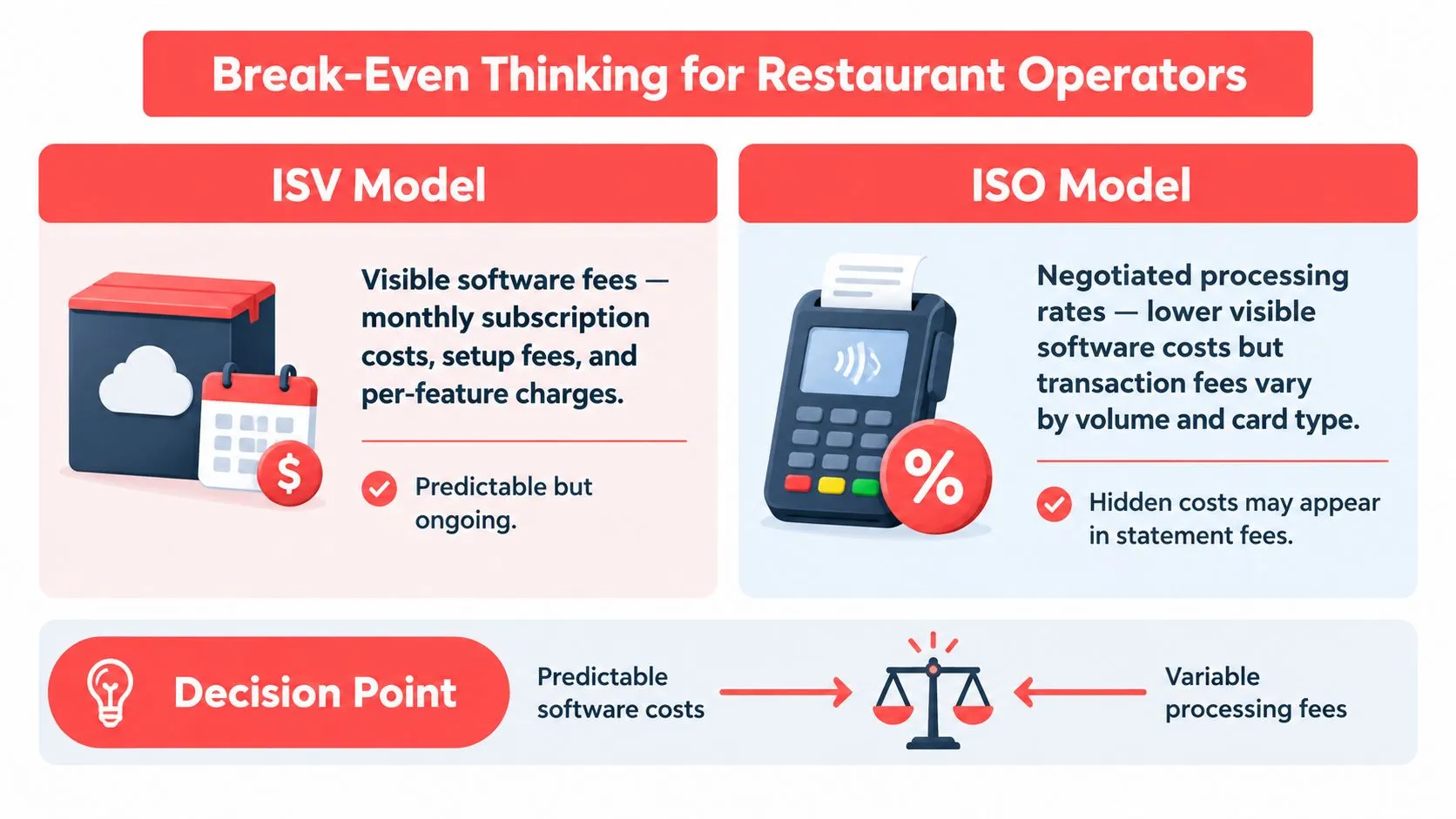
The lowest advertised processing rate isn’t a complete restaurant-tech price. Compare arrangements using the work your operator performs, including delivery order entry, exception handling, and reconciliation. Keep this calculation focused on the stack, not on a generic restaurant profit model.
Priority Commerce’s comparison of ISV, ISO, and PayFac models describes different software and payment economics. My advice is to use those distinctions as inputs, then calculate the operational consequences using the restaurant’s own records.
Compare complete arrangements
Start with the visible charges: software subscriptions, applicable setup or feature charges, processing terms, and contractual commitments. Don’t assume every ISV bundles payments or every ISO offers a cheaper arrangement.
Then collect the restaurant-specific inputs:
- Order-entry effort: Record how much staff time goes into transferring marketplace orders into the POS.
- Error-related refunds: Separate entry mistakes from refunds caused by unrelated service issues.
- Reconciliation effort: Identify time spent matching marketplace activity, integration records, and POS orders.
- Downtime exposure: Document how staff handle failed connections and what it takes to recover.
- Exit costs: Check cancellation terms, data access, and the work required to change providers.
Use actual monthly marketplace orders, average ticket, labor cost, and refund frequency. Business Loan Warrior’s explanation of how to calculate your break-even point offers general calculation context; populate the comparison with your own delivery-workflow inputs rather than borrowed assumptions.
An ISV-led arrangement can cost more on the proposal and less in operation when it removes enough manual work. An ISO-negotiated arrangement can win when the operator can manage the integration work without adding substantial cost.
Test the assumptions that change the decision
Don’t credit software with eliminating every refund or all support work. Estimate only the avoidable effort tied to re-keying, mismatched items, and fragmented order records. Likewise, don’t count negotiated processing savings without including applicable fees and terms.
Run the comparison for ordinary demand and heavier marketplace activity. Ask whether the restaurant’s existing staff can handle exceptions, and whether its technical team can maintain connectors without distracting from other responsibilities.
For channel sellers, the Clover reseller program guide provides useful partner context. Keep the customer’s operating case separate from your recurring-revenue opportunity. The right recommendation should still make sense when the operator sees every charge and understands every support boundary.
Which Model Fits Your Restaurant Profile
For a single-location restaurant or small chain using Clover or Square, start with an ISV-led delivery workflow. The operator needs marketplace orders in the POS, not another system that staff must reconcile manually. A payments negotiation won’t solve disconnected order entry.
For a multi-unit operator with capable internal IT, evaluate an ISO-negotiated processing arrangement alongside the integration layer. That recommendation depends on demonstrated technical capacity, not location count alone. Ask who maintains mappings, tests changes, and responds when marketplace orders stop arriving.
Match the proposal to operating capacity
| Restaurant profile | Recommended starting point | Decision test |
|---|---|---|
| Owner-managed restaurant | ISV-led delivery integration | Can staff run delivery orders through the POS without re-keying? |
| Small chain with limited technical support | Supported integration plus a clear payments contact | Does someone own cross-vendor escalation? |
| Multi-unit operator with internal integration expertise | Evaluate ISO-negotiated processing and software separately | Do the negotiated terms justify the coordination effort? |
| Restaurant with existing processing it wants to retain | Review delivery integration independently | Can the proposed connection meet its workflow requirements? |
OrderOut’s delivery-to-POS solution removes extra delivery tablets and manual re-keying by injecting marketplace orders into Clover or Square. The POS stays the operational source of truth. That’s the solution to evaluate here, rather than bundling unrelated products into the decision.
Give partners a concrete handoff
Agents evaluating commercial options can review the OrderOut ISO and agent reseller program. For platform-specific opportunities, use the OrderOut Square reseller program or the OrderOut Clover reseller program.
Read how the OrderOut reseller program works before setting expectations with a client. OrderOut is an official Square reseller and handles merchant onboarding for the partner; don’t turn that into an invented promise about certification, setup timing, or a special kickoff process.
Make the proposal concrete: identify the restaurant’s POS, active marketplaces, menu-mapping requirements, and support escalation path. Sell the removal of a defined operational problem, then show which company remains responsible for processing.
The strongest channel relationship doesn’t require the reseller to write integration software. It requires the reseller to know where its responsibility ends, choose a software partner that owns the next part, and prevent the restaurant from getting stranded between them.
Frequently Asked Questions
Does OrderOut work with Clover and Square?
Yes. OrderOut routes supported marketplace orders into Clover and Square through its normalized integration layer. Confirm the restaurant’s POS and marketplace connections when evaluating the setup, and review menu mappings before relying on the workflow.
Does OrderOut handle Grubhub orders?
Yes. The supported marketplace workflow includes Grubhub alongside Uber Eats and DoorDash. Those orders are normalized for routing into the connected POS, so staff don’t have to manually translate each marketplace’s order format.
Is OrderOut free to install on the Clover App Market?
Yes, OrderOut is free to install on the Clover App Market. Free installation isn’t the same as saying every service or subscription is free. Review the applicable product terms before presenting the full operating cost to a restaurant.
What does OrderOut’s AI phone ordering do?
The separate AI phone-ordering product answers the phone, takes the order, and drops it into the POS. It addresses missed calls during busy service, rather than marketplace-order integration. Evaluate it separately so the operator knows which workflow each product covers.
Who should I contact if a delivery order doesn’t reach the POS?
Start with the agreed software or integration support contact. Provide the marketplace, merchant location, order identifier, and visible POS status so support can investigate without blindly resending the order. A payment-settlement problem belongs with the designated payment-service contact instead.
OrderOut connects Uber Eats, DoorDash, and Grubhub orders to Clover or Square, giving restaurant partners a software solution alongside their merchant-services relationship. Visit OrderOut to review the delivery workflow, then request access to the OrderOut Reseller Portal to explore the partner program for your restaurant clients.