

Reselling Square POS is harder to make profitable than new partners expect. Square is easy for merchants to adopt on their own, margins on basic setup work are thin, and standard partner revenue usually does not leave much room after sales time, onboarding, support, and hardware logistics.
That creates two real paths. You can work inside Square’s official channel structure and accept limited recurring revenue, or you can build an independent offer around Square and make your money on the services merchants keep using after launch. In practice, the second model is the one that holds up.
The common mistake is treating Square like a hardware business. A reader, register, or terminal may open the account, but hardware rarely carries the economics of the relationship. The reseller makes money when the merchant depends on a workflow you set up, maintain, and improve over time.
Restaurants make that trade-off obvious. They do not need another box on the counter. They need orders to flow into the POS correctly, staff to spend less time re-entering tickets, and phone orders to stop pulling people off the line during service. OrderOut is the missing piece for many Square resellers because it gives you something operational to attach to the install: delivery order injection, commission-free online ordering, and AI phone ordering that stays relevant after day one.
A simple test helps. If the merchant could replace your offer with a self-serve signup and a card reader, you do not have a durable channel business. You have a low-margin install service with weak retention.
Introduction
Square launched in 2009 and grew from a simple payments tool into a full POS platform for physical and online sellers, with pricing that ranges from a free option to paid subscription tiers ranging from an entry plan to a restaurant-premium plan, according to Wikipedia’s summary of Square’s platform and pricing structure). That flexibility is exactly why so many small businesses adopt it.
It’s also why resellers get squeezed. Square is easy to start with, widely recognized, and designed for self-serve adoption. That lowers friction for merchants, but it also lowers the amount of paid guidance many merchants think they need up front.
For restaurant channel partners, the better move is to stop pitching “Square setup” as the core offer. Pitch the operating outcome. Restaurants don’t wake up wanting a payment terminal. They want fewer missed modifiers, fewer staff handoffs, and one place where orders land correctly during service.
A partner model only works when the attached solution solves something urgent enough that the restaurant keeps paying attention after the install. That’s why serious restaurant resellers usually do better when they package POS, workflow design, onboarding, and a delivery-to-POS layer together.
Understanding the Two Paths to Resell Square POS
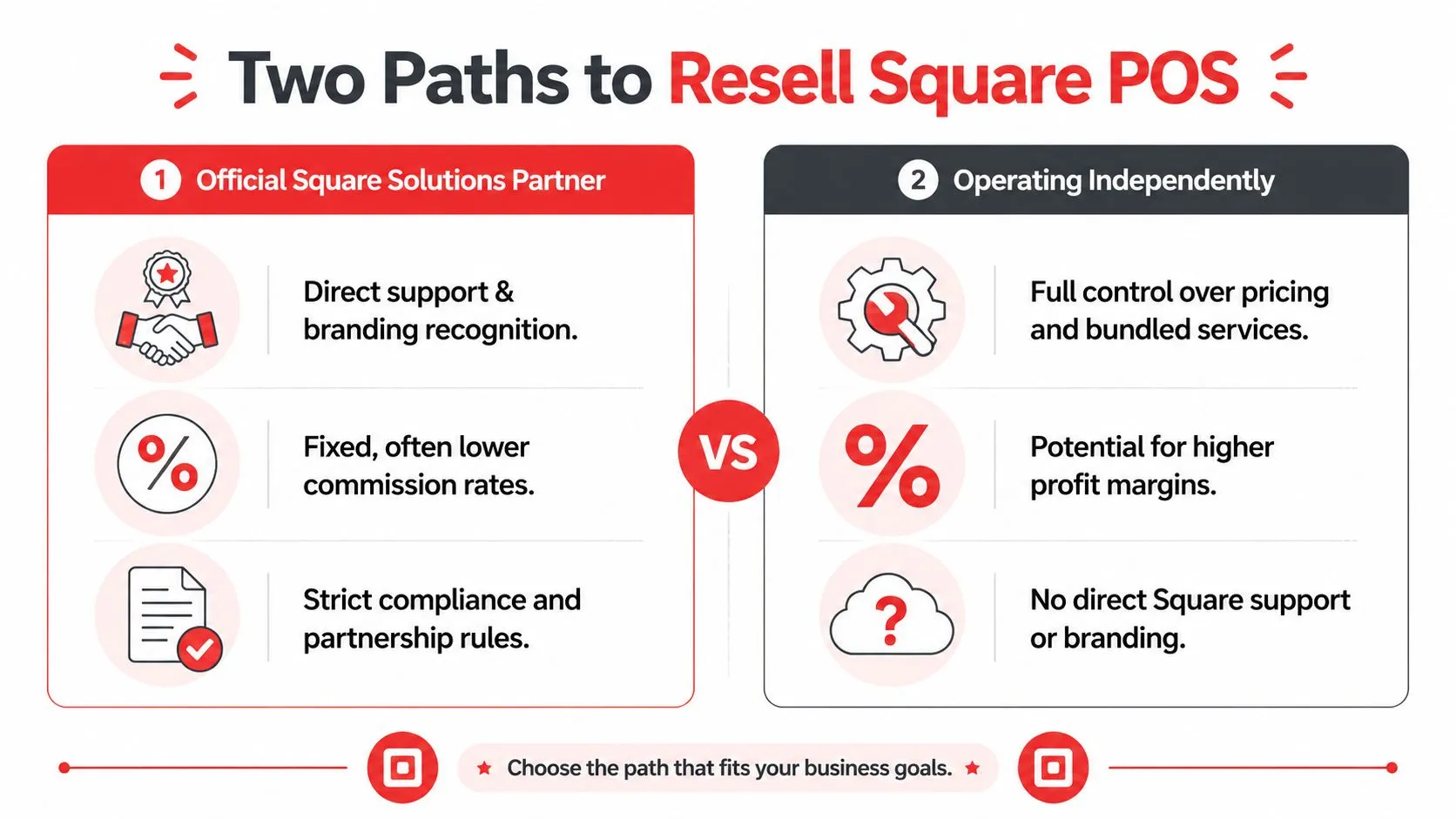
There are two real ways to resell Square POS. One is the official partner route. The other is to operate independently as a value-added reseller that wraps Square inside a broader restaurant tech offer.
The official partner path
The official route gives you brand adjacency, some structure, and a cleaner story when you’re explaining your relationship to merchants. For some partners, especially those new to POS, that feels safer.
The problem is the math. Reforming Retail’s analysis of Square’s restaurant reseller economics states that Square resellers receive only a thin slice of recurring SaaS revenue. That’s not much room to cover prospecting, onboarding, support, menu cleanup, printer issues, or integration troubleshooting.
If you’re building a restaurant-focused book, those tasks are not optional. Restaurants need more handholding than a basic card-acceptance account. A low recurring payout may look manageable on a spreadsheet, but in the field it usually collapses under service demands.
A deeper look at the Square partner program for restaurant resellers helps frame why many partners hit this wall after the first batch of installs.
The independent reseller path
Independent reselling gives up some official polish, but it gives you control. You decide what gets bundled, how onboarding works, how support is positioned, and where the recurring value comes from.
That matters because restaurants don’t buy a POS in isolation. They buy a workflow. In practice, your margin comes from owning that workflow better than a self-serve signup page can.
A simple comparison makes the trade-off clear:
| Path | Strength | Weakness |
|---|---|---|
| Official Square partner | Easier credibility story | Thin recurring revenue |
| Independent reseller | Control over bundles and pricing | More responsibility for delivery and support |
The reseller who wins with Square usually isn’t the one with the cheapest hardware. It’s the one who removes the most operational friction.
What actually works
A workable independent model usually has three layers:
- Square as the core POS: Give the merchant a familiar platform with broad market acceptance.
- A restaurant-specific workflow bundle: Include menu setup, printers, staff training, and delivery process design.
- A recurring software layer: Add services the restaurant uses daily, so your account relationship doesn’t end after installation.
What doesn’t work is relying on reader sales and hoping volume solves the problem. It rarely does. Thin revenue multiplied across many support-heavy accounts still creates a support-heavy business.
Sourcing Hardware and Managing Inventory
Hardware discipline decides whether your first dozen Square installs create momentum or drain cash. New resellers usually overestimate hardware margin and underestimate the operational cost of stocking the wrong mix.
Start with a simple rule. Inventory should protect installs and service response times, not become a warehouse business. For most new resellers, that means carrying a small amount of stock for demos, urgent replacements, and the bundles you install repeatedly, then buying the rest against signed deals.
That approach does two things. It limits cash tied up in devices that may sit for months, and it forces you to standardize the package you know how to deploy well.
Source for repeatability, not variety
The fastest way to make inventory messy is to approve every one-off hardware request. A tighter catalog is usually better business. Pick a default countertop bundle, a mobile bundle, and a kitchen printing setup you can support without guessing.
Use a short operating checklist:
- Set standard bundles: Define the reader, stand, printer, cash drawer, and kitchen ticket flow you will sell most often.
- Keep demo units separate: Demo hardware helps close deals. It should not get pulled into live merchant fulfillment.
- Write a replacement policy: Your team needs a clear answer on swaps, loaners, damaged units, and who covers the cost.
- Watch market pricing: If you source through distributors or secondary channels, use tools that help you track reseller prices so your margin does not disappear between quote and purchase.
A lot of early channel mistakes start here. The reseller wins a deal, rush-orders unfamiliar hardware, then spends the margin on troubleshooting, return handling, and support calls.
Use hardware flexibility to your advantage
Square hardware is relatively forgiving compared with systems that create tighter device lock-in. In practice, that makes loaners, field replacements, and temporary swaps easier to manage if your team follows a documented process for logout, reassignment, and testing before the device goes back out.
That matters on Friday afternoons, not in theory. If a merchant drops a reader or opens a seasonal service station, you need a clean swap procedure and a known-good spare. Speed is part of the product.
Printers deserve extra attention because they create more install friction than readers. Before you commit to a standard restaurant bundle, review these Square-supported printers for restaurant setups and narrow your supported list. Fewer printer combinations usually means fewer support tickets.
Protect cash, but do not starve the install process
Holding zero stock sounds efficient until a merchant needs a replacement the same day and you cannot deliver. Holding too much stock creates the opposite problem. Cash gets trapped in boxes while your real profit opportunity sits elsewhere.
The practical middle ground is small, intentional inventory. Keep enough on hand to run demos, cover failures, and install your most common package fast. Everything else should be special-order unless demand is proven.
That matters even more in the Square channel because hardware revenue is thin. If you let inventory sprawl, the economics get worse fast. The business starts to work only when hardware is standardized, installs are predictable, and the recurring software layer, including tools like OrderOut, carries the long-term account value.
The Value-Add That Makes Your Business Profitable
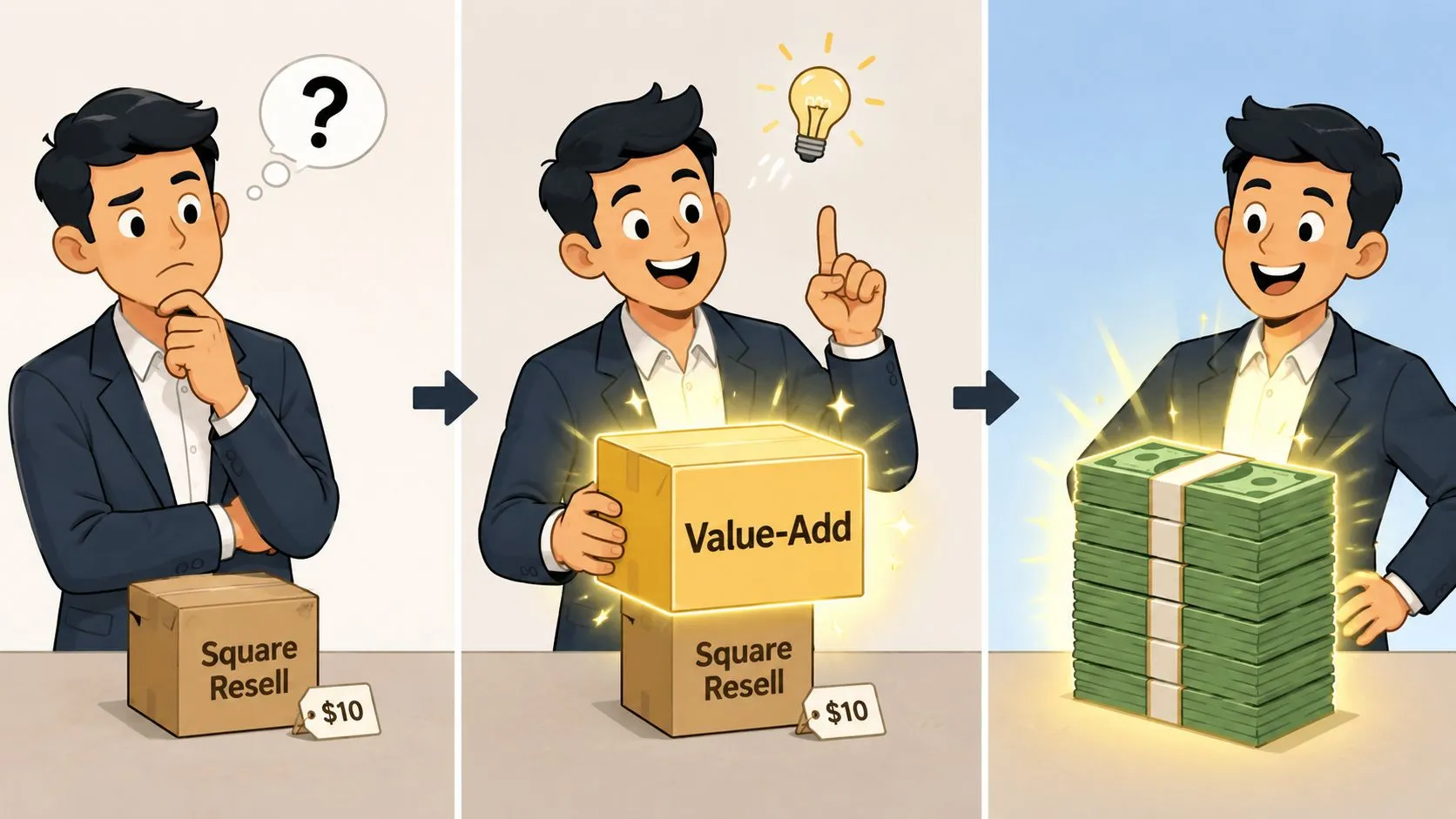
Square hardware alone rarely gives a reseller a durable business. The margins are limited, implementation revenue is finite, and standard POS accounts do not produce much recurring software income unless you attach a workflow problem that the merchant will keep paying to solve.
Why restaurants pay for outcomes
Restaurant operators usually do not need help understanding card acceptance. They need help fixing the mess created by third-party ordering channels, menu mismatches, and staff re-entering orders during a rush. That is the gap a reseller can monetize.
OrderOut gives Square-focused partners a service line that is worth managing. It routes third-party delivery orders into the POS, removes extra tablets and manual re-keying, and maps marketplace menus into a normalized POS structure. As explained in OrderOut’s overview of POS system integration, that setup reduces the order mistakes that happen when staff manually enter modifiers and special instructions.
That changes the conversation with the merchant. You are no longer selling a register and hoping support revenue appears later. You are selling fewer order errors, less staff interruption, and a cleaner handoff from marketplace to kitchen. Operators pay for that outcome because it touches labor, service speed, and guest experience every day.
A useful companion read is this guide to Square online ordering for restaurants, which shows the merchant side of the ordering workflow and why front-end ordering still breaks down without the right POS connection behind it.
How this changes your economics
The economics improve once Square is packaged with a recurring operational fix.
- You stop living on one-time installs: The account has ongoing value tied to a live workflow, not just a completed hardware deployment.
- You have a clearer reason to stay involved: Menu updates, delivery channel changes, and order flow issues create legitimate service work.
- You can price around business impact: Merchants compare reduced friction and accountability, not only the cost of a terminal.
- You build a broader restaurant technology practice: Delivery integration often leads to online ordering support, phone order automation, and process consulting.
This is the missing piece for many new Square resellers. Without software and service attached, the model is hard to scale profitably. With the right add-on, the reseller relationship becomes stickier and the account is worth maintaining.
Pricing discipline still matters. If you are bundling hardware, software, onboarding, and support, it helps to track reseller prices so you do not underprice a package that includes real service obligations.
If you want to see the install path your restaurant clients would use, point them to the Square App Marketplace listing for OrderOut delivery integration.
The broader OrderOut reseller program for POS and restaurant technology partners and the developer and integration partner program are the better places to review fit if your business includes agencies, multi-location rollouts, or custom implementation work.
Field advice: Pitch the reduction in re-entry work, tablet clutter, and order mistakes. That is where the recurring revenue comes from.
Building Your Go-to-Market Strategy
Square hardware alone rarely gives a reseller enough margin to build a durable business. The go-to-market plan has to start with a merchant problem that creates recurring revenue, or the account turns into a one-time device sale plus ongoing support work.

Choose the right merchant profile
The easiest deals are not merchants shopping for a new card reader. They are operators already feeling pain in daily service and willing to pay to remove it.
For a new reseller, that usually means restaurant and food-service accounts with enough order volume to make workflow mistakes expensive. Existing Square merchants are often a better target than greenfield prospects because the POS decision is already made. Your job is to improve what happens around Square, not restart the whole POS evaluation.
Look for merchants with a few clear signs:
- They process orders from multiple channels: Marketplace orders, phone orders, and in-store traffic create handoff problems fast.
- They have staff touching the same order twice: Manual entry, tablet checking, and kitchen confusion are easy pain points to quantify.
- They need faster accountability: Operators want one partner who can diagnose the issue and fix it, not a chain of vendors pointing fingers.
- They can justify monthly spend: If the merchant will only buy hardware once and resist every service fee after that, the account is hard to support profitably.
Sell the bundle, not the device
A practical pitch sounds like operations advice, not a hardware catalog.
Lead with the current process. Ask where orders originate, where they get re-entered, where staff lose time, and what breaks during a busy shift. That gives you a path to position Square as the core POS and OrderOut as the software layer that makes the account financially worthwhile for both the merchant and the reseller.
OrderOut’s Square and Grubhub integration workflow gives merchants a concrete example of how orders can flow into the POS without extra tablet management. The parent third-party order engine for delivery POS integration helps frame the wider operational use case if the merchant uses several delivery channels. Partners that want to tighten their offer can review the Square reseller program.
That sales position is stronger than “we resell Square” because it addresses economics. Hardware revenue is finite. Recurring software, onboarding, configuration, and support are what make the account worth acquiring.
Keep the sales motion simple
Do not overbuild the pitch deck. A short discovery call and a focused demo close more restaurant deals than a broad POS presentation.
Use a talk track like this:
- Which order channels are live today.
- Where orders get re-entered, checked, or corrected by staff.
- Which system should remain the source of truth.
- What the operator wants removed from the daily shift routine.
- What monthly value the merchant gets if those steps disappear.
That last point matters. New resellers often avoid price discussion and end up defending margins later. If the merchant sees fewer order errors, less tablet clutter, and less staff time wasted, the monthly fee is easier to defend and the account is easier to keep.
Frequently Asked Questions
Can you really make money when you resell Square POS?
Yes, but the margin math is tighter than new resellers expect. Hardware revenue is one-time, and standard reseller economics rarely cover the time spent on setup, menu cleanup, staff training, and support for restaurant accounts. A Square deal becomes financially sensible when you attach recurring services that solve an operating problem the merchant feels every day.
That is why many resellers stall after a few installs. They sell the POS, stay busy helping the account, and realize the monthly income is too small to support the work.
Is it better to become an official Square partner or sell independently?
Each path has a trade-off. The official route gives you a cleaner affiliation story and a more defined process. Independent reselling gives you more control over pricing, packaging, and the customer relationship.
For restaurant sellers, control usually matters more. The account value often comes from the services around Square, not from Square alone.
What kind of restaurants are the best fit for a Square reseller offer?
Restaurant operators with multiple order channels are usually the best fit. They have more friction, more room for error, and a clearer reason to pay for help that reduces manual work. Simple counter-service accounts with very few moving parts can still buy Square, but they often do not justify a service-heavy reseller model.
Do I need to stock a lot of Square hardware to get started?
No. Keep enough inventory for demos, urgent swaps, and the deals you already have in motion. Tying up cash in extra terminals and accessories usually hurts early-stage resellers more than it helps.
Cash is better spent on onboarding capacity, implementation help, and sales follow-up.
Can Square hardware be moved between merchants?
In some cases, yes. Square readers can be reassigned after the original user is logged out, which helps with temporary replacements and field swaps. Check the device type and account setup before you promise anything to a merchant.
What should I bundle with Square if I focus on restaurants?
Bundle the services that remove labor from the shift. That usually means delivery order integration, online ordering support, menu configuration, printer setup, call handling, and onboarding. The strongest add-on for many restaurant resellers is OrderOut, because it gives you a recurring software layer tied to a real workflow problem instead of relying on POS margin alone.
That changes the business model. You are no longer selling a register and hoping support time stays low. You are packaging an operating fix that the merchant can justify month after month.
How should I pitch delivery integration to a restaurant owner?
Stay concrete and stay operational. Show where staff currently re-enter orders, where modifiers get missed, and where tablet checks interrupt the line. Then show the owner what changes when those orders flow into the POS as part of the normal workflow.
Owners do not buy “integration” as a concept. They buy fewer mistakes, less staff distraction, and a simpler shift.
Where can I learn more about common POS integration questions before selling this?
Start with this guide to common POS integration questions for restaurant operators and partners. It is useful for sales prep, onboarding calls, and objection handling when an operator wants to understand how delivery orders will appear inside the existing POS flow.
If you are building a recurring revenue offer around Square installs, review OrderOut pricing for restaurant technology deployments and use the OrderOut FAQ for partner and restaurant setup questions to tighten your sales and onboarding process.
The next practical step is to request access to the OrderOut Reseller Portal for free restaurant and partner onboarding. That gives you a concrete starting point for selling a profitable service package instead of depending on hardware margin that disappears after the install.
New to the OrderOut Reseller Portal? The help center for merchant services agents has written steps, screenshots and a short video for each job in the portal — signing your Master Agreement, adding an agent, creating an onboarding link and tracking a merchant application. Every change ships with a note in what’s new in the Reseller Portal.