

A merchant services agent is an independent salesperson who places card-processing accounts with a processor or ISO and earns recurring residuals on the volume those merchants process. The popular advice says to chase the headline rate and treat those residuals as passive income. I’d do the opposite. The rate is only one line in a layered cost stack, and a residual is variable contractual revenue that you have to verify every month, line by line.
What a Merchant Services Agent Does Day to Day
Say a neighborhood restaurant wants to take cards at the counter, online, and through delivery apps. The owner doesn’t call a card network. The owner talks to you, the merchant services agent, and you run the first leg of a relay that ends with money settling in the restaurant’s account.
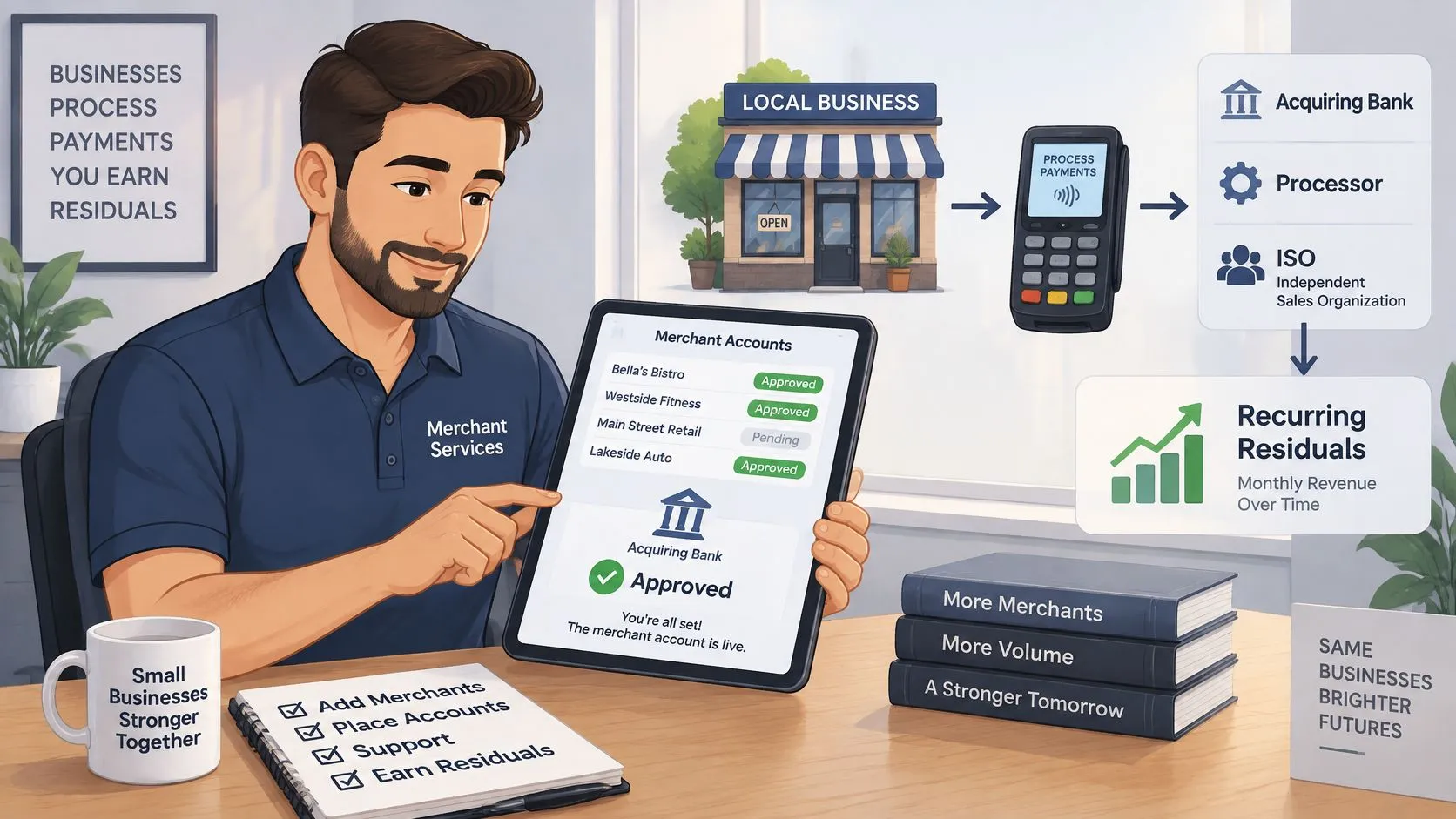
You prospect the account, explain pricing and equipment in plain language, coordinate underwriting, and stay on as the relationship owner after activation. The processor behind you handles authorization, settlement, network connectivity, and risk controls. That division matters because you can’t fix a settlement problem by selling harder, and the processor won’t walk into the dining room to rebuild trust after a bad month.
Who Does What in a Card Payment Relationship
| Party | Main job | Touchpoint with the restaurant |
|---|---|---|
| Merchant services agent | Prospects, explains pricing and equipment, coordinates underwriting | Owns the day-to-day merchant relationship |
| Processor or acquirer | Authorization, settlement, network connectivity and risk controls | Handles funding, statements and chargebacks |
| ISO or sponsoring partner | Packages processing with a sponsor bank or processor | Sets the contract, pricing structure and portfolio support |
| POS or software partner | Runs the point-of-sale and integrations | Controls ticket flow, menu data and order records |
| Restaurant owner | Accepts cards and reviews statements | Decides pricing, tools and channel mix |
The role exists because payment infrastructure is concentrated while merchants are fragmented. A Federal Reserve analysis of the acquiring market found that U.S. payment-card transactions rose from 23.9 billion in 2000 to 47.1 billion in 2006, while the three largest acquirers’ share of all card transactions rose from 48% in 2000 to 62% in 2007. Agents bridge that gap for restaurants, retailers, and professional services firms that need a person, not a portal login.
Card acceptance is also no longer optional. The Federal Reserve Banks’ 2024 Report on Payments, based on the 2023 Small Business Credit Survey, found that 79% of small businesses accepted at least one form of card payment. Restaurants need that acceptance tied to the POS, ordering, and reporting, not sitting on an isolated terminal.
If you’re sorting out where your role ends and a software vendor’s begins, the distinction in ISV versus ISO roles in payments is worth getting right before you sign anything. You’re a distribution and relationship layer, and what you sell is operational clarity as much as a competitive rate.
How Residual Income Works and Where It Breaks
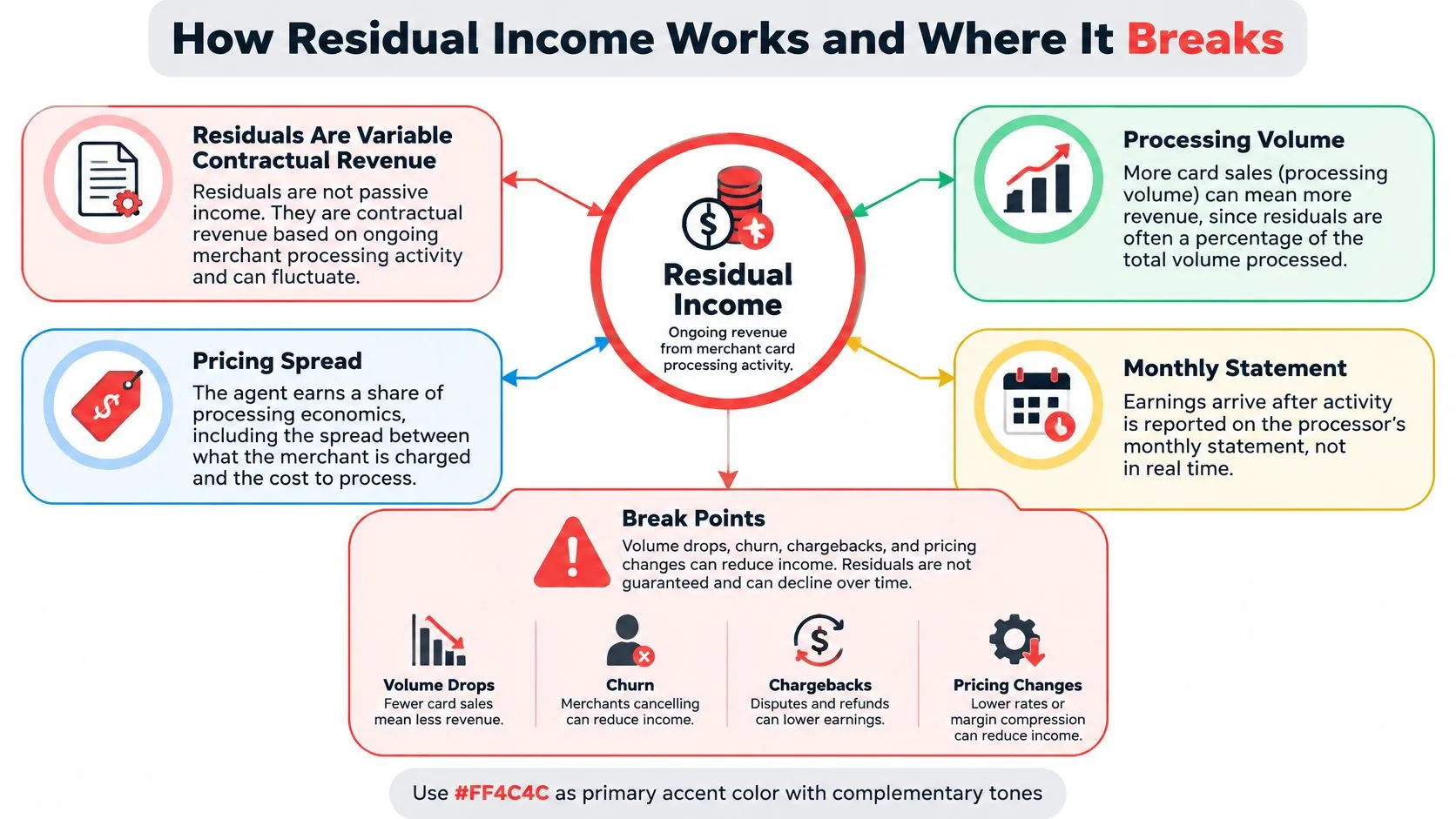
Residuals aren’t passive income. They’re variable contractual revenue, and treating them as guaranteed is how agents overcommit on rent, staff, and lead spend in a good month and panic in a slow one.
Here’s a visual map of how that income builds and where it breaks.
Before the mechanics, name the compensation model in front of you, because each one pays on a different trigger.
- Residual share: a share of processing revenue on merchants you placed, repeating monthly while the merchant stays active
- Upfront or signing payments: paid once at activation, and they may carry clawback terms you need to read
- Equipment or hardware margin: a one-time amount tied to the sale, not to ongoing volume
- Bonus or tiered structures: tied to volume or retention thresholds defined in the contract
The residual itself is calculated after certain costs come out. As Premier Payments’ guide to merchant services residuals explains, contract terms may deduct processor, acquirer, gateway, network, chargeback, adjustment, minimum, or holdback costs before your split is calculated. Vesting, termination, survival, and forfeiture clauses then decide whether anything continues after you leave.
That structure explains the break points. Volume dips in a seasonal month. A pricing change compresses the revenue your split applies to. An account closes and the stream stops. And because some programs adjust later payments for disputed transactions, a portfolio can look profitable until chargebacks are reconciled and earlier revenue reverses.
Restaurants sharpen every one of those risks. A restaurant book mixes recurring card sales with refunds, disputes, tips, no-shows, and seasonal swings, so your income moves with the dining room, not just with your pipeline. That’s the practical reality behind how ISO merchant services portfolios actually pay, and it’s why a strong month proves very little on its own.
The short video below walks through that variability in plain terms.
Practical rule: Treat every residual as a forecast to verify each month, never as a floor, and tie each assumption back to the contract language on survival and termination.
Picture the residual at the center of a map, with volume, deductions, adjustments, retention, and contract rights as branches. If any branch moves, your payout moves, whether or not you changed anything that month.
Reading a Residual Statement Line by Line
A headline residual is only as useful as the lines beneath it. Review the statement in the same order each month, and reconcile the figures before accepting the total.
Residual Statement Line Items to Verify
| Line item | What it shows | What to check |
|---|---|---|
| Gross card volume | Settled card sales for the period | Matches the merchant’s deposits and processing reports |
| Eligible revenue | The revenue the agent’s split applies to | Confirms which fees count toward the residual |
| Processor and network deductions | Costs taken before the split | Identifies each deduction by name |
| Chargebacks and adjustments | Disputed amounts reversed in later periods | Checks timing and any effect on later payments |
| Holdbacks and minimums | Amounts withheld or minimum thresholds | Confirms release terms in writing |
| Split basis | How the residual share is applied | Matches the contract, not an assumption |
| Payment type mix | Card-present, card-not-present, debit and rewards volume | Matches the processor’s monthly statement detail |
| Vesting and post-termination rights | Whether residuals continue after the agent leaves | Checks survival and forfeiture clauses |
Start with gross card volume. Reconcile it against the merchant’s deposits and processing reports. If those figures differ, pause the review: every calculation below depends on the volume being right.
Next, confirm eligible revenue and the split basis against the contract. A merchant’s total fees are not necessarily the base for your share. Ask for each processor and network deduction by name; a single netted figure can conceal which costs changed.
Then examine chargebacks and adjustments. A dispute from an earlier period can reverse revenue already counted, so compare adjustments with the period they relate to and record any unresolved questions.
Checking a Square Residual
For a Square merchant, check each residual line against the merchant’s processing reports and the terms of the agreement. Confirm the volume, payment-type mix, eligible revenue, deductions, and split basis before explaining the payout. The goal is a traceable calculation, not a plausible-looking total.
Use the same checks in the merchant conversation. Reconcile the figures together, identify deductions clearly, and note anything that needs an answer at the next review. OrderOut’s Reseller Program lets resellers sell Square, Clover, and Online Ordering, but statement review still depends on matching the processor’s monthly details to the contract.
If a line item cannot be tied to a merchant record or a contract clause, it is not verified, regardless of how clean the statement looks.
Working with Restaurant Owners on Square
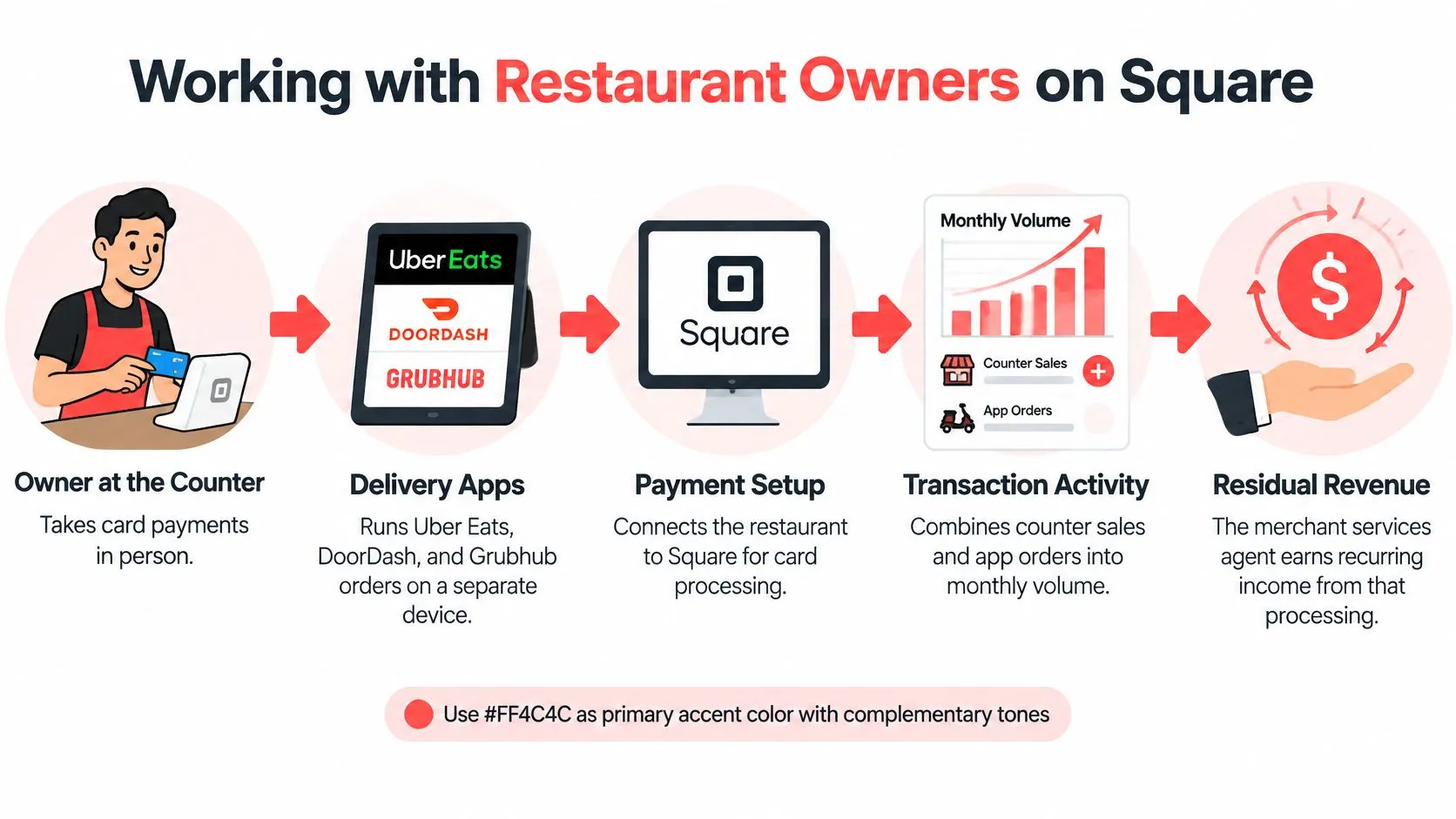
Take one owner from the counter to the monthly residual. She takes card payments in person and runs Uber Eats, DoorDash, and Grubhub on a separate tablet that staff re-key into the register during the rush. Her problem isn’t one rate. It’s a stack of costs and a workflow that creates errors.
This flow shows how the pieces connect for a Square restaurant.
Step 1 is discovery of the volume mix. Ask how sales split between counter, phone, direct online, and marketplace channels. You’re looking for where card-present volume ends and card-not-present volume begins, because that boundary drives both pricing and dispute exposure.
Step 2 is the statement review. Calculate the effective rate as total fees divided by settled volume. A Federal Reserve note on merchant payments puts U.S. credit-card processing at commonly about 1.5% to 3.0% of transaction value, with interchange often representing 70% to 90% of the total merchant fee. That context keeps owners from treating the quoted discount rate as your margin, when most of it passes through.
Step 3 is segmentation. Break transactions into card-present, card-not-present, debit, rewards, commercial, and keyed-entry categories, then compare authorization, downgrade, chargeback, and batch-fee patterns. Keyed entries from re-typed delivery orders are exactly the kind of avoidable cost and error source this step should surface.
Step 4 is the proposal, framed as a contribution-margin analysis over at least twelve months. Estimate the fee change, implementation cost, chargeback exposure, and retention value. Don’t promise a basis-point saving you can’t control, because delivery and online channels can shift the mix toward card-not-present pricing after you sign.
Where Delivery Integration Fits
This is the point where the tablet problem belongs in the conversation. OrderOut’s 3rd-party order engine for delivery to POS injects Uber Eats, DoorDash, and Grubhub orders straight into the Square POS, with no extra tablets and no re-keying, which means fewer order-entry errors. Direct online orders also route into the Clover or Square POS as standard tickets, with no extra tablet needed.
Menu accuracy carries the integration. OrderOut syncs prices, item availability, and out-of-stock changes from Square to the Uber Eats menu automatically, so the ticket the kitchen fires matches what the guest ordered. The technical background in how Square integration handles order flow helps you answer the owner’s how-does-it-connect questions without guessing.
When she’s ready to look, the install point is the OrderOut listing on the Square App Marketplace. For your side of the relationship, OrderOut’s Square reseller program is where the Square reselling route sits. The owner then decides on the full picture, fees, workflow, and risk together, rather than on a headline rate alone.
Vetting an Agent Partner and Spotting Red Flags
A headline rate can attract a merchant; the contract and monthly statements determine whether the relationship holds up. Evaluate a partner against written criteria before agreeing to represent its offer.
Partner Evaluation Criteria
| Criterion | What to verify | Why it matters |
|---|---|---|
| Pricing transparency | A written fee schedule that identifies pass-through and service charges | Lets you calculate the effective rate, not just the headline rate |
| Residual statement detail | Merchant-level statements, month by month | Shows how each residual adds up |
| Responsibility matrix | Named owners for incidents, remediation, access control and PCI evidence | Prevents gaps when something breaks |
| Payment software validation | Independent assessment of payment components | Clarifies the compliance scope |
| Operational testing | Duplicate orders, partial approvals, refunds, voids, offline transactions and settlement matching | Catches failures before merchants do |
| Integration openness | API terms, client requirements and exit conditions | Shows whether leaving would require rebuilding |
| Coverage and pricing tiers | Written list of eligible regions and available tiers | Prevents quoting a merchant an offer that does not apply |
Pricing transparency means you can identify every fee and calculate the effective rate. Residual statement detail means merchant-level reporting, not a portfolio total. If the partner cannot show how an individual merchant’s residual is calculated, you cannot explain the payout clearly.
The responsibility matrix should name who owns incident response, vulnerability remediation, access control and PCI evidence across the merchant, acquirer, processor, POS provider and integration vendor. PCI Security Standards Council guidance on secure software distinguishes payment software vendors as a scope to assess. Check whether the POS, payment application, middleware and ordering connector use validated components, how card data is handled, and where encryption boundaries sit.
Limit the systems that handle card numbers, and define each system’s responsibilities. Poorly defined interfaces can expand compliance scope and create reconciliation or authorization failures. Before go-live, require tests for duplicate orders, partial approvals, refunds, voids, offline transactions and settlement matching.
For integration openness, check API access, any required proprietary client, and what happens to merchant data and workflows if the relationship ends. Before quoting, get written confirmation of the regions and pricing tiers covered by the partner program. Do not assume a tier or offer applies across every market.
Dispute handling also deserves scrutiny. Ask who handles chargeback exposure, refund permissions, dispute evidence and delivery-order errors. These issues can affect a restaurant’s costs and your reputation, so consider how you would explore dispute alert partnerships. The Square ISO program explained can help clarify the difference between a defined partner route and an informal referral arrangement.
Red Flags and the Question to Ask
- Rate-only pitch: The partner has little to say about operations. Ask how refunds, disputes and order errors are handled.
- Guaranteed residual promises: The pitch may leave deductions out of view. Ask what is deducted before the split and how changes affect your payout.
- Refusal to document deductions: Adjustment timing and split basis remain verbal. Get both in writing before recruiting a merchant.
- No post-termination rights in writing: Your residuals may not continue after the relationship ends. Ask how vesting, survival and forfeiture work.
- Pressure to sign before reading: Ask why the agreement cannot wait for a careful review.
- Pricing that changes after signing: Ask what triggers a change, who can make it, and how notice is provided.
The walk-away rule: If the partner will not answer these questions in writing, do not sign. Verbal assurances will not resolve a later dispute over a merchant statement.
Frequently Asked Questions
Does OrderOut Work With Clover and Square
Yes. OrderOut connects delivery apps such as Uber Eats, DoorDash, and Grubhub to Clover and Square POS systems, so staff can manage incoming orders without re-keying tickets from separate tablets.
How Do Merchant Services Agents Get Paid
Agents mainly earn residuals, a share of processing revenue from merchants they place, calculated after deductions. Some agreements also include one-time signing or equipment payments, or bonuses tied to volume or retention. Check the contract for the payment trigger, deductions, and split basis.
Is a Residual Guaranteed
No. Residuals are variable contractual revenue. They can change with processing volume, pricing, chargebacks, adjustments, and merchant retention. Treat the headline rate as a starting point, then check the merchant-level statement against the card processor’s reports each month. Read the survival and termination terms to understand what continues if you leave.
Where Can a Reseller Check a Merchant Residual
Compare merchant-level statements with the card processor’s reports, tracing the volume, deductions, and resulting residual line by line. For general prospecting process questions, see the SignalVan prospecting FAQs.
Request Reseller Access to Start Selling Square
The decision in front of you is whether to add Square reselling alongside your existing merchant portfolio. I’d make it on three checks, not on a pitch.
First, verify residual transparency month by month, at merchant level, with figures you can trace to Square’s report. Second, confirm the responsibility matrix in writing, so incidents, remediation, access control, and PCI evidence each have a named owner. Third, test the operational flows restaurants depend on, including refunds, voids, duplicate orders, and settlement matching, before your first merchant relies on them.
The Reseller Program lets resellers resell Square, Clover, and Online Ordering to their restaurant clients, while we handle the delivery-to-POS integration behind it. Start by reading how the OrderOut reseller program works, then look at OrderOut’s Square reseller program for the Square-specific route. The broader picture for agents sits at OrderOut’s reseller hub for agents and ISOs, and the practical angle in how to resell Square POS to restaurants is worth a read before your first pitch.
Merchant residuals are live in the Reseller Portal, so you can open a month, click Explain, and check the numbers yourself. When you’re ready, request access through the Reseller Portal. That’s the reseller route, not the merchant dashboard, and it’s the right door if Square fits your book.
If you sell Square to restaurants, OrderOut gives you delivery-to-POS integration for Uber Eats, DoorDash, and Grubhub inside the Square workflow your merchants already use, with residuals you can open and explain month by month in the Reseller Portal. Bring your three checks, residual transparency, a written responsibility matrix, and tested operational flows, and request reseller access to start selling Square with the statement discipline this guide describes.