
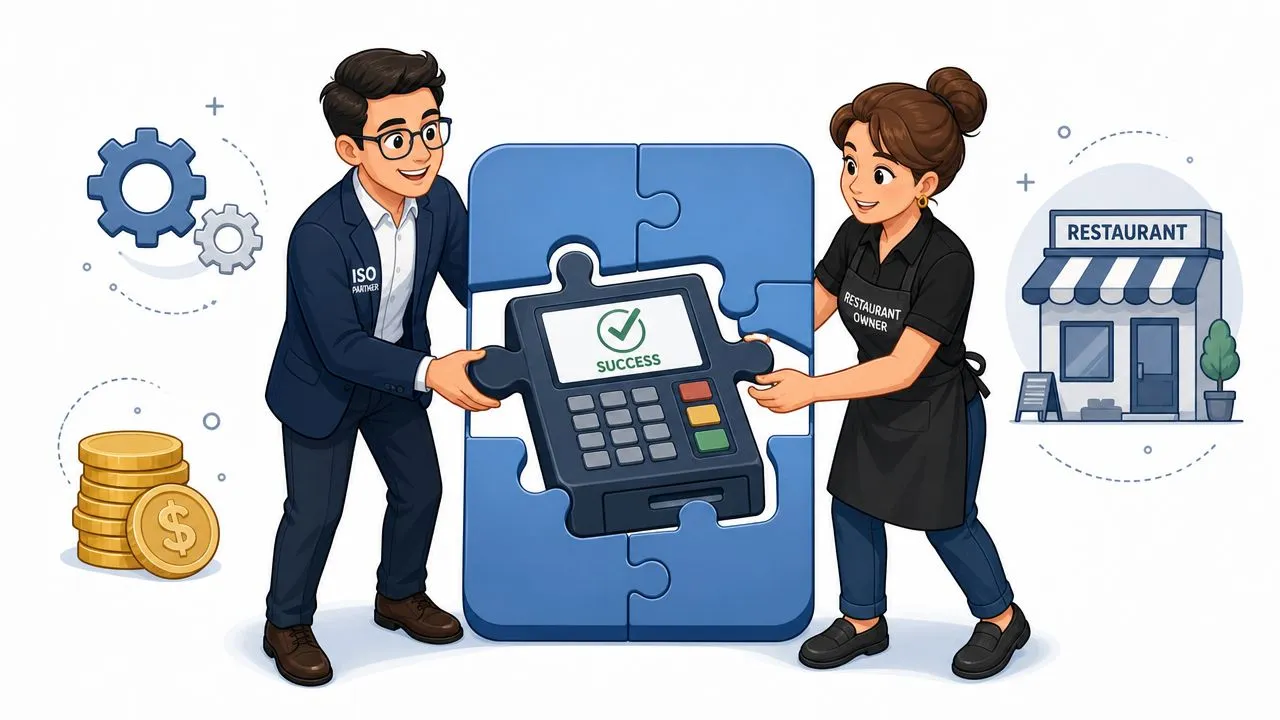
The Square ISO program is a channel partnership that lets Independent Sales Organizations resell Square payments and hardware to merchants and earn commissions on the accounts they bring in. The surprising part is that the money usually isn’t in the hardware pitch alone. It’s in the operational problems you can solve after the account is live, especially for restaurants trying to run Uber Eats, DoorDash, and Grubhub through Square without tablet chaos.
Restaurant partners learn this fast. Selling a terminal is easy. Keeping a restaurant account happy is harder, because the owner cares less about the box on the counter than about whether orders land cleanly, the kitchen sees one ticket, and the staff doesn’t spend service re-keying orders.
What the Square ISO Program Actually Is
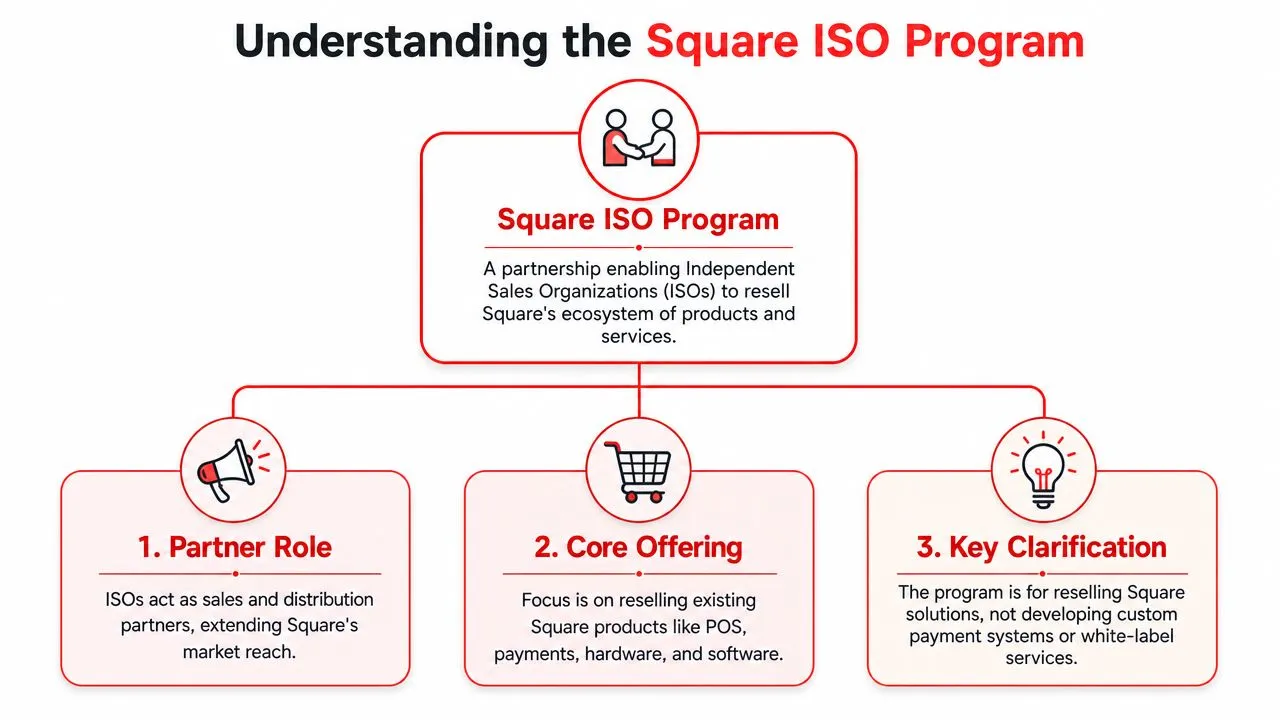
The Square ISO program is a partnership for Independent Sales Organizations that want to resell Square products and merchant processing.
That sounds simple, but searchers often get tripped up by the word ISO. In this context, ISO means Independent Sales Organization, not an international standards body, not a security certification, and not a software quality framework.
What ISO means here
If you’re advising restaurant merchants, this distinction matters because people mix up three separate things:
- Square’s partner channel: a reseller relationship for payments, hardware, and merchant acquisition
- ISO/IEC 27001: a security certification Square has achieved for its information security management
- SQuaRE: the ISO/IEC 25000 software quality framework used in software engineering
QMII’s explanation is one of the clearest on this point. It notes that SQuaRE refers to the ISO/IEC 25000 series, while Square has achieved ISO/IEC 27001 certification, and both are separate from the ISO partner program.
For a new agent, the practical takeaway is straightforward. The Square ISO program is a go-to-market channel, not a technical compliance scheme.
What partners actually sell
In day-to-day channel terms, you’re helping merchants buy into the Square ecosystem. That usually means a mix of:
- Payments acceptance: card processing tied to the merchant account
- POS hardware: registers, readers, and countertop setups
- Square software footprint: the merchant’s operating layer for checkout and order handling
- Onboarding guidance: helping the merchant choose the setup that matches how the restaurant runs
The catch is that restaurants don’t buy “payments” in isolation. They buy a working operation. If the front counter runs on Square but delivery orders still live on separate tablets, the merchant doesn’t feel like the system is unified.
Practical rule: If you can’t explain how the restaurant will handle third-party delivery orders after the sale, you’re not really selling a complete POS solution.
That’s why channel partners who focus on restaurants should read the Square partner program overview for restaurant resellers with a skeptical eye. The core partnership model is real. The differentiator comes later, when the merchant starts asking operational questions that a pure payments pitch doesn’t answer.
Eligibility and Requirements for Partners
A lot of people ask whether they can join the Square ISO program with little more than a book of business and a willingness to sell. In practice, the better question is whether you’re built to support restaurant merchants after the paperwork clears.
Business readiness
Square wants partners who look like real operators, not hobbyists testing a side hustle. Before you even think about applying, make sure you can show:
- A legitimate business presence: registered entity, clear business identity, and a professional sales motion
- A defined market: restaurant, retail, services, or another segment where you already know the workflow
- A merchant-facing process: onboarding, follow-up, and support expectations that don’t fall apart after the install
Restaurants especially will notice if your sales process is polished but your post-sale support is improvised.
Sales fit
Square is easier to place when you already know how to sell business systems, not just card rates. The strongest partners usually have experience in one or more of these lanes:
| Partner trait | Why it matters in restaurants |
|---|---|
| Existing merchant relationships | You can shorten the trust cycle |
| B2B sales experience | Owners expect direct answers, not scripts |
| Payments knowledge | You can explain account setup without confusion |
| POS fluency | You can connect payments to daily operations |
That last point gets underestimated. A restaurant owner isn’t comparing processors in a vacuum. They’re asking whether the system will work with their menu, their service style, and their delivery channels.
Technical judgment
You don’t need to be an engineer. You do need enough technical judgment to recognize what can break.
A new agent should be comfortable evaluating:
- How orders enter the POS
- Whether menus and modifiers stay consistent across channels
- What the staff has to touch during service
- Who owns first-line support when something goes wrong
The fastest way to lose credibility is to promise “easy integration” before you understand the merchant’s actual order flow.
If you’re still building that muscle, the guide on how to resell Square POS is a useful starting point because it forces you to think beyond account activation and into the actual service model.
Analyzing the Commercial Model and Commissions
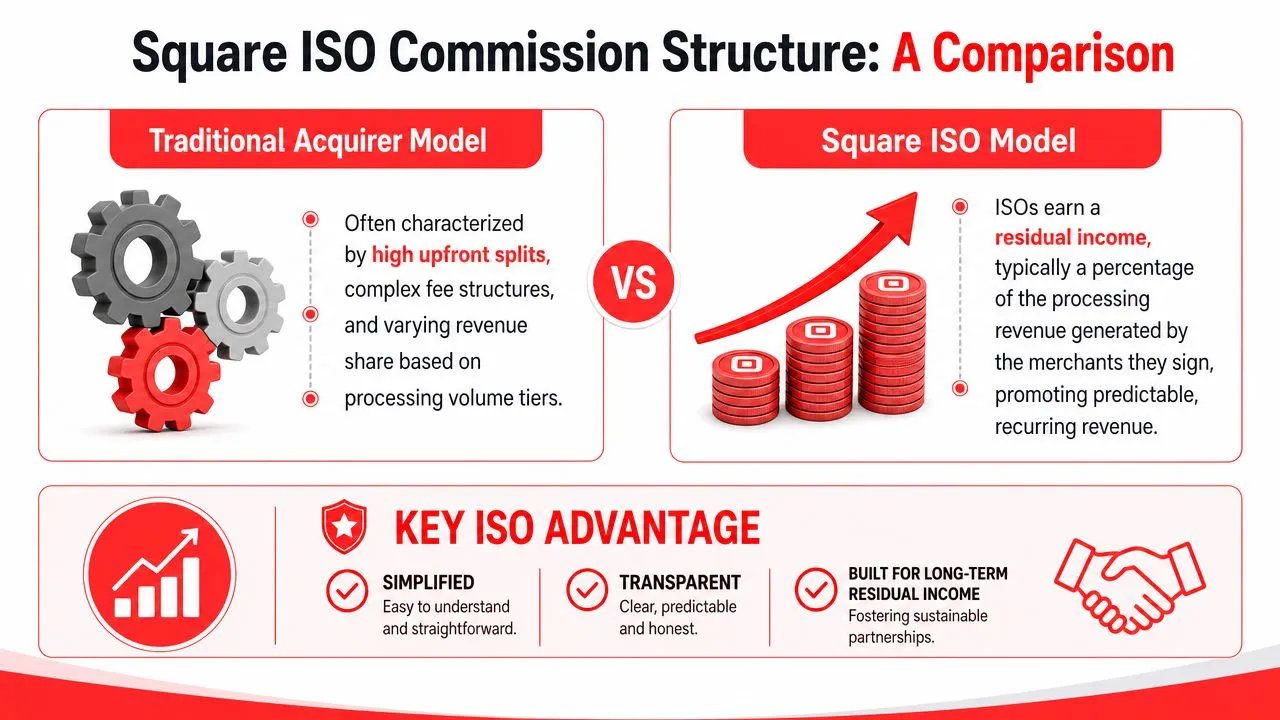
The commercial appeal of the Square ISO program is easy to understand. You bring in merchants, they process payments, and you earn residual income from the accounts you’ve signed.
That recurring model is why agents look at Square in the first place. Predictable residuals are better than one-off hardware flips. But if you’re comparing channels, you need to be honest about where Square is strong and where it’s tighter.
Where the model is tighter
The trade-off most partners miss early is revenue flexibility. Square’s partner program is structured differently from other POS platforms when it comes to software revenue share — a trade-off worth understanding as you compare channels.
That doesn’t make Square a bad channel. It does mean you can’t rely on software rev share to carry your economics.
Here’s the practical implication:
- If you only sell payments, your differentiation is thin
- If you only sell hardware, you’re exposed to price shopping
- If you add workflow solutions, you create a reason for the merchant to stay with you
What profitable partners do differently
The agents who do well in a tighter rev-share model usually stop behaving like rate sellers. They package services around the merchant’s operational pain.
For restaurant accounts, that often means:
- Owning the setup conversation so the merchant knows how the full stack will work
- Reducing complexity at the store level because managers hate juggling disconnected systems
- Becoming the first call for workflow issues instead of leaving the merchant to sort it out alone
A lower software share changes the game. It pushes you to make your margin through expertise, retention, and add-on value.
That’s why delivery integration matters so much in restaurant sales. It isn’t just a nice extra. It’s one of the clearest ways to justify your role when the core Square economics are less flexible than other channels.
The Undiscussed Challenge for ISOs: Integration and Support
Most partner write-ups make the Square ISO program sound cleaner than it is. Sign merchants, deploy hardware, earn residuals. In the restaurant segment, that story falls apart the minute an owner asks how Uber Eats, DoorDash, and Grubhub orders will flow into the POS.
The support gap is real
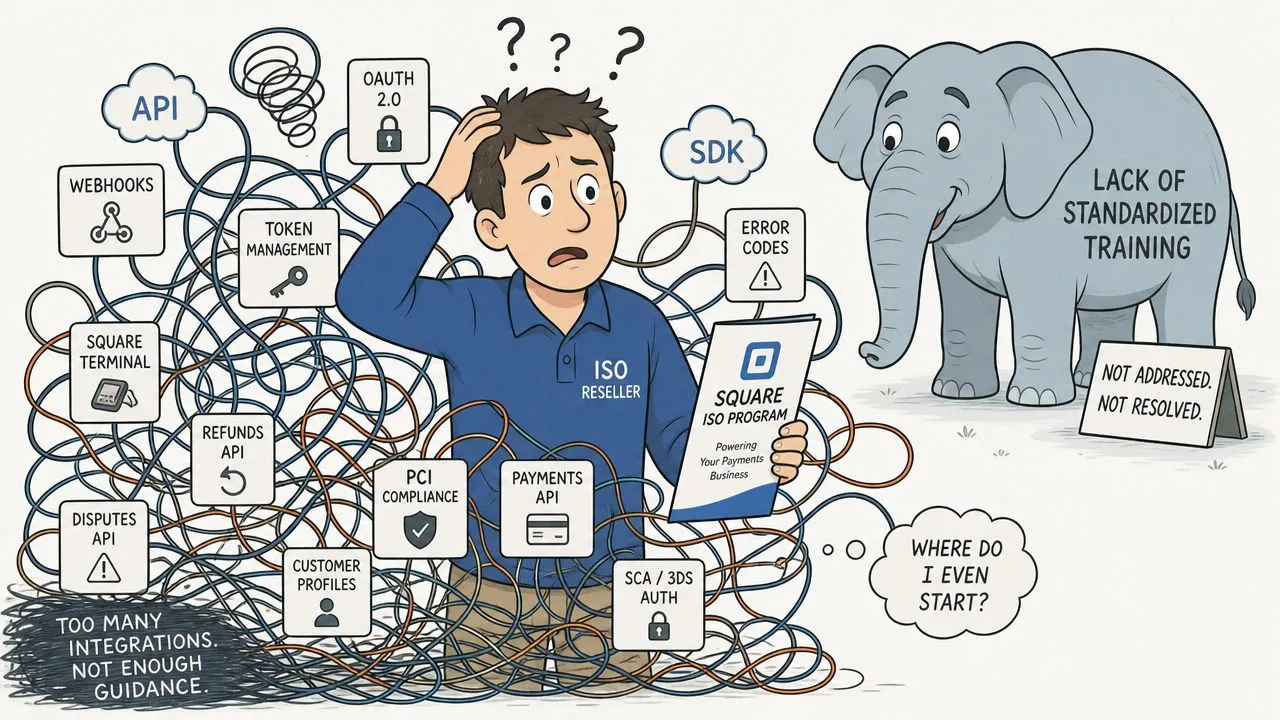
Digital Transactions reported that Square expanded to 140 ISO partners, but also noted there’s no public data showing whether new agents receive standardized training on complex third-party delivery app integrations. You can read that in Digital Transactions’ coverage of Square’s growing ISO channel.
That matters because support quality won’t be uniform. Some agents know restaurant operations. Some don’t. Some can troubleshoot a payment terminal. Fewer can walk a merchant through the operational consequences of disconnected delivery workflows.
What restaurant owners actually need
Restaurant merchants rarely say, “I need middleware architecture.” They say things like:
- My staff keeps bouncing between tablets
- The kitchen misses orders when the counter gets slammed
- Modifiers don’t line up cleanly
- Managers waste time reconciling what came from where
Those are integration problems disguised as service complaints.
If you want a broader lens on the kinds of systems restaurant operators evaluate, it’s useful to compare restaurant management platforms and look at how often order flow, staff workload, and channel sprawl come up in the decision.
Selling Square into restaurants without an integration plan turns you into a commodity. Solving the daily mess turns you into an advisor.
Agents who want to stay relevant need a working grasp of APIs, order mapping, and support ownership, even if they never write code. The POS integration API discussion for restaurant workflows is a good reference point because it frames integration as an operational issue, not just a technical one.
How to Win with Square by Solving Delivery Chaos
The easiest restaurant sale to lose is the one where the owner likes Square, agrees on payments, then realizes the staff still has to manage separate tablets for Uber Eats, DoorDash, and Grubhub.
That’s where the pitch changes. The restaurant doesn’t need another app to watch. It needs delivery orders to land in the POS the same way in-house orders do.
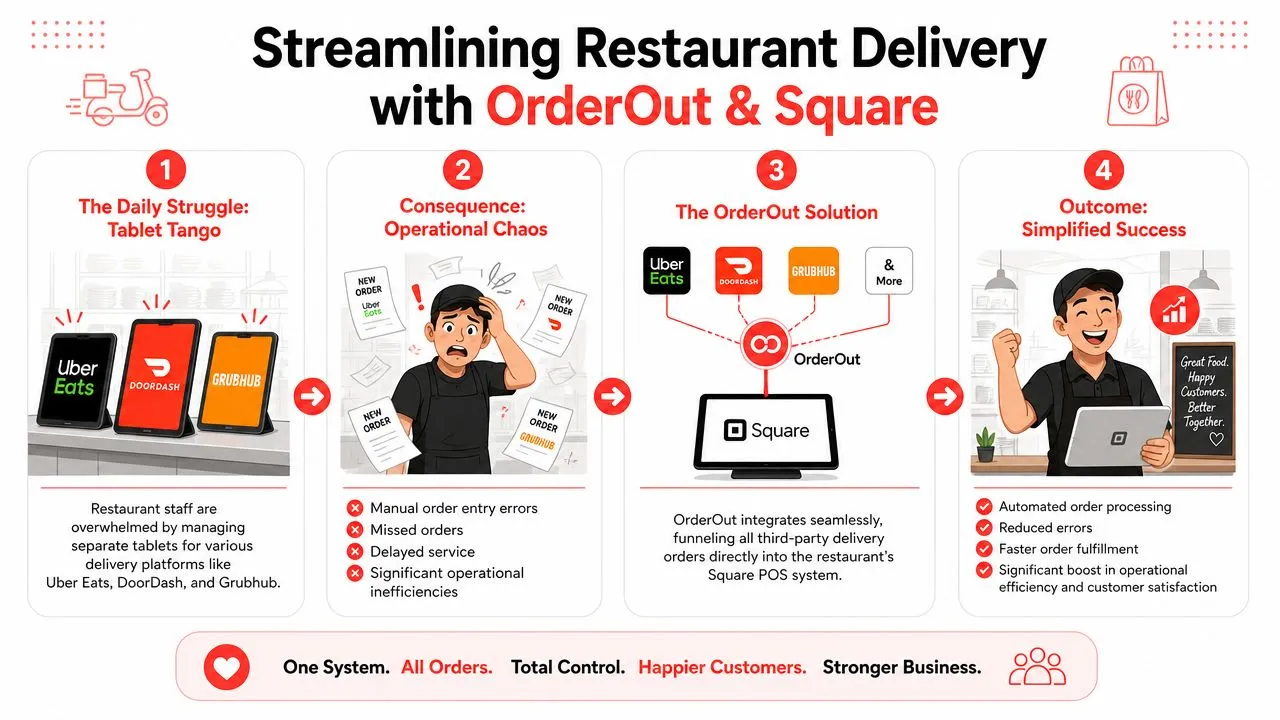
What clean delivery POS integration looks like
In plain language, the goal is simple. An order from Uber Eats or DoorDash should show up in Square as a normal ticket, with the right items, prices, and modifiers, so the kitchen can work from one source of truth.
On the technical side, that only works if the system maps each marketplace menu into a normalized POS schema instead of dumping messy third-party data into the workflow. OrderOut’s FAQ explains that its platform maps each marketplace menu to a normalized POS schema so orders inject directly into Square POS as standard tickets with correct modifiers and pricing.
That’s the part many partners miss. “Integration” isn’t just connecting logos. It’s making sure the order lands cleanly enough that staff can trust it.
Why this is the partner’s margin lever
For a Square-focused reseller, competitive differentiation becomes a tangible advantage. If you can bundle delivery POS integration into your Square offer, you’re not just placing a payment account. You’re solving a pain the merchant feels every shift.
One option is OrderOut’s Square reseller program for delivery-to-POS integration, which lets partners resell delivery order injection, commission-free online ordering, and AI phone ordering under their own brand. For restaurant accounts already using Uber Eats, DoorDash, or Grubhub, that’s much easier to position than a generic “technology partner” promise.
A Square operator can also see the broader workflow at OrderOut’s third-party order engine for restaurant delivery POS integration and review a channel-specific example like Uber Eats to Square delivery POS integration.
For partners who want a product-level explanation of why removing manual entry matters, the order entry automation guide for restaurant POS workflows is worth reading.
Here’s the product flow in action:
What to show a prospect
When I’m advising agents on restaurant deals, I tell them to demo the workflow, not the feature list.
Show the owner this sequence:
- Uber Eats order arrives: it routes into Square as a standard ticket
- Modifiers stay attached: the kitchen doesn’t have to decode marketplace formatting
- Staff stop re-keying: they work from the POS instead of hopping between tablets
- The kitchen sees one stream: dine-in and delivery workflows stay aligned
That’s a better sales conversation than talking about processing in the abstract.
If you’re selling into Square restaurants now, the practical in-context starting point is the Square App Marketplace listing for OrderOut delivery integration. If you’re building a broader channel motion, the OrderOut reseller and partner program for restaurant technology providers and the developer and integration partner program show how to package it into your own client stack.
Frequently Asked Questions
Is the Square ISO program the same thing as ISO certification?
No. In the Square ISO program, ISO means Independent Sales Organization. That’s different from standards like ISO/IEC 27001 and different from SQuaRE software quality terminology. If you’re joining the channel, you’re entering a reseller relationship, not a certification track.
How do Square partners make more money if software revenue share is limited?
They usually do it by adding operational services that merchants need. In restaurants, that often means solving order flow, delivery app integration, onboarding, and first-line support issues instead of competing only on hardware or payment pricing. That approach protects retention and gives the merchant a reason to keep working with the same partner.
Why does delivery integration matter so much for Square restaurant accounts?
Because restaurant owners feel operational friction immediately. If Uber Eats, DoorDash, and Grubhub live on separate tablets, staff has more places to watch, more chances to mistype orders, and more room for service breakdowns. Direct delivery-to-POS flow is easier to defend in a sales conversation because the benefit is visible during a normal shift.
Can partners offer Square merchants a cleaner way to handle delivery orders?
Yes. Partners can package a delivery-to-POS integration layer so third-party marketplace orders land in Square as standard tickets instead of being re-entered by staff. That’s the kind of workflow improvement owners understand quickly because it reduces busywork and keeps the POS at the center of service.
Where should a new partner start learning the operational side?
Start with restaurant order flow, not just payments training. Learn how menus, modifiers, kitchen printing, and third-party delivery orders move through the store. The OrderOut POS integration frequently asked questions page is a practical place to get familiar with the kinds of issues restaurant operators and partners run into.
If you want to turn Square accounts into stickier restaurant relationships, start with onboarding the delivery workflow, not just the payment account. Create your free account and begin setup at OrderOut, or go straight to the OrderOut reseller portal to request access.
New to the OrderOut Reseller Portal? The help center for merchant services agents has written steps, screenshots and a short video for each job in the portal — signing your Master Agreement, adding an agent, creating an onboarding link and tracking a merchant application. Every change ships with a note in what’s new in the Reseller Portal.