

An ISO agent reseller residual split is the agreed share of recurring net processing margin that an organization passes to the sub-ISOs and agents who bring in or service its merchants. So why does a partner meeting still stall on the headline percentage?
Because the percentage is the part everyone can recite, and it’s the part that decides almost nothing on its own. The base it applies to, the deductions the contract allows before anyone divides anything, and the tier that holds the merchant relationship decide what a slow month pays. A partner who signs a number without a written base has agreed to a number, not an income.
How an ISO Agent Reseller Residual Split Works
The base is margin. Not the restaurant’s card volume, and not the total on the merchant’s processing bill. Relyon’s explanation of what an ISO is in payments frames it the same way: the split applies to net processing margin after costs, which is why two partners can quote the same split and earn different amounts.
Walk the calculation in the order a residual statement reads:
- Collect the merchant fees for the month. That means what the restaurant paid in processing costs across card-present, card-not-present, and marketplace-settled orders.
- Subtract interchange, card-network assessments, and processor or acquirer costs. These pass through before anyone shares anything, and they shift with card mix and average ticket.
- Subtract only the pass-through expenses the agreement defines as deductible. Eligible software, gateway, or compliance fees belong here when the contract names them. A cost the contract doesn’t name still comes out of someone’s share, and the default shouldn’t be yours.
- The remainder is the residual pool. This is the only number anyone divides.
- Apply the agreed split to the pool. The organization takes its share, then passes the sub-ISO and agent shares under their own written schedules.
The flow from signed merchant to paid residual looks like this.
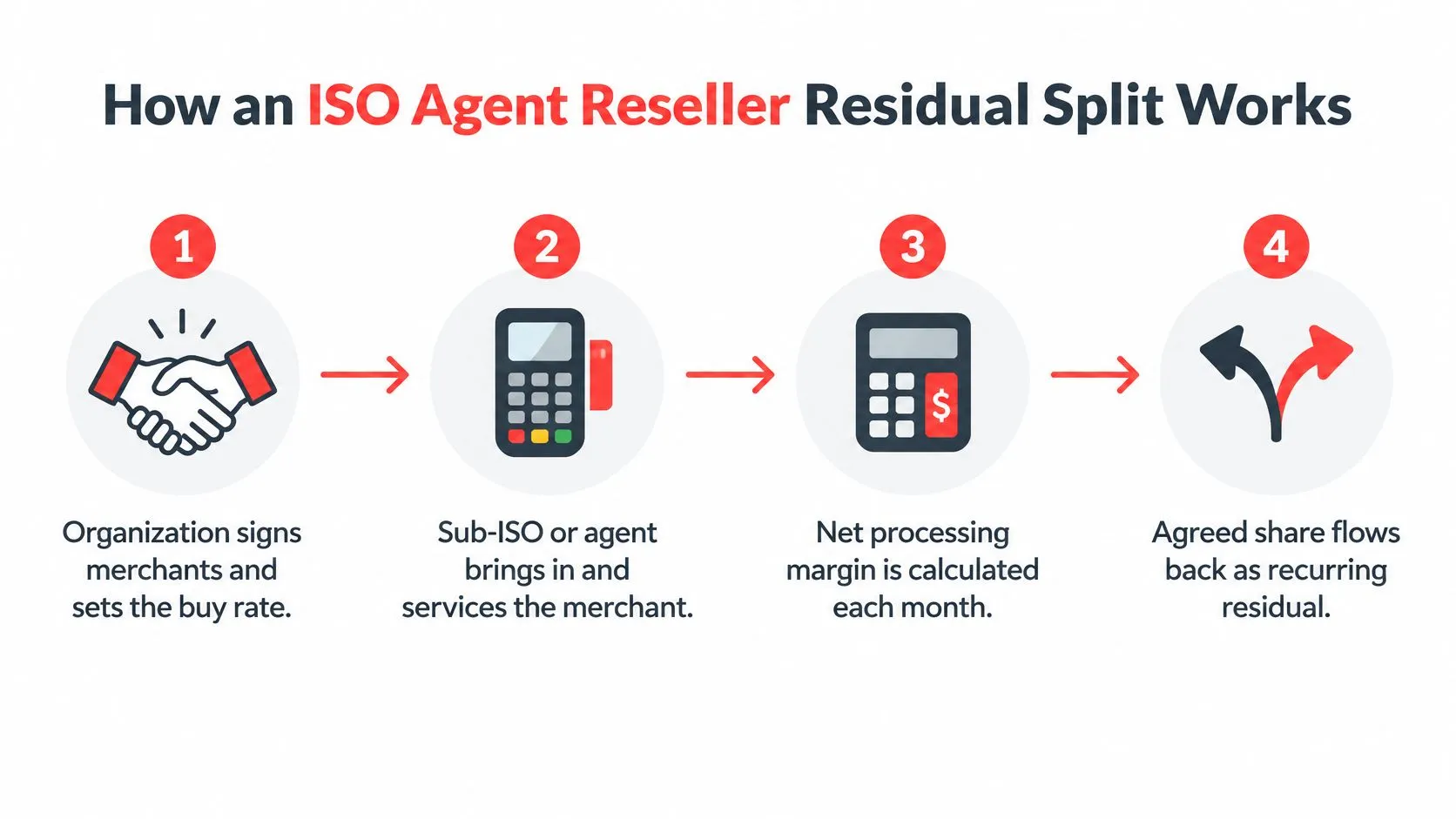
Where the Percentage Actually Applies
Think of the pool as the tip jar after the house has covered its costs. The jar gets shared; the till doesn’t.
Practical rule: Never agree a split until you can name the base and every deduction that touches it. If a partner can’t list the deductions in writing, the percentage is decoration.
That distinction has teeth. A restaurant can add volume and still produce a smaller pool, because the new volume arrives on card types with thinner margin, or because delivery orders bring disputes the agreement charges back before the split. The ISO merchant services explainer covers how those roles stack.
A sanity check before you sign anything: can you name each deduction, in order, and say whether it lands before or after the split? If not, you’re negotiating blind.
Who Sets the Split Between Organization, Sub-ISOs and Agents
Three tiers touch a restaurant account, and each one earns on a different basis. Compare them before you promise anyone anything.
| Partner Tier | Typical Role | Split Based On | Who Sets the Terms |
|---|---|---|---|
| Organization (reseller) | Holds the program agreement and the merchant relationship | Residual pool on the merchants it brings or services | The organization, in its own partner agreements |
| Sub-ISO | Takes on pricing, merchant support and portfolio responsibility | Its share of the margin on its own merchants, after agreed deductions | The organization, in a written sub-ISO agreement |
| Agent or referral partner | Originates merchants and hands off servicing | Eligible margin share or fixed referral terms | The organization or sub-ISO, in a written agent agreement |
The organization writes the terms. It holds the program agreement and the merchant relationship, and it decides what each tier below receives.
A sub-ISO carries pricing calls, merchant support, and portfolio responsibility for its own accounts. That load is why its share is structured differently from an agent’s. The Mastercard rules place compliance obligations on the acquirer and its payment facilitator, and a sub-ISO absorbing servicing absorbs more of that work.
An agent or referral partner introduces and moves on. The economics reflect introduction, not operations, and they should be written that way.
A split is payment for work. If two partners do different work, identical percentages mean different things.
Reward allocation inside a partner firm runs into the same problem, which is why why reward splits need written terms is a useful read alongside any sub-ISO agreement.
Then do one thing: build a partner map, one line per merchant, naming who services it. OrderOut doesn’t set or pay partner splits, so that map and its schedule live with you. The ISV vs ISO comparison helps you place each partner in the right column before money moves.
Compensation Structures Partners Commonly Use
Four structures show up again and again. Each pays on a different trigger, and each has one term worth reading twice.
| Structure | How the Partner Is Paid | What to Check |
|---|---|---|
| Residual only | Recurring share of eligible monthly margin | Fee base, deductions, and whether residuals continue after cancellation |
| Residual plus upfront incentive | Smaller recurring share plus a one-time payment | Clawback terms if the merchant leaves early |
| Fixed referral fee | Agreed amount per referred merchant | Whether it continues after activation and who services the account |
| Technology referral credit | Share of software or integration fees alongside processing margin | Whether software revenue sits in the same fee base as processing margin |
Residual only rewards retention. It pays for as long as the merchant stays active, so the quality of the account matters more than the count.
Residual plus upfront gets cash moving early. The trade-off sits in the clawback clause, which decides whether that early payment survives a merchant who leaves.
Fixed referral suits partners who introduce and step away. Ask whether the payment stops at activation, because that answer defines the relationship.
Technology referral credit pays for the software side of the deal. Most agreements are thinnest at that point. Hospitality Technology’s restaurant tech trends coverage describes a shift toward unified commerce and API-first infrastructure as restaurants connect delivery platforms, POS, and payment providers from different vendors, and it identifies delivery, loyalty, and accounting integrations as standard expectations. When the payment partner and the ordering platform are different companies, the integration work still creates retention and support savings that a processing residual never captures.
The matching rule: pick the structure that matches who services the account. A partner doing support and integrations shouldn’t be paid on referral terms, and a referral partner shouldn’t be paid as if it runs the portfolio. If you can’t explain the structure to a partner in one sentence, it’s the wrong structure. For how one partner model packages software alongside processing, see the Clover reseller program breakdown and the commission-free online ordering solution.
Contract Terms to Verify Before You Sign
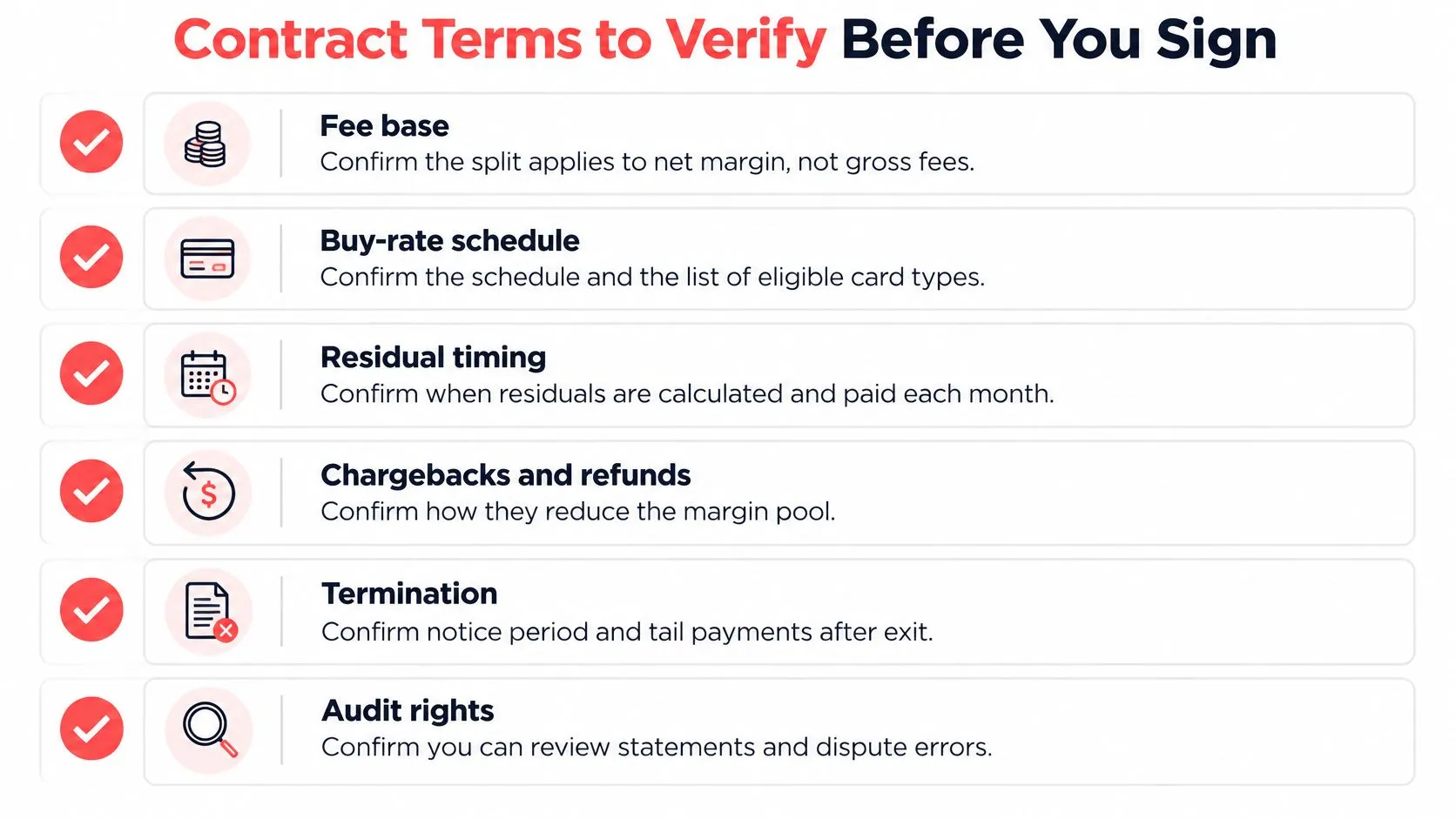
Turn the agreement into a checklist and take one line at a time. Each of these decides something a percentage can’t.
- Fee base. Confirm the split applies to net margin, not gross fees. Gross-fee language changes the deal.
- Buy-rate schedule and eligible deductions. Get the schedule and every deductible cost in writing, including software, gateway, and compliance fees.
- Payment timing and reporting. Know when residuals are calculated and paid, and what merchant-level detail you receive. Paysafe’s outline of agent recruitment programs makes the same point: confirm whether compensation runs on gross fees, net margin, a fixed percentage, or tiers, and how refunds and chargebacks affect the payout.
- Chargebacks and refunds. Confirm how disputes reduce the pool, and when.
- Vesting and termination. Ask whether residuals survive your exit, and what notice period applies.
- Audit access. You need the right to review statements and dispute errors, or you can’t reconcile anything.
Six terms that decide most arguments, in one place.
Portfolio and Post-Termination Clauses
Portfolio language belongs last because it’s the clause partners read least and regret most. Legal guidance on ISO-agent disputes from Romell PLLC notes that a contract can require the portfolio buyer to assume the residual obligation, or require the seller to fund an agent buyout, with the buyout sometimes valued from average monthly residual and the multiple used in the sale. That’s why ownership, vesting, survival, and the treatment of dormant or transferred accounts need counsel review before a single restaurant sits under the agreement. The merchant services agent guide walks through the statement checks that catch these gaps later.
Worked Split Example for a Restaurant Portfolio
Juniper Street Cafe is an invented Square merchant placed through a sub-ISO, with an organization above it. This month, card volume rose and a larger share came from regulated debit, so the margin pool grew less than sales. The split follows the agreement’s definition of the pool, not the headline sales figure.
- Collect the fees Juniper Street Cafe paid for the month.
- Subtract the buy-rate costs specified in the agreement.
- Subtract only deductions the agreement allows. In this example, chargebacks are eligible deductions.
- The remainder is the merchant’s residual pool.
- The organization takes its share, then the sub-ISO and agent receive their shares according to the written schedule.
- Reconcile that schedule against the residual figures for Juniper Street Cafe for the month.
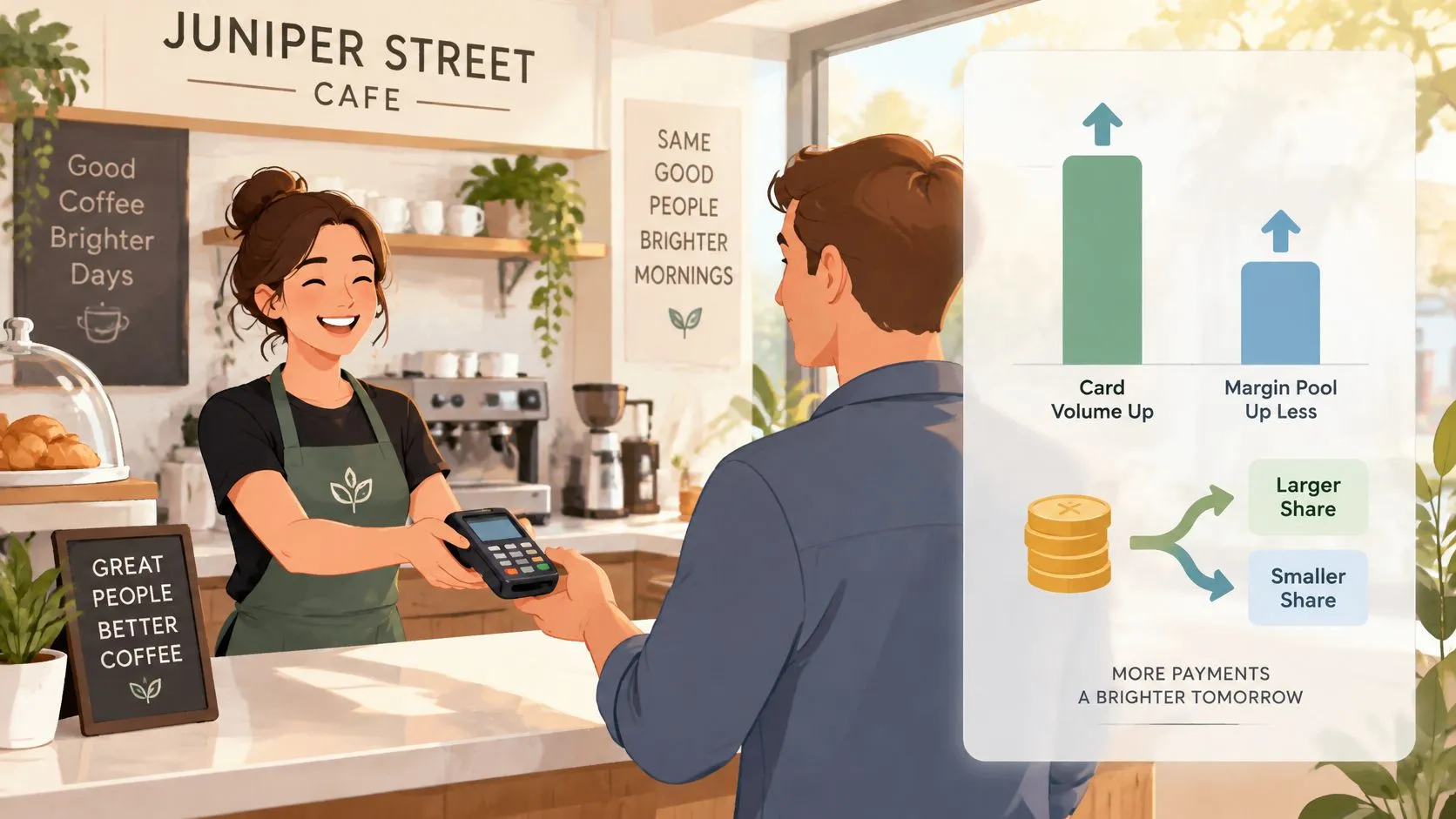
Volume growth alone doesn’t raise a residual. The defined margin base does.
Juniper Street Cafe sends Uber Eats, DoorDash, and Grubhub orders into the same Square POS through the Square App Marketplace listing. A change in card mix can therefore affect the margin pool even as sales climb. Put the calculation and each partner’s share in your schedule, so the organization, sub-ISO, and agent can trace how the merchant’s residual is divided.
Verify Each Partner’s Residuals in the Portal
Use the monthly residuals by merchant to check each partner’s share against the written split schedule. The schedule defines the payout; the residual line provides the amount to reconcile.
- Pull the month’s residuals by merchant. Check each merchant separately before reviewing portfolio totals.
- Investigate lines that differ from expectations. Compare the merchant’s residual with the prior month and check the underlying figures available to your organization.
- Apply the written split schedule. Confirm each tier’s percentage and any permitted deductions before calculating what the organization, sub-ISO and agent receive.
- Reconcile payouts against your own records. Record the amount due to each partner and track payment using the process set out in your agreements.
Keep the audit trail at both levels: the merchant-month residual and the split calculation for each partner. That makes it easier to identify whether a discrepancy comes from the residual figure, the agreement’s terms or the payout calculation.
Frequently Asked Questions
Does the OrderOut portal calculate my split?
No. The portal shows residuals by merchant and month, while Explain shows how each residual line was built. Your written schedule determines how those residuals are divided and paid.
Who sets and pays sub-ISOs and agents?
The organization sets the terms in its agreements with sub-ISOs and agents, then pays them according to those terms. OrderOut does not set or pay partner splits, and the portal does not track those payouts.
Does this work in Canada?
The program covers the US and Canada. Confirm current coverage and tier terms with your program contact before setting partner agreements.
Where do residual figures come from?
Residual figures come from Square’s report and the payments OrderOut collects from Square. Explain shows how each line was built, so partners can compare the residual with the split schedule they have agreed to.
Request Access to the Reseller Program
How each partner earns depends on the written split schedule, not the headline percentage. Set out the residual base and each tier’s share before onboarding sub-ISOs or agents. Clear terms make it easier to explain monthly earnings and resolve disagreements.
OrderOut’s Reseller Program lets partners resell Square, Clover and Online Ordering, earning residuals on the merchants they bring to OrderOut. Review the OrderOut Reseller Program to request access and understand the offer.
OrderOut connects delivery apps such as Uber Eats, DoorDash and Grubhub to restaurant POS systems, helping reduce manual order entry and errors. Its product offering also includes AI Phone Ordering, with OrderOut routing orders captured by a partner-provided voice agent into the POS.
Request reseller access through the program page, then document your organization, sub-ISO and agent tiers, including how each partner’s residual is calculated and paid. Set the schedule before your first partner agreement is signed.
New to the OrderOut Reseller Portal? The help center for merchant services agents has written steps, screenshots and a short video for each job in the portal — signing your Master Agreement, adding an agent, creating an onboarding link and tracking a merchant application. Every change ships with a note in what’s new in the Reseller Portal.