
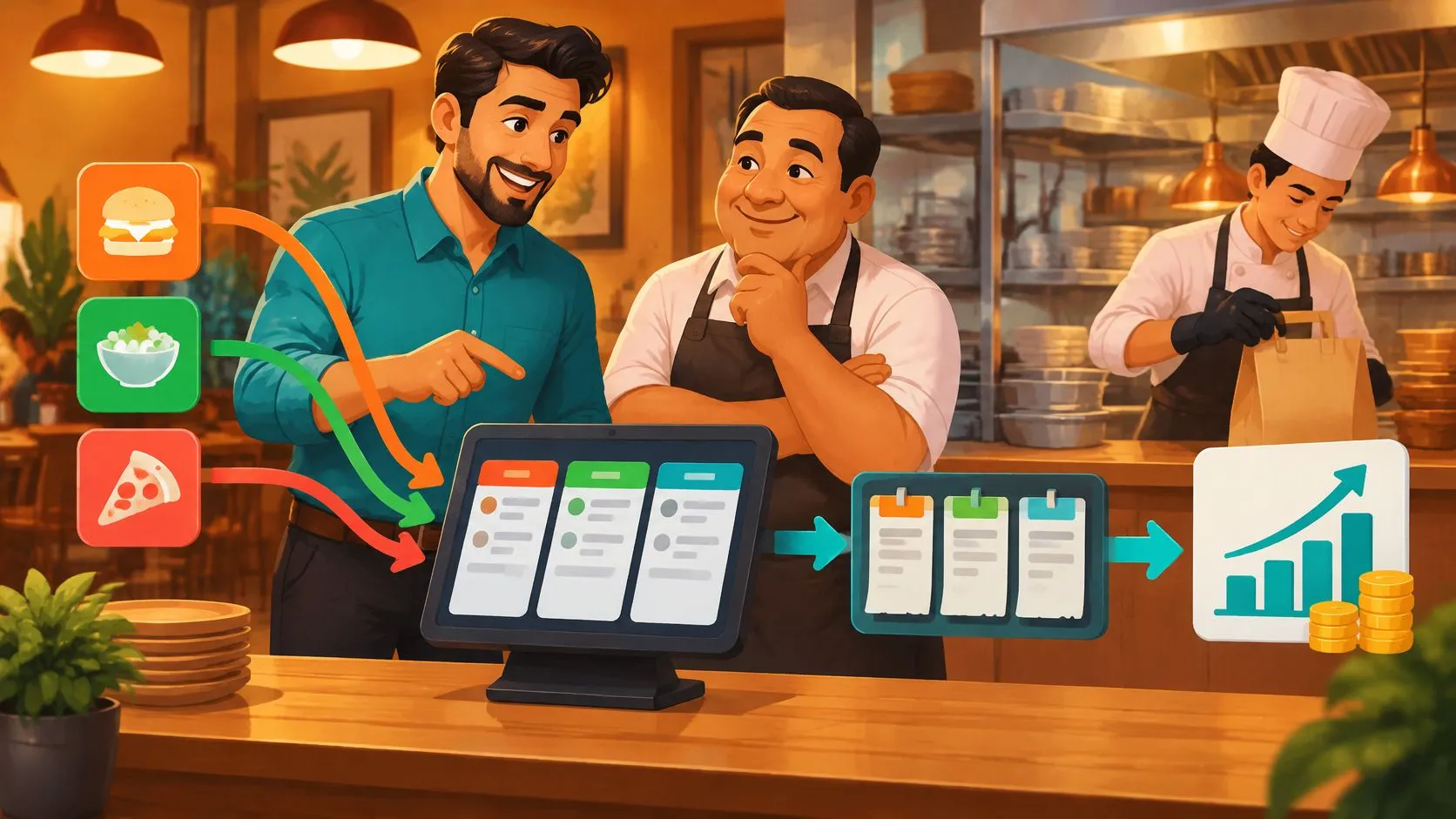
A food delivery consultant is an outside specialist who reviews and manages a restaurant’s delivery marketplace channels, including Uber Eats, DoorDash and Grubhub, so each channel earns its place in the POS and the kitchen schedule. The useful question isn’t how many orders delivery brings in. It’s what the restaurant keeps after fulfilling them.
For owners running Clover or Square, that means examining both channel costs and the way orders reach the kitchen. A consultant who recommends more promotions without checking menu mapping, refunds and manual order entry hasn’t finished the job.
What a Food Delivery Consultant Does for Restaurants
Say your counter has separate delivery tablets, staff type incoming orders into the register during the rush, and marketplace sales look healthy. You still can’t tell whether the busiest channel contributes enough to justify its discounts, packaging and extra work.
A delivery consultant connects those operational details to channel decisions. They inspect what customers can order, how tickets reach the kitchen, which charges appear on marketplace statements and where staff have to intervene.
The scale of delivery makes that work relevant beyond takeout-focused businesses. The National Restaurant Association’s delivery comments report that 65% of U.S. limited-service restaurants offered delivery in 2025, with 70% of those operators saying it represented a larger share of sales than in 2019; among full-service restaurants, 37% offered delivery, and 57% of those operators reported the same shift.
Delivery Advice Must Fit the Restaurant
Those restaurant formats shouldn’t receive identical recommendations. An operation built around quick assembly needs a different delivery menu and order-routing review from a dining room where delivery tickets compete with seated guests for preparation capacity.
The consultant should examine the actual handoffs:
- Menu suitability: Can the kitchen fulfill the app’s items and modifiers without clarification?
- Packaging: Does the order require additional materials or handling?
- Staffing and capacity: Who handles delivery exceptions while serving existing guests?
- Service areas: Are distant orders worth the operational demands?
- Customer acquisition: Are marketplace offers bringing additional business or moving existing customers into a costlier channel?
- Operational controls: Who changes availability, reviews refunds and approves promotions?
The review should connect the owner’s channel decisions to everyday work.
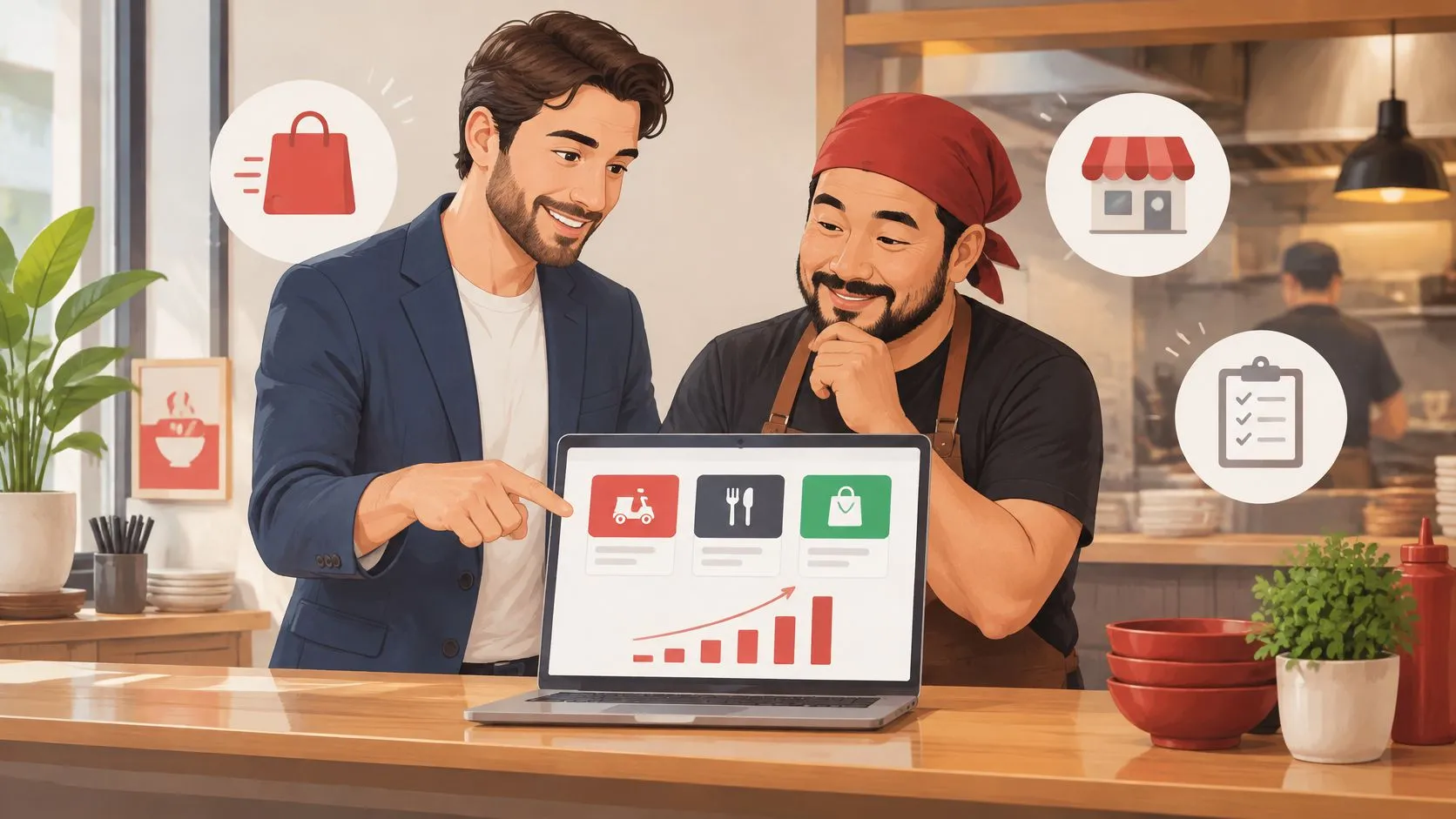
Hiring test: A consultant should explain what staff will do differently, not just present a marketplace sales chart.
The strongest reason to hire is a visibility gap. Delivery already matters to the business, but the owner can’t confidently connect its sales, charges and kitchen workload to a keep, change or stop decision.
Core Services a Delivery Consultant Provides
Use this service comparison to separate a delivery-to-POS engagement from general advice about selling more food.
| Service | What the consultant does | What the restaurant gets |
|---|---|---|
| Menu and modifier mapping | Matches each marketplace menu to POS items and modifiers | Orders that read correctly on the kitchen ticket |
| Order routing into the POS | Connects Uber Eats, DoorDash and Grubhub to Clover or Square | One order queue instead of separate tablets |
| Channel profit review | Calculates contribution per channel after all costs | Clear keep, change or stop decisions by channel |
| Promotion and discount rules | Limits discounts to items and times that still earn margin | Fewer discounts on orders that lose money |
| Peak-hour prep planning | Matches delivery volume to kitchen capacity | Fewer stockouts and late tickets during rush |
| Delivery area and radius review | Checks which service areas and radius settings pay | Service areas matched to real demand |
| Refund and dispute review | Reviews refunds and charges by channel | Costly refund patterns spotted early |
Menu Mapping Comes Before Reliable Routing
Menu hygiene means more than matching item names. The consultant must check modifier groups, required selections, prices and availability against the POS configuration.
Say a marketplace lets a guest choose a size and add an extra ingredient, but the POS stores that choice under a different modifier structure. The mapping must preserve what the customer purchased in a form the kitchen can read. Copying the display name isn’t enough.
A normalized POS schema is a consistent structure for those items and choices. Each marketplace’s menu must translate into that structure before an incoming order can become a usable POS ticket.
Service Deliverables Should Be Concrete
Ask for evidence of the work: a mapping record, an order-routing diagram, a channel review worksheet and named owners for exceptions. A recommendation to improve operations is too broad to approve or verify.
The third-party delivery order engine overview explains the integration approach. Pair that setup review with delivery management best practices so the engagement covers what happens after an order arrives, not just the initial connection.
Before requesting proposals, mark each service as working, missing or unclear. That gives the consultant a defined scope and prevents you from paying for an expansive review when the immediate problem is an unmapped modifier or a broken handoff.
Commission Tiers and What Each Plan Costs
DoorDash’s published U.S. merchant pricing lists Basic delivery at 15%, Plus at 25% and Premier at 30%, with pickup at 6% across the plans, producing the following commission calculations.
| Plan or order type | Commission rate | Commission on $1,000 subtotal |
|---|---|---|
| Basic delivery | 15% | About $150 |
| Plus delivery | 25% | About $250 |
| Premier delivery | 30% | About $300 |
| Pickup orders, all three plans | 6% | About $60 on a pickup subtotal |
These are marketplace commissions, before other contractual adjustments. The pickup calculation applies to pickup sales, not a delivery subtotal.
Higher-priced plans can include a wider delivery radius, DashPass access, lower customer delivery fees and additional marketing support. Those are distribution and customer-acquisition choices, not merely different payment-processing rates.
Judge the Plan by Incremental Orders
A consultant should ask what changes when the restaurant selects a higher tier. Does it reach customers the restaurant wouldn’t otherwise serve, or does it charge more to handle customers who already know the business?
Say a restaurant expands its delivery radius. The additional orders may be worthwhile when the kitchen has spare capacity and the menu travels well. The same expansion may be unattractive when distant orders create preparation pressure, packaging demands or refund exposure.
Compare the plan against the restaurant’s actual order mix:
- Additional demand: Identify orders plausibly attributable to the plan’s reach and benefits.
- Customer substitution: Watch for existing business moving from cheaper channels.
- Fulfillment pressure: Check whether extra orders arrive when the kitchen can accommodate them.
- Retained contribution: Evaluate what remains after the complete cost of serving those orders.
Local Conditions Matter
Delivery coverage is national, but each provider sets coverage, ETA and per-delivery cost, and those vary by market. A consultant should inspect the restaurant’s local settings and actual charges rather than use national assumptions.
Routing DoorDash orders into Clover or Square doesn’t remove marketplace commission. Order handling and marketplace pricing are separate decisions: improving the former doesn’t renegotiate the latter.
Use these ways to negotiate third-party delivery fees to prepare a focused commercial review. Start by finding your current plan, applying its rate to the latest applicable subtotal and reconciling the result against the statement before considering an upgrade.
Checking Whether Each Delivery Order Pays
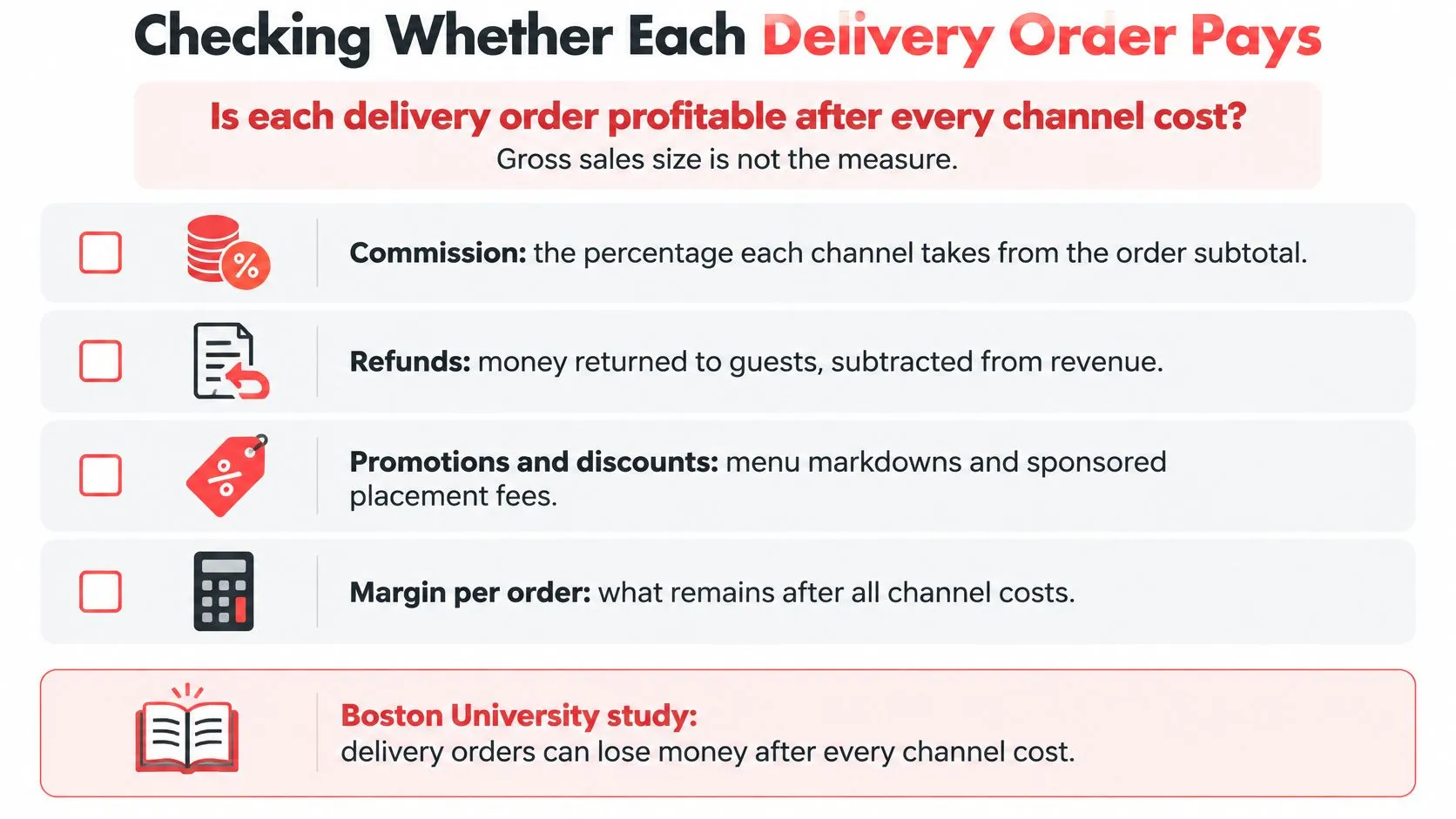
Is each delivery order profitable after every channel cost? That should be the consultant’s first commercial question, not how large the platform sales total has become.
A Boston University study of restaurant delivery platforms estimates that commissions commonly range from 15% to 30% of order value and identifies a break-even commission rate of approximately 16.3% to 17.4% in its empirical setting. That’s not a universal restaurant threshold; it demonstrates why the economics of the individual operation matter.
Build the Order Contribution Checklist
When the commission exceeds the incremental contribution generated by an order, more delivery volume can reduce profitability while revenue rises. To test your own orders, begin with menu revenue and subtract:
- Marketplace commission: Use the charge for that order.
- Payment fees: Include applicable processing costs without double-counting bundled charges.
- Packaging and food: Include what the order requires.
- Incremental labor: Identify added work attributable to delivery.
- Refunds and adjustments: Assign deductions to the relevant orders.
- Promotions and advertising: Include restaurant-funded discounts and attributable campaign spending.
- Delivery-related costs: Include other fulfillment charges and channel-specific handling.
Use the checklist to keep visible charges and less obvious deductions together.
Keep the Comparison Fair
Don’t allocate all existing labor to delivery just because staff handle delivery tickets. Separate work the restaurant would perform anyway from additional handling, exception management and reconciliation caused by the channel.
Also distinguish contribution from total business profit. An order can contribute toward fixed expenses without covering an arbitrary share of every expense, but an order with negative incremental contribution needs a corrective decision.
Faster order handling can remove avoidable work. It can’t make an excessively expensive channel commercially sound by itself.
Review results by channel, store, daypart and order type using a consistent restaurant data analytics approach. Start with a recent order, apply every relevant deduction and inspect what remains, then test whether that order represents the broader mix.
Removing Tablets and Re-Keying From Delivery Orders
When staff copy delivery orders from separate tablets into the POS, mistakes can reach the kitchen: a missing modifier or incorrect item creates extra work and may not match what the guest ordered. The fix is to route orders into the POS rather than rely on careful re-entry.
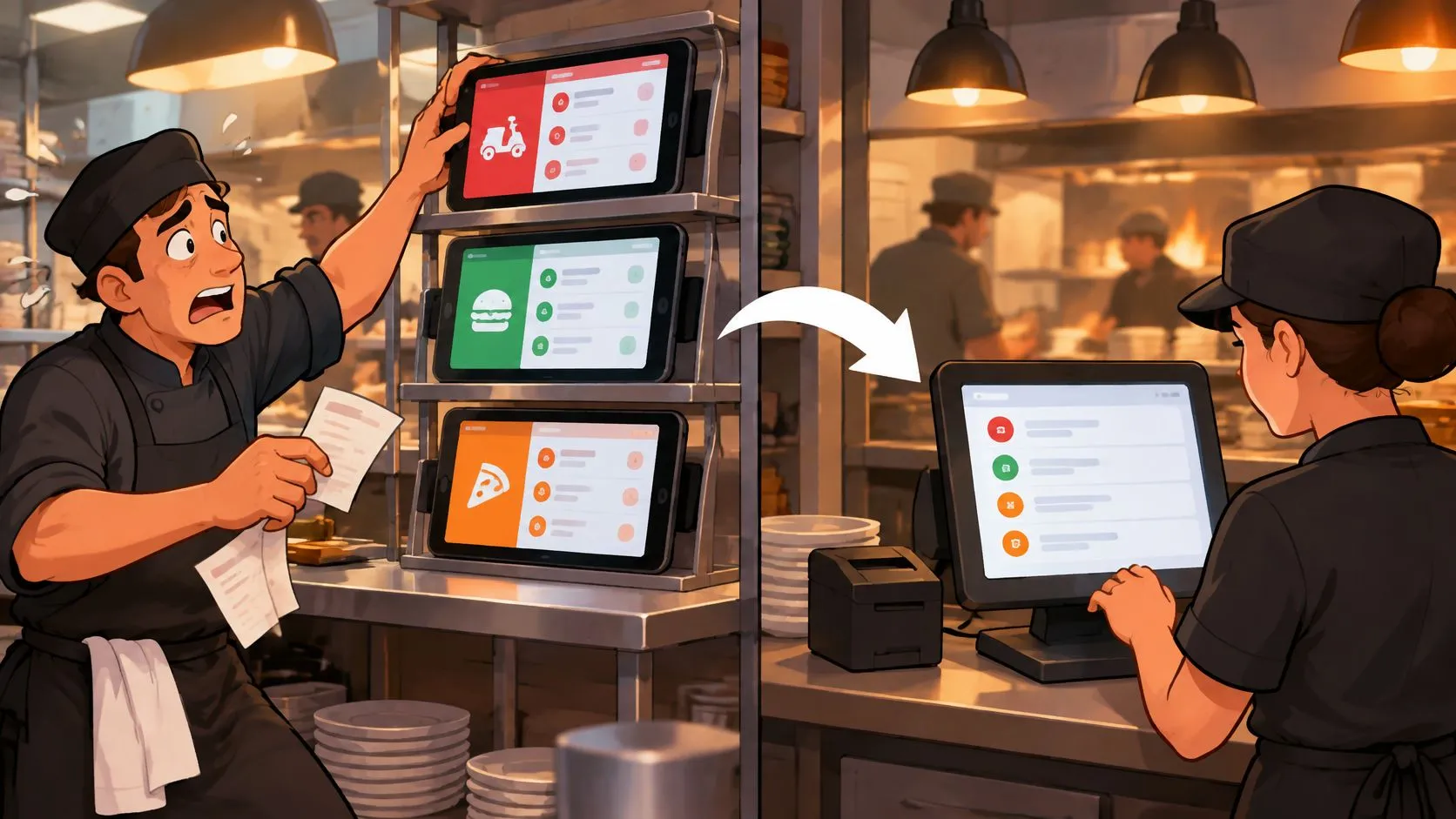
OrderOut routes orders from Uber Eats, DoorDash and Grubhub into supported POS systems such as Clover and Square, so staff can manage orders in one queue instead of re-keying them. Menu items, prices and availability changes made in the POS are pushed to connected delivery marketplaces. Accurate item and modifier setup still matters: routing an order correctly cannot fix a menu that is mapped incorrectly.
For a Clover setup, review OrderOut’s Clover delivery integration. Coffee Talk LLC said OrderOut helped them manage delivery orders better than tablets.
Integration Doesn’t Create Kitchen Capacity
A delivery order can arrive correctly in the POS and still strain the kitchen. A consultant should assess whether each channel brings incremental demand, whether orders contribute after variable costs, and whether the kitchen can handle the workload. Stockouts and preparation bottlenecks can also limit how many orders the restaurant can fulfill.
A busy kitchen may need to limit low-margin promotions during peak periods. When the kitchen has spare capacity, accepting a lower-margin order may make sense if it still adds positive contribution.
The research in Management Science on restaurant delivery platform strategy models how commissions, delivery fees, promotions and uncertain demand affect restaurant and platform decisions. Its practical lesson is that additional visibility or discounted delivery can bring costs and capacity demands that a restaurant needs to account for.
The following video provides more context on order management workflows.
Start With the Actual Order Path
Map the current delivery tablet workflow before changing it. Place a test order and check that its selections appear under the correct POS items and reach the intended kitchen ticket. A successful login alone does not confirm that the order path is working properly.
Clover owners can install OrderOut from the Clover App Market, where it is free to install. Square owners can start through the OrderOut listing in the Square App Marketplace.
When Hiring a Delivery Consultant Pays Off
Hire a consultant when delivery already carries a meaningful share of sales and you can’t see which channels justify their costs. The decision turns on visibility and implementation capacity, not restaurant size alone.
Warning signs include separate tablets at the counter, rush-hour manual entry, refunds nobody reviews by channel and marketplace menus that don’t match the POS. Unpriced promotions are another concern: you shouldn’t have to guess whether an offer is worth keeping.
Compare Outside Help With an Owner-Led Review
| Decision factor | Hire a consultant | Run the review in-house |
|---|---|---|
| Cost visibility | Statements and deductions don’t reconcile clearly | You can trace charges to orders |
| Workflow knowledge | Nobody owns routing and mapping problems | A manager understands the order path |
| Decision capacity | Changes repeatedly stall | You can implement and check changes |
| Scope | Routing and commercial review both need attention | The problem is narrow and identifiable |
An outside specialist can build the contribution model, set promotion limits and review preparation constraints, radius settings and refunds. An owner with a manageable channel setup and time to inspect the records can perform a focused review without outsourcing the entire job.
First deliverable: Ask for a channel-by-channel contribution model before approving discounts or menu changes.
If the recommendation includes changing fulfillment arrangements, compare the responsibilities in in-house versus third-party delivery. Changing who delivers the food also changes which tasks and costs the restaurant must manage.
Don’t buy a broad engagement to solve an undefined concern. Name the missing decision, identify the evidence needed and agree on who will implement the resulting change.
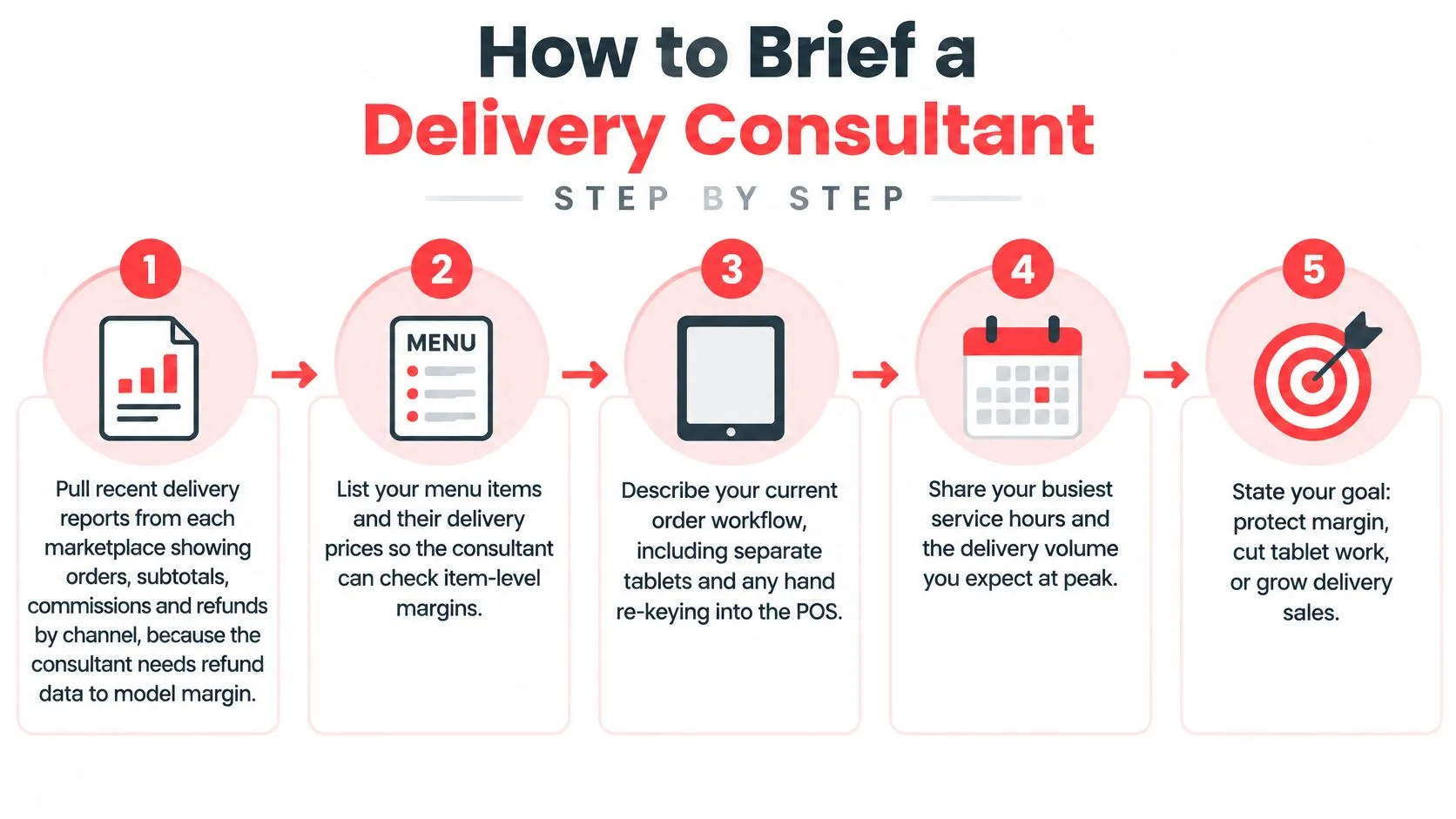
How to Brief a Delivery Consultant Step by Step
Give the consultant a usable operating picture before discussing growth. The brief should make it possible to trace an order from the marketplace listing to the kitchen ticket and then to the channel’s charges.
Use this preparation checklist to organize the handoff.
Prepare the Reports and Access
-
Pull recent marketplace reports. Include orders, subtotals, commissions, refunds and adjustments for matching reporting periods. Sending sales summaries without refund detail prevents the consultant from tracing what the restaurant retained.
-
Inventory the current order path. List the POS, delivery tablets, platform accounts and kitchen ticket destinations, and note where staff type orders again. Include menu items, delivery prices and modifier structures because a workflow review without menu context misses important failure points.
-
Choose the primary goal. Decide whether the priority is better contribution, fewer order-entry errors or additional delivery demand. Give the consultant your busiest service periods and expected workload so a sales-growth recommendation doesn’t ignore production limits.
-
Assign platform access deliberately. Setup requires access to delivery platform logins such as Uber Eats Manager or DoorDash Merchant, so identify who controls access and use platform-supported permissions where available. Our setup usually takes about 5 to 10 minutes, but missing credentials can interrupt the handoff; the delivery-to-POS integration API overview helps clarify the connection’s purpose.
Define the Decisions Before Changes Begin
-
Request a channel contribution model. Have the consultant show the deductions, assumptions and treatment of shared work, not just a final margin label. The common slip is approving discounts before anyone has established what the affected orders contribute.
-
Set a review rhythm and decision owners. Name who can approve promotions, change availability, adjust preparation settings and resolve disputed charges. Agree on how results will be checked, because a recommendation without an accountable operator can remain unimplemented.
-
Confirm Clover or Square competence. Ask the consultant to explain how marketplace items and modifiers map to your actual POS configuration and how they’ll validate a kitchen ticket. Familiarity with delivery apps alone doesn’t establish the ability to diagnose a delivery-to-POS problem.
Finish the brief with acceptance criteria. You should receive an understandable channel recommendation, a record of configuration changes and a clear owner for unresolved exceptions.
Every commercial recommendation should make sense in contribution terms. Every technical recommendation should identify the order-handling problem it changes, rather than promise that connecting software will automatically improve the channel’s economics.
Frequently Asked Questions
Does a Food Delivery Consultant Replace the POS?
No, the POS remains the restaurant’s operational source of truth. The consultant works on marketplace configuration, menu mapping, promotions and channel decisions around that system. If they recommend changing the order path, ask how staff will handle exceptions without creating another competing queue.
Does OrderOut Work With Clover?
Yes, OrderOut routes Uber Eats, DoorDash and Grubhub orders into Clover and also supports Square. It’s free to install on the Clover App Market. Before connecting channels, make sure the marketplace’s sellable items and choices can be matched to the POS menu.
Do I Have to Share Delivery App Logins?
Setup requires access to platform logins such as Uber Eats Manager or DoorDash Merchant. Decide who holds that access, keep ownership with the restaurant and use available account permissions rather than distributing credentials casually. Record which accounts were connected so access remains manageable when responsibilities change.
Start Your Delivery Channel Review Today
A channel’s headline commission does not determine whether its orders are profitable. Start with the channel that costs the most to operate. Review a recent report and a sample of orders, then identify whether the issue is pricing, deductions, order handling or capacity.
Choose a clear action: keep, change or stop. For a change, name the task, such as correcting modifier mapping, narrowing an offer or investigating a recurring refund charge.
Turn the Review Into an Operating Decision
- Reviewing in-house: Assign one person to gather records and another to approve changes.
- Hiring a consultant: Provide the same reports and ask them to state their assumptions.
- Addressing duplicate entry: Test POS routing with representative menu selections before relying on it during service.
Change one thing at a time so you can judge whether it helped. A useful review leaves the owner with clear criteria for which orders to accept, how orders should reach the kitchen and who handles breakdowns.
OrderOut connects delivery orders from Uber Eats, DoorDash and Grubhub to supported POS systems, helping reduce tablet handling and manual re-keying. Setup usually takes about 5 to 10 minutes; have access to marketplace accounts such as Uber Eats Manager or DoorDash Merchant ready. Start onboarding in the OrderOut dashboard.