
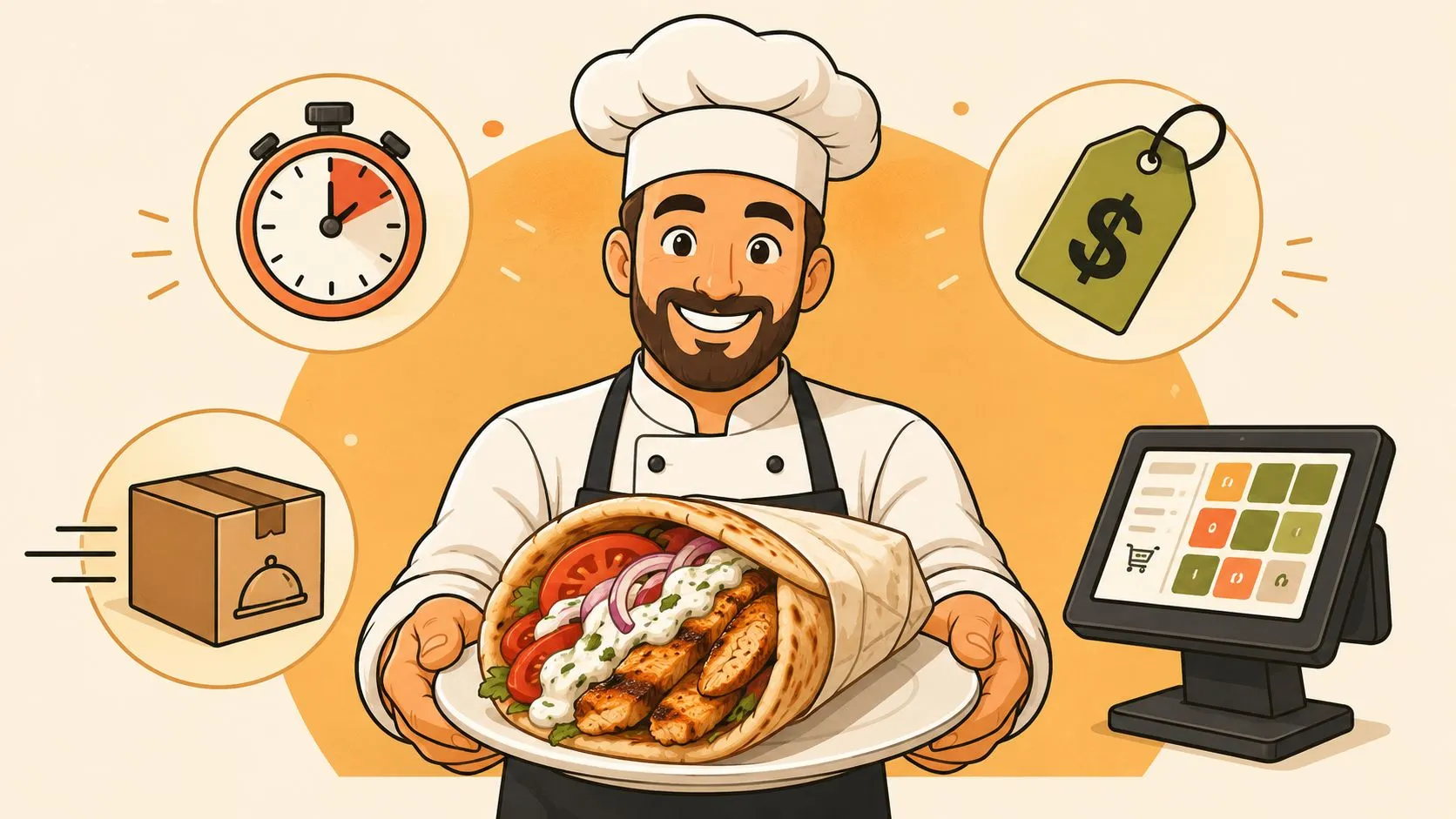
Friday night on the line tells you everything about chicken and gyro. Tickets stack up, the chicken is moving, the pita is warming, and the core problem isn’t the recipe, it’s whether the kitchen can keep one clean workflow from marinade to hold to delivery without a modifier mistake on the screen.
A gyro is Greek roasted meat served in pita, usually with tomato, onion, and tzatziki, and the meat is commonly lamb, beef, pork, or chicken roasted on a vertical skewer and shaved as it cooks, according to Britannica’s gyro entry. That standard build matters because chicken isn’t an outlier here, it’s one of the core gyro proteins. In Greek and American menu traffic, the format has long since moved from niche to mainstream, with Greco Truly Greek noting that gyros were first introduced to Americans in 1965 by George Apostolou at the Parkview Restaurant in Chicago, Illinois, and that Americans now eat over 300,000 gyros daily, or more than 109 million per year if sustained evenly across the calendar, from Greco Truly Greek’s history page.
For operators, the right question isn’t whether chicken and gyro belongs on the menu. It’s whether you’re running it like a special or like a system. The menu item has enough history, volume, and build consistency to justify tighter prep sheets, cleaner delivery packaging, and a POS workflow that doesn’t force the line to interpret every order from scratch.
Why Chicken and Gyro Deserves Its Own Playbook
The first thing that breaks on a busy gyro line is usually the handoff between the ticket, the cook, and the person assembling the wrap. When the same item shows up through dine-in, delivery, and late-night takeout, a chicken gyro stops behaving like a single recipe and starts acting like a product line that has to survive rush pressure.
That product line has to be built around a defined format. Gyros are a standard menu item, and chicken fits that format cleanly. The history gives the right frame, this is a long-running quick-service build that adapted into the U.S. market and kept expanding. The same source’s note that Americans eat over 300,000 gyros daily tells you the demand side without extra spin. Greco Truly Greek
What that means on the line
A chicken gyro needs standards, not a discretionary assembly. If one location free-pours tzatziki, another stuffs fries inside the pita, and a third uses a looser wrap, the guest sees three different experiences under one name. Quality drifts, and ticket times get messy.
Practical rule: if the guest can’t predict the build, the kitchen can’t predict the ticket.
Chicken also works because it sits inside one of the largest protein categories in the U.S. food system. The National Chicken Council says the U.S. chicken industry produced over 63 billion pounds of liveweight chicken in 2025, which helps explain why chicken shows up everywhere from lunch counters to late-night delivery menus, including gyro-style wraps and chicken gyros. That scale is also why operators can standardize it, source it consistently, and run it through a tight prep flow without treating it like a one-off special. National Chicken Council statistics
The operational move is straightforward. Treat chicken and gyro as a system. Once the build, prep window, portion, and channel rules are locked, the item is easier to staff, price, and deliver. That is also where define prep and cook standards becomes part of the job, because the line needs a shared playbook before the rush starts.
Marinade, Cook, and Hold Workflow for Chicken Gyro
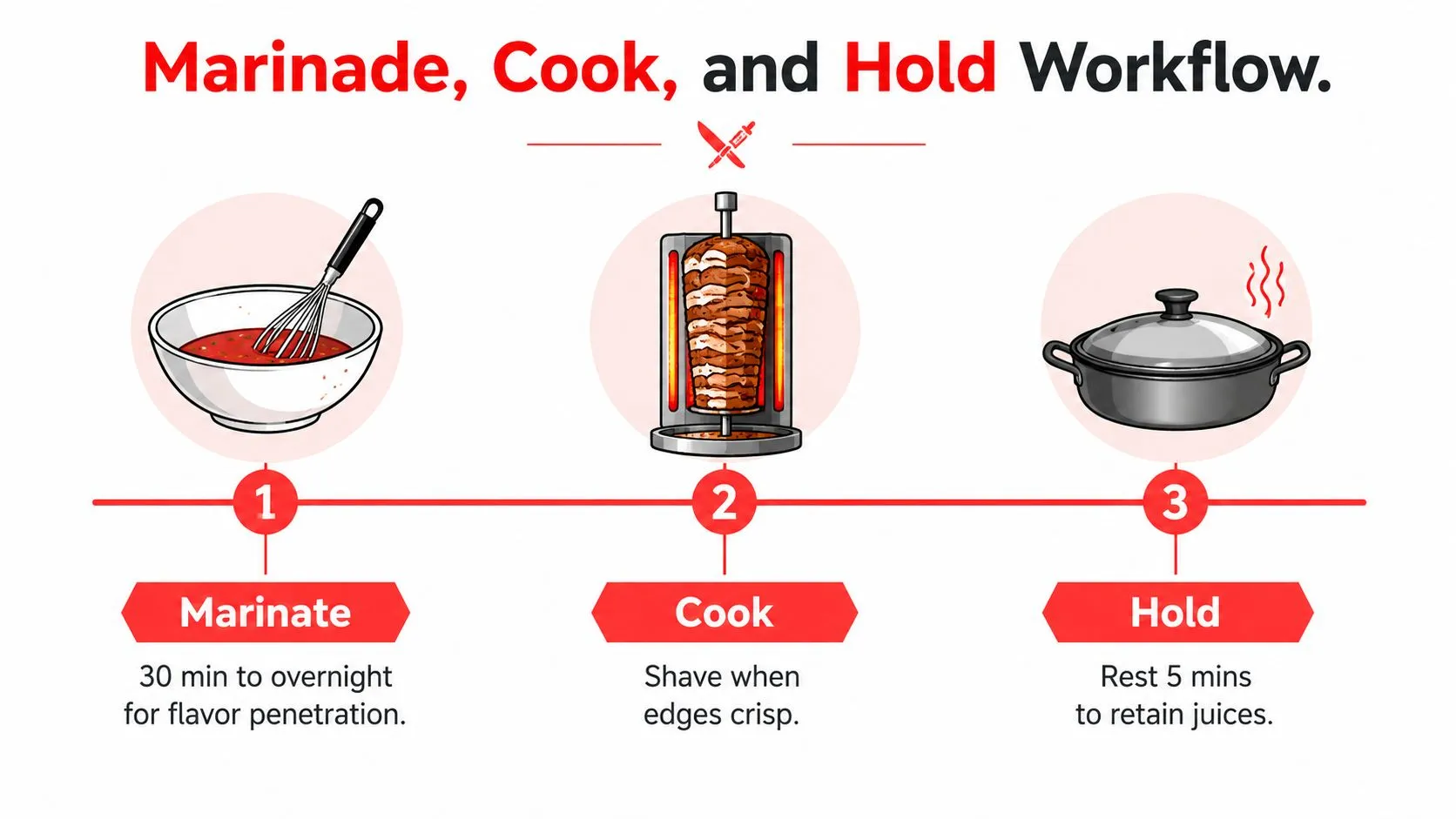
Chicken gyro quality is won or lost in the prep block. Published methods in the brief cluster around 30 minutes to overnight, with some calling for 2 to 24 hours and warning against pushing past 24 to 36 hours because yogurt-based marinades can start to break down the chicken’s texture, according to the guidance from Half Baked Harvest. On a busy line, that means marination has a window, and the window needs a start time, an end time, and a named owner.
Build the prep block
Run it the same way every day. Marinate in cold storage, never on a pass or in a warm prep room. Cook to an internal 165°F, which is the endpoint reflected across the published methods in the brief, and keep the schedule tight when the line gets slammed. Yogurt-heavy marinades soften the meat if they sit too long, so extra time does not buy better texture.
A useful oven benchmark comes from Mia Kouppa’s authentic Greek chicken gyros method, which calls for a minimum 2-hour marinade and a maximum 24-hour marinade, then baking at 400°F for 1 to 1½ hours with the top loosely covered with foil after about 40 minutes. That is not a restaurant batch spec, but it gives operators a clear control point. Covered finishing helps manage moisture and color, and the time window shows why this item needs planned prep, not last-minute improvisation.
For faster prep, the same general benchmark family in the brief points to 400 to 425°F for about 15 to 24 minutes in sheet-pan or air-fry methods, or about 6 to 8 minutes in a hot skillet, with the product done at 165°F internal. That range matters because it tells the kitchen to write one method and train to it, rather than letting three people build their own version of done.
The failure points are usually simple. Overmarination makes the meat soft. Under-cooking leaves you with carryover anxiety. Overcooking kills the texture that makes chicken gyros sell.
For a kitchen manager, the hold step matters as much as the cook step. A commercial foodservice spec sheet for stacked, rotisserie-style chicken gyro cone prep says the cone must cook continuously at full heat from loading until fully carved, and the finished meat must be held at 165°F or above in a steam cabinet until service. Any remaining meat at day’s end has to be fully cooked and carved, so temperature control and end-of-day inventory become the two control points that shape yield and food safety. Attribytes foodservice spec sheet
The prep sheet should be plain. Marinate cold. Cook to temp. Hold hot. Carve what you need. Cool the rest by policy, not by guesswork.
A quick install note for operators
If this item is already working in your kitchen and you are trying to cut the ticket chaos around it, the operational fix usually sits in the ordering layer. For Clover users, the installation path starts at the OrderOut listing in the Clover App Market, where the order flow can be set up to land more cleanly on the POS.
For the prep side, define prep and cook standards before the rush starts. That keeps the line working from one shared method, which is what chicken gyro service needs when the board fills up and everyone is moving fast.
Portion Sizing, Yield, and Food Cost
Chicken gyro pricing only works when the portion is fixed first. The nutrition listings in the brief show why. One grilled chicken gyro is listed at 530 calories with 28g of protein, 14g of fat, and 650mg of sodium per serving, another chicken gyro listing shows 555 calories with 39g of protein and 20g of fat, and a separate chicken gyro variant reports 430 calories. Those numbers come from different menu builds, which means the same name can hide major changes in bread, sauce, and meat quantity. That is the planning problem.
Use the range to set the spec
The protein spread gives you the target. If one version lands at 28g of protein and another at 39g, the chicken load, pita size, and sauce amount are not the same. Operators should set a target finished weight and portion the chicken to that spec every time, then keep the rest of the build steady around it.
Gyros are a defined format, and that makes cost control manageable. Souvlaki Authentique’s gyro description describes a portable wrap with seasoned meat, tzatziki, sliced tomatoes, chopped onions, and sometimes French fries folded inside the pita before serving. Your cost stack stays inside a small group of repeatable parts, which is far easier to manage than a sprawling ingredient list. Tight specs keep the plate predictable. Loose specs let food cost drift.
| Listing Source | Calories | Protein | Fat | Sodium |
|---|---|---|---|---|
| Grilled chicken gyro listing | 530 | 28g | 14g | 650mg |
| Chicken gyro listing | 555 | 39g | 20g | not stated |
| Chicken gyro variant | 430 | not stated | not stated | not stated |
Once the inputs are fixed, the calculator work is straightforward. Set a raw chicken target that produces the cooked portion you want, then layer in pita, tzatziki, tomato, onion, and any fries-in-pita version only if your concept supports it. The point is to calculate from the serving spec, not from whatever the cook happens to carve that day.
If you need a cleaner way to build that math into your workflow, keep your internal costing sheet close to a menu management discipline. A practical starting point is OrderOut’s food cost percent guide, which is useful when you are aligning portion control with menu pricing.
Practical rule: a chicken gyro stays margin-friendly only when the portion is locked. If it rides on instinct, the calculator will not save you.
Menu Engineering Across Delivery and POS
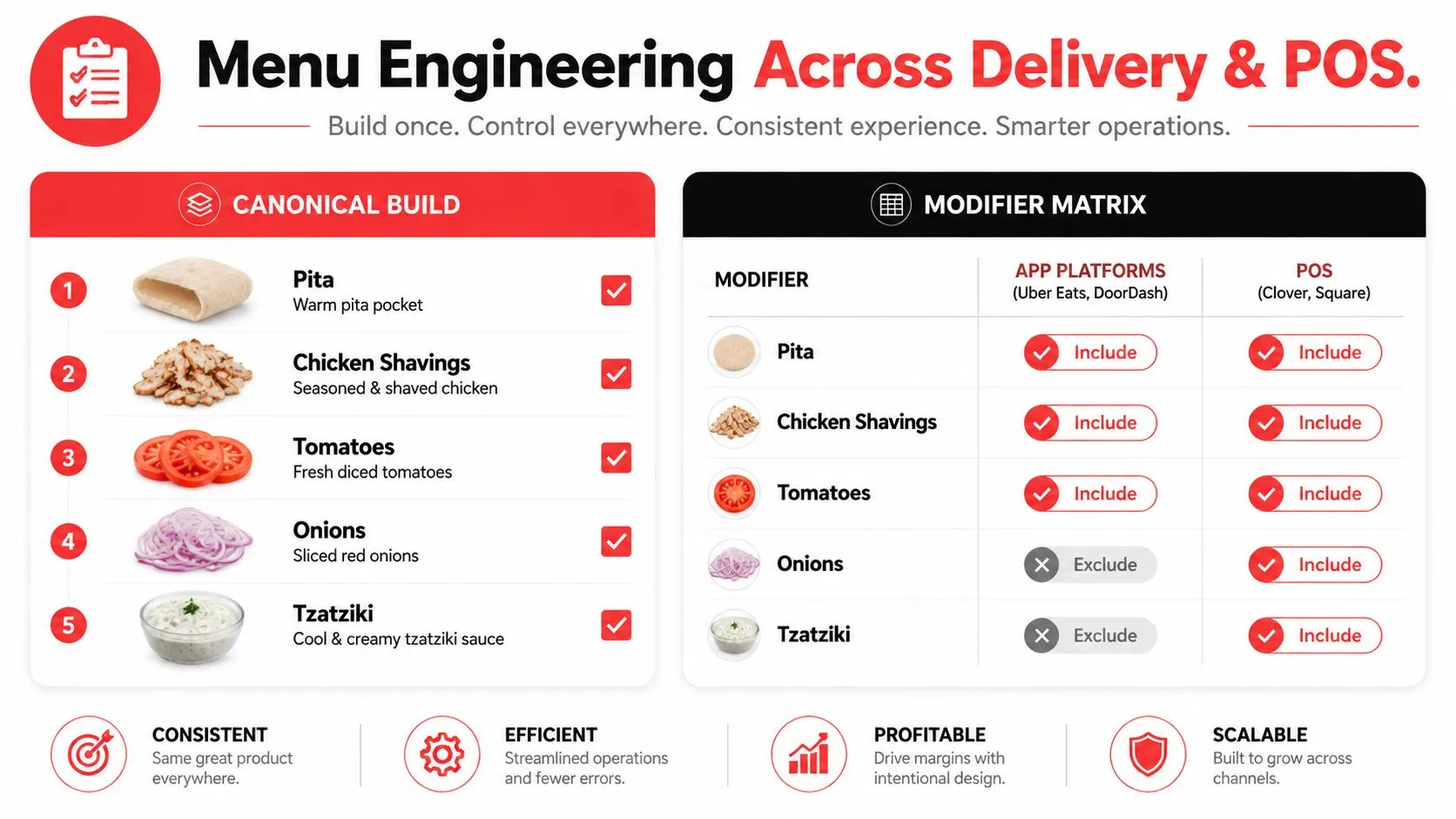
A busy line needs a chicken and gyro menu that behaves the same way every time the ticket prints. Build it around a canonical spec, meat, pita, tzatziki, tomato, onion, and a defined fries option, then map those choices into a fixed modifier matrix. That structure keeps prep, pickup, and delivery aligned without forcing the crew to interpret each order from scratch.
The point is control at the menu level. If the item lives as a loose sandwich in the POS, the line inherits every small variation as a judgment call. If it lives as a standardized build, the kitchen can hold the same portion logic across channels and keep the ticket readable for staff and drivers alike.
Keep the matrix small
A clean chicken and gyro setup usually needs only a few choice points:
- Protein choice: chicken or the house alternative, if you offer one.
- Sauce level: standard tzatziki, light sauce, or sauce on the side.
- Vegetable toggles: tomato on or off, onion on or off.
- Fries decision: inside the pita, on the side, or excluded.
- Packaging version: dine-in wrap, pickup wrap, delivery pack.
That kind of structure matters because every free-text field on a marketplace menu becomes a manual judgment on the line. If the app says “extra tzatziki, heavy onion, no tomato, add fries, sauce separate,” but the kitchen only sees a loose note, the ticket slows down and the wrong build goes out. The more normalized the menu schema, the less interpretation your crew has to do.
Practical rule: the menu should describe the same build the printer can produce.
Delivery apps and POS also need to speak the same language. OrderOut maps marketplace menus into a normalized POS schema, which keeps a chicken gyro modifier set consistent when orders move from Uber Eats, DoorDash, or Grubhub into Clover or Square. The broader OrderOut third-party order engine hub explains the channel-to-POS structure, and the Grubhub to Clover engine cell shows one clean example of that mapping in practice.
The internal housekeeping piece belongs with your managers, too. A tighter menu means fewer exceptions, cleaner routing, and fewer last-minute corrections on the line. For a more detailed operator view, OrderOut’s restaurant menu management software guide is useful for keeping the build stable across platforms, and pricing for operators should sit beside it when you review how the item is set up for channel economics.
Packaging, Pricing, and Delivery Experience
The delivery version of a chicken gyro fails when the pita absorbs steam and the tzatziki leaks into the wrap. That’s not a recipe problem, it’s a packaging problem. The fix starts with separating wet components, keeping the bread structurally stable, and pricing the menu item for the channel instead of pretending all orders behave the same.
Build for travel, not just the pass
Use small, leak-proof cups for tzatziki and juicy toppings when the order has to travel. Keep tomatoes from sitting directly against the bread if the wrap will spend time in a courier bag. A rigid, foil-lined container helps the food hold shape and reduces sogginess, which is why the delivery build matters so much more than the home-style version of the item. The brief also points out an operational gap in recipe content from RecipeTin Eats, home recipes rarely address line-rush holding or how long cooked gyro meat can sit on a hot line before quality and safety degrade. That gap is exactly what operators have to solve.
A simple packaging stack usually works better than an overcomplicated one.
- Separate wet items: tzatziki and tomatoes go in their own containers when the route is longer.
- Protect the bread: use a rigid container so the pita doesn’t compress under the bag weight.
- Vent the box correctly: keep steam from condensing back into the wrap.
- Label the channel: pickup, dine-in, and delivery should not look identical in the kitchen.
For channel pricing, use a base dine-in price, a small pickup adjustment if your market supports it, and a higher delivery price that absorbs packaging and marketplace friction without pushing the item outside the local chicken gyro band. The exact number belongs on your own pricing sheet, but the method is the same. If you need a practical pricing reference for the operator side, pricing for operators is a useful benchmark for how other restaurant teams think about channel-specific pricing structure.
Don’t let the box fight the food
A gyro that arrives dry on the top and soaked on the bottom has already lost the repeat order. That’s why the best delivery version is usually the one with the fewest loose, wet, and compressible parts on the main build. Once you know which packaging holds shape, you can standardize it in the POS and stop improvising at handoff.
For broader delivery workflow discipline, OrderOut’s delivery management best practices is a good companion read when you’re tightening how the item travels from the kitchen to the guest.
Wiring Chicken and Gyro Orders Into One POS
When chicken gyro orders come in through Uber Eats, DoorDash, and Grubhub, the kitchen can get stuck with extra tablets or manual re-entry. That is usually where wrong sauces, missed onions, and late fire times start showing up. Routing those tickets into the same POS queue your staff already uses keeps Clover or Square as the source of truth and cuts down on handoffs.
Keep the tickets on one rail
OrderOut routes third-party orders into the POS instead of making staff bounce between screens. The kitchen sees one ticket flow rather than three disconnected systems. That matters for chicken and gyro because the item usually carries multiple modifiers, and every time a cashier or line cook has to re-enter those choices, the chance of a wrong build goes up.
For Clover operators, OrderOut is free to install on the Clover App Market. For Square operators, the matching marketplace path is the OrderOut app in the Square App Marketplace. Either way, the operational gain is the same, marketplace menus are mapped to a normalized POS schema so the chicken gyro spec you built earlier reaches the kitchen with much less translation work.
That normalization does real work on the line. A “tzatziki on the side” note should land as a clean modifier, not as free text that somebody has to interpret during a rush. A “no onion” ticket should stay no onion from marketplace to bump screen. When the POS and delivery apps are aligned, the crew moves faster and spends less time checking each other’s work.
Practical rule: one order rail beats three tablets every time the line gets busy.
OrderOut’s connect multiple delivery apps to one POS is a useful operational reference if you are mapping several marketplace channels into Clover or Square. For teams that need the broader setup behind that workflow, franchise development also depends on the same kind of order discipline when a concept has to repeat cleanly across locations.
The point is fewer wrong-sauce tickets, cleaner line flow, and staff who can stay on the grill instead of splitting attention between a phone, a tablet, and the register.
Rollout Checklist and Next Steps for Operators
The cleanest rollout starts with the chicken spec, not the software. Lock the marinade window, the cook temp, the hold rule, and the exact wrap build. Then build the delivery version, because the version that leaves the building is the version your guests remember.
A simple launch order
- Lock the chicken gyro spec. Decide the protein portion, sauce amount, and whether fries live inside the pita.
- Set the modifier matrix for all channels. Keep Uber Eats, DoorDash, Grubhub, and in-house ordering aligned.
- Build packaging SKUs for delivery. Use containers that protect the wrap and separate wet items.
- Price each channel separately. Don’t let delivery and pickup eat the same margin assumptions.
- Turn on POS integration. Make sure the ticket reaches Clover or Square without re-entry.
If you’re operating across locations or helping a concept standardize for growth, the same discipline also shows up in franchise development planning. A chicken gyro only scales well when the spec is stable enough to repeat in more than one kitchen.
At this point, don’t keep the item trapped in spreadsheet mode. If you’re on Clover, install the delivery workflow from the marketplace listing and test a few live orders. If you’re on Square, do the same from the Square app marketplace and watch how the modifiers land on the ticket.
OrderOut connects Uber Eats, DoorDash, and Grubhub directly into your POS so chicken and gyro orders land in one clean rail instead of bouncing across tablets and manual re-entry. If you’re ready to tighten the build, protect the delivery experience, and give your line a simpler workflow, visit OrderOut and start onboarding from there.