
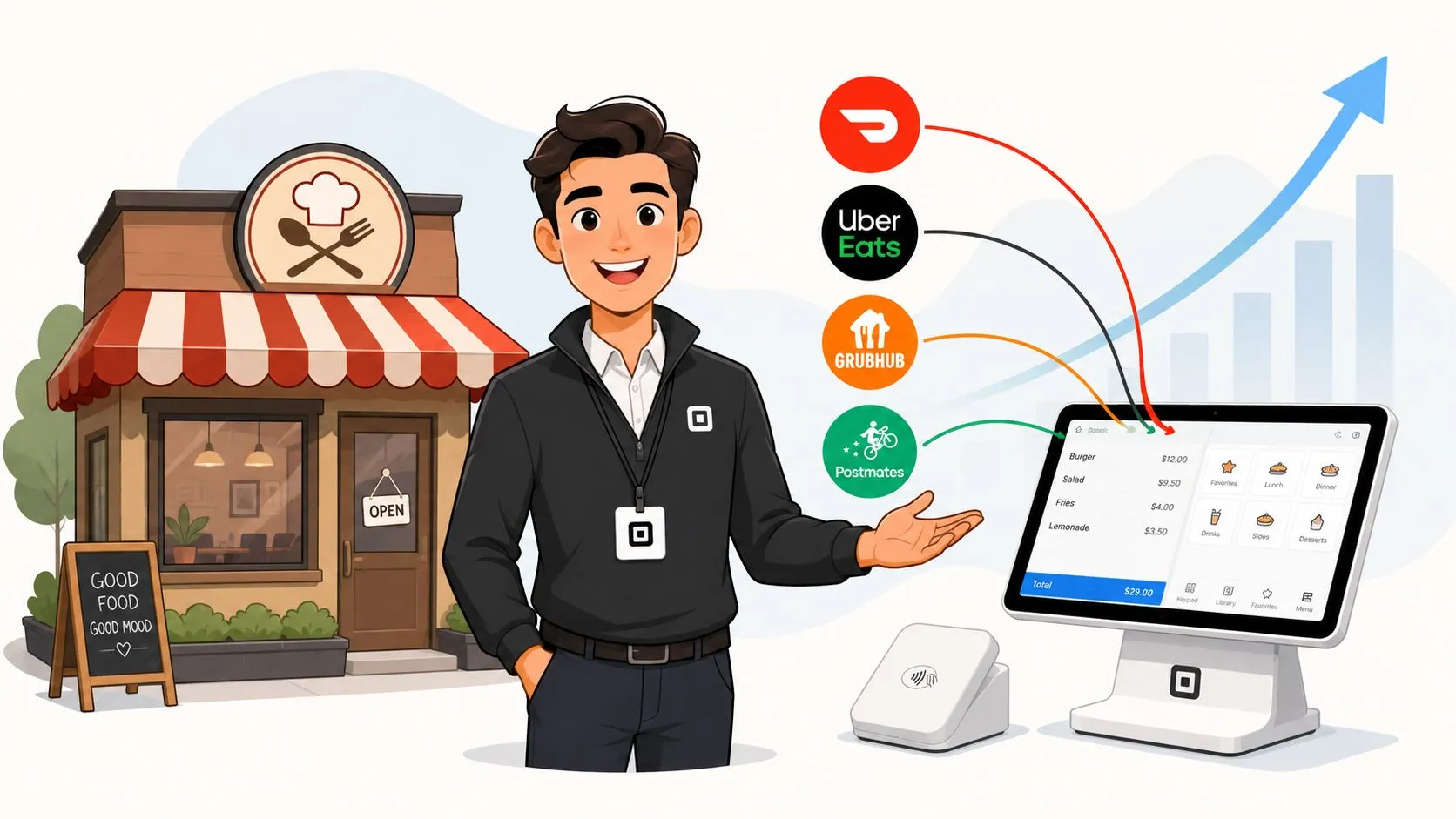
A Square reseller is a certified partner who sells, implements, and supports Square POS and payments for merchants. It’s a major opportunity because Square is the U.S. market leader in point-of-sale systems, serving 4 million sellers and processing $228 billion in annual transactions, and food and drink sellers make up 26% of its gross payment volume.
Most partners still approach this market the wrong way. They chase hardware deals, fight over processing, and end up with thin margins. The smarter play is to use Square as the core system, then build a restaurant tech consultancy around the operational problems restaurants pay to solve.
That means less time talking about terminals and more time solving delivery chaos, phone-order bottlenecks, and disconnected ordering workflows. If you’re trying to build a durable Square reseller business, that’s where the true value sits.
What Is a Square Reseller and Why Is It a Major Opportunity
A Square reseller who only sells terminals is building a weak business. A Square reseller who fixes restaurant operations can build a sticky, higher-margin consultancy.
At a basic level, a Square reseller sells, configures, and supports Square for merchants. In restaurants, that definition is too narrow. The profitable version of the role is broader: you use Square as the system of record, then wrap services around the issues that disrupt service, drain labor, and frustrate operators.
That distinction matters. Restaurants replace hardware. They keep partners who reduce mistakes, save staff time, and make ordering easier to manage during a live shift.
Where the margin actually comes from
Margin comes from owning the workflow around Square, not from the POS box itself.
A restaurant will pay for outcomes. If you stop staff from re-entering marketplace orders, clean up menu sync problems, and reduce the phone-order pileup during peak hours, you are no longer a commodity reseller. You are the person keeping revenue channels under control.
That is the model to copy:
- Fix delivery order chaos: Connect third-party ordering channels so staff stop juggling tablets and retyping tickets.
- Clean up menu mismatches: Keep item names, modifiers, prices, and availability aligned across systems.
- Reduce front-of-house overload: Route phone and pickup ordering into a process that does not depend on whoever happens to answer during the rush.
- Add ongoing support: Stay involved after launch, because restaurants judge value in service, not in setup day.
The strongest partners package these problems into a monthly service offer. That creates recurring revenue, better retention, and a much stronger position than competing on hardware quotes.
If you want a model built for that approach, study the Square reseller program for restaurant technology partners. The opportunity is bigger than POS resale. The money is in solving the operational mess around it.
The Square Partner Ecosystem Explained
Square’s ecosystem has layers. If you don’t understand where you fit, you’ll price your services wrong and undersell your value.
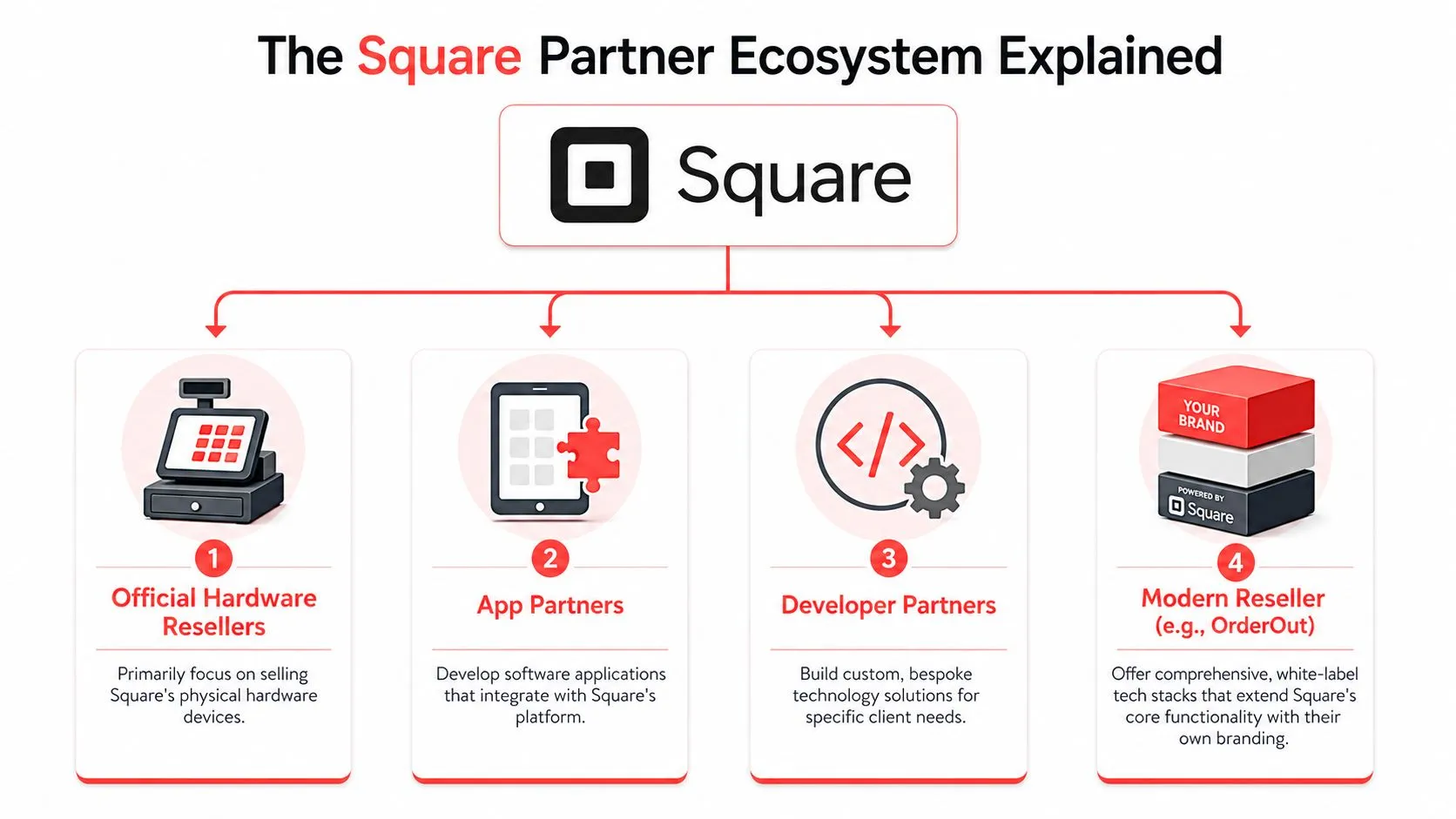
At the base level, you have partners who move hardware and help merchants get live. That’s useful, but it’s not enough for restaurant accounts with delivery, menu, and multi-channel ordering complexity.
Higher up, you have implementation and integration partners who can extend Square beyond out-of-the-box usage. That’s where the business gets more defensible.
The four practical partner lanes
| Partner type | What they usually do | Business reality |
|---|---|---|
| Hardware reseller | Sells POS devices and basic setup | Easier sale, weaker moat |
| App partner | Connects software into Square | Stronger recurring value |
| Developer partner | Builds custom workflows and integrations | Higher complexity, higher stickiness |
| Modern reseller | Bundles POS, ordering, delivery, and support under one offer | Best fit for restaurant consulting |
The important shift is this: restaurants don’t care what Square calls the partner category. They care whether someone can make the stack work in live service.
Square has also expanded its partner model to support more custom tooling and connected workflows. The company describes its ecosystem as enabling partners to build business-specific solutions in its Square Solutions Partner Program announcement. That matters because restaurants rarely operate on a clean, simple setup.
Why modern resellers win
A modern Square reseller acts less like a dealer and more like an operator-facing consultant. That means:
- Diagnosing workflow gaps: Not just quoting hardware
- Connecting systems: POS, marketplace orders, online ordering, and phone ordering
- Owning implementation: Menu mapping, testing, training, and support
- Selling outcomes: Cleaner service, fewer mistakes, less staff distraction
If you want a deeper breakdown of how the ecosystem is evolving, review this guide to the Square partner program. It shows the path forward. Move up the stack or get stuck competing on commodity deals.
Why Restaurants Need More Than Just a POS
Restaurants don’t struggle because they lack a POS. They struggle because too much of the work around the POS is still manual.
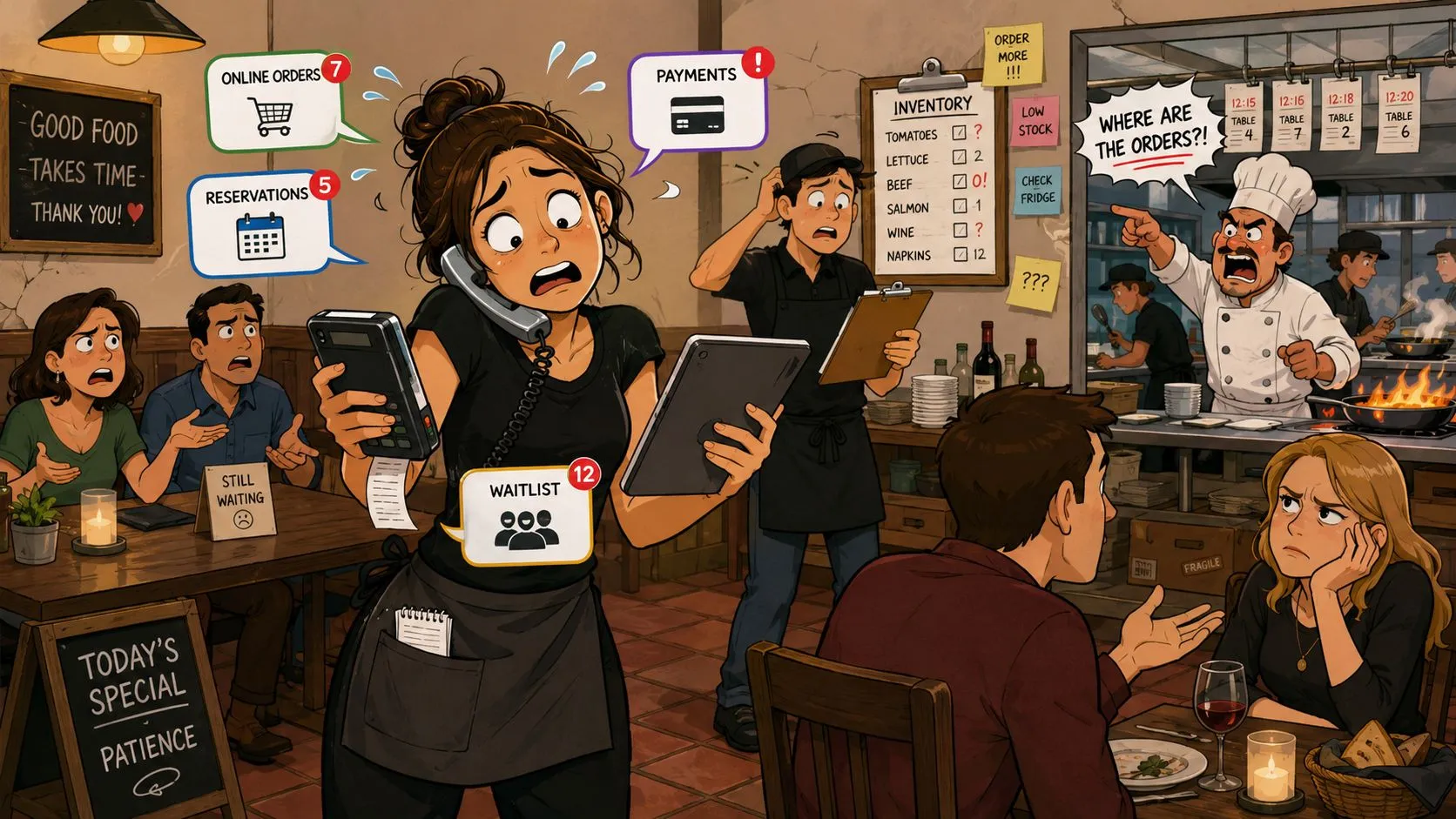
A typical restaurant using Square might also run Uber Eats, DoorDash, and Grubhub. If those orders don’t flow straight into the POS, someone has to watch tablets, re-key tickets, check modifiers, and hope nothing gets missed. During a rush, that setup falls apart.
The cost isn’t theoretical. According to OrderOut’s Square integration analysis, manual double-entry errors in restaurant delivery orders cost businesses 5–10% in lost revenue annually due to incorrect charges and wasted food, and that loss is eliminated when orders are injected straight into the POS.
The chaos shows up in three places
First, the host stand or cashier becomes an air traffic controller. They’re juggling in-store guests, ringing phones, and delivery tablets at the same time.
Second, the kitchen gets inconsistent tickets. Missing modifiers and duplicate entries create avoidable remakes.
Third, the manager becomes the cleanup crew. Instead of coaching staff or managing labor, they’re fixing order flow problems.
Restaurants don’t need another device on the counter. They need fewer failure points between the customer and the kitchen.
For partners, that’s the opening. You’re not selling software for the sake of software. You’re removing routine operational friction that staff deal with every shift.
What operators actually respond to
Operators buy when you talk in plain business terms:
- Less re-keying
- Fewer order mistakes
- A cleaner line of communication from marketplace to kitchen
- One system staff can trust
If you work with catering-heavy restaurants, broader operational discipline matters too. This guide with expert advice for boosting catering revenue is useful because it focuses on menu structure and sales execution, which often expose the same workflow weaknesses that break delivery operations.
For a technical baseline, this overview of an integrated POS system is worth reviewing. It frames the issue correctly. The POS isn’t the whole system anymore. It’s the hub, and everything around it has to connect cleanly.
Your White-Label Restaurant Tech Toolkit
A profitable Square reseller does not win by pushing terminals. It wins by fixing the operational mess that keeps restaurants stuck in reactive mode.
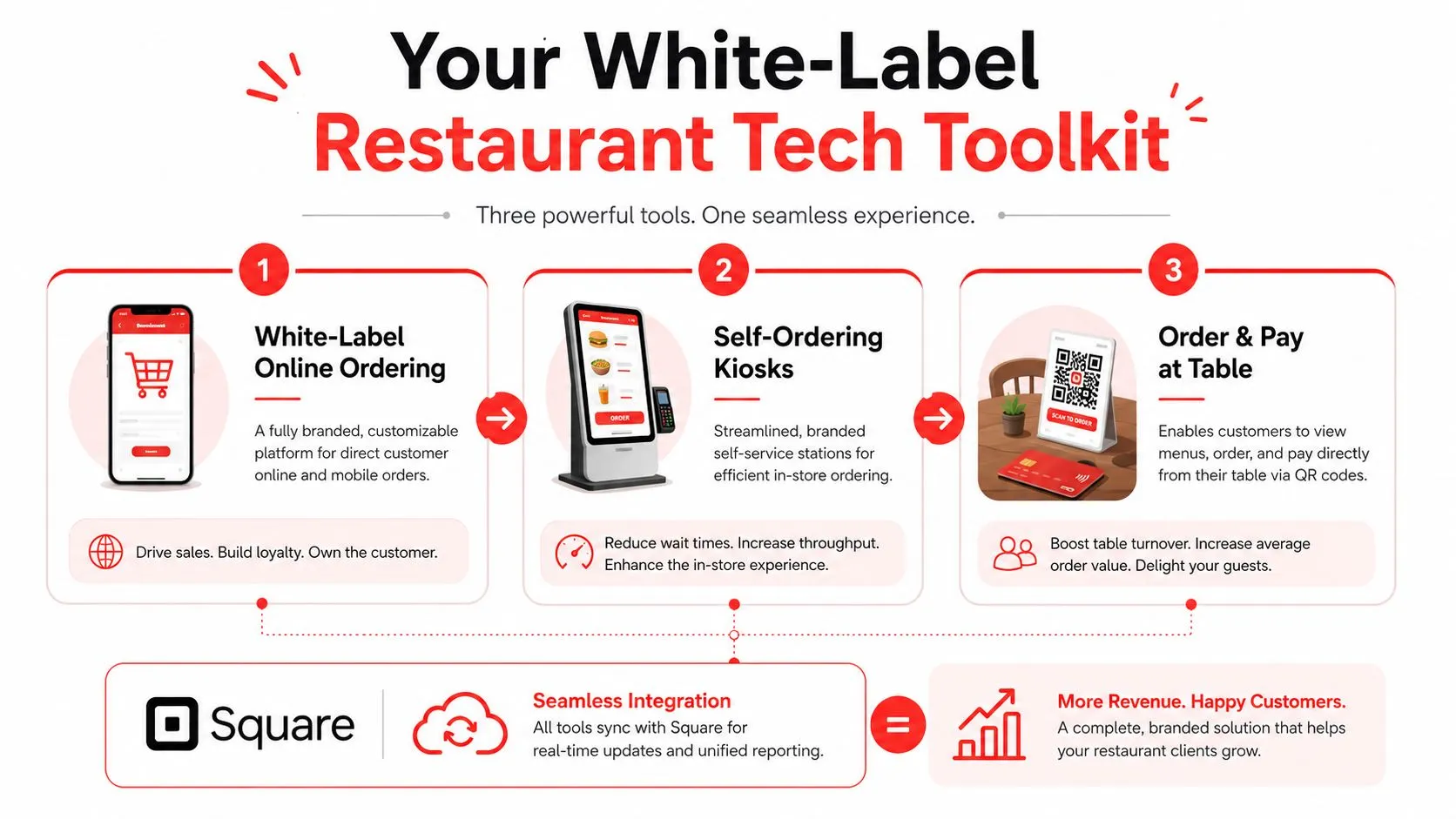
Your toolkit should cover three jobs. Route third-party delivery orders into Square correctly. Give the restaurant a direct ordering channel it owns. Capture phone orders without pulling staff off the floor. That mix turns you from a hardware seller into a revenue and operations partner.
Square has already made room for partners to build this kind of business. In its partner ecosystem announcement, Square says its Solutions Partner ecosystem supports bespoke integrations that automate data flow between delivery apps and the POS, reducing manual entry errors.
Start with delivery POS integration
Start here because the pain is obvious and the return is easy to explain. Uber Eats, DoorDash, and Grubhub orders should enter Square automatically, with the right modifiers, menu items, and routing, so staff work from one system.
That only happens if menu data is structured correctly. Sloppy categories, bad modifier groups, and inconsistent naming create bad order injection. If you want fewer remakes and cleaner kitchen tickets, fix menu architecture first.
A practical route is using OrderOut’s Square delivery integration for partners, which handles third-party delivery injection into POS workflows and keeps Square as the operating source of truth. Partners can also review the broader third-party order engine for restaurant delivery POS integration and a channel-specific example like Uber Eats to Square delivery order injection.
Margin starts to improve. You are not billing for a connector alone. You are billing for menu mapping, channel setup, testing, launch, and ongoing support.
Add direct ordering and phone capture
Once order injection is stable, sell control.
Restaurants need a direct digital channel that protects margin and gives them customer ownership. They also need a reliable way to capture phone orders during peak periods, because missed calls still mean lost revenue.
Your stack should include:
- Commission-free online ordering: A branded ordering page the restaurant controls instead of a marketplace relationship it rents.
- AI phone ordering: Calls get answered, orders get captured, and staff stay focused on service and production.
- Branded partner packaging: The client sees one clear system under your brand, not a collection of unrelated apps.
If you are building that service layer under your own consultancy, agency, or ISO brand, this guide to white-label mobile applications is worth reviewing. It shows how to package customer-facing tools without building every component from scratch. The same logic applies to intake and onboarding workflows. A form builder with white label options can help you standardize lead capture, client setup, and support requests under your own brand.
Sell the result in operator language. “We stop staff from retyping delivery orders” is stronger than “we provide middleware.”
For the install conversation, Square sellers can point prospects to the OrderOut app in the Square App Marketplace. That gives you a clean way to show how the workflow fits inside a live Square environment.
The best reseller toolkit solves order flow, protects margin, and gives the operator fewer systems to babysit. That is a better business than living on one-time hardware commissions.
How to Become an Indispensable Square Reseller
The jump from vendor to indispensable partner happens when you stop leading with product and start leading with diagnosis.
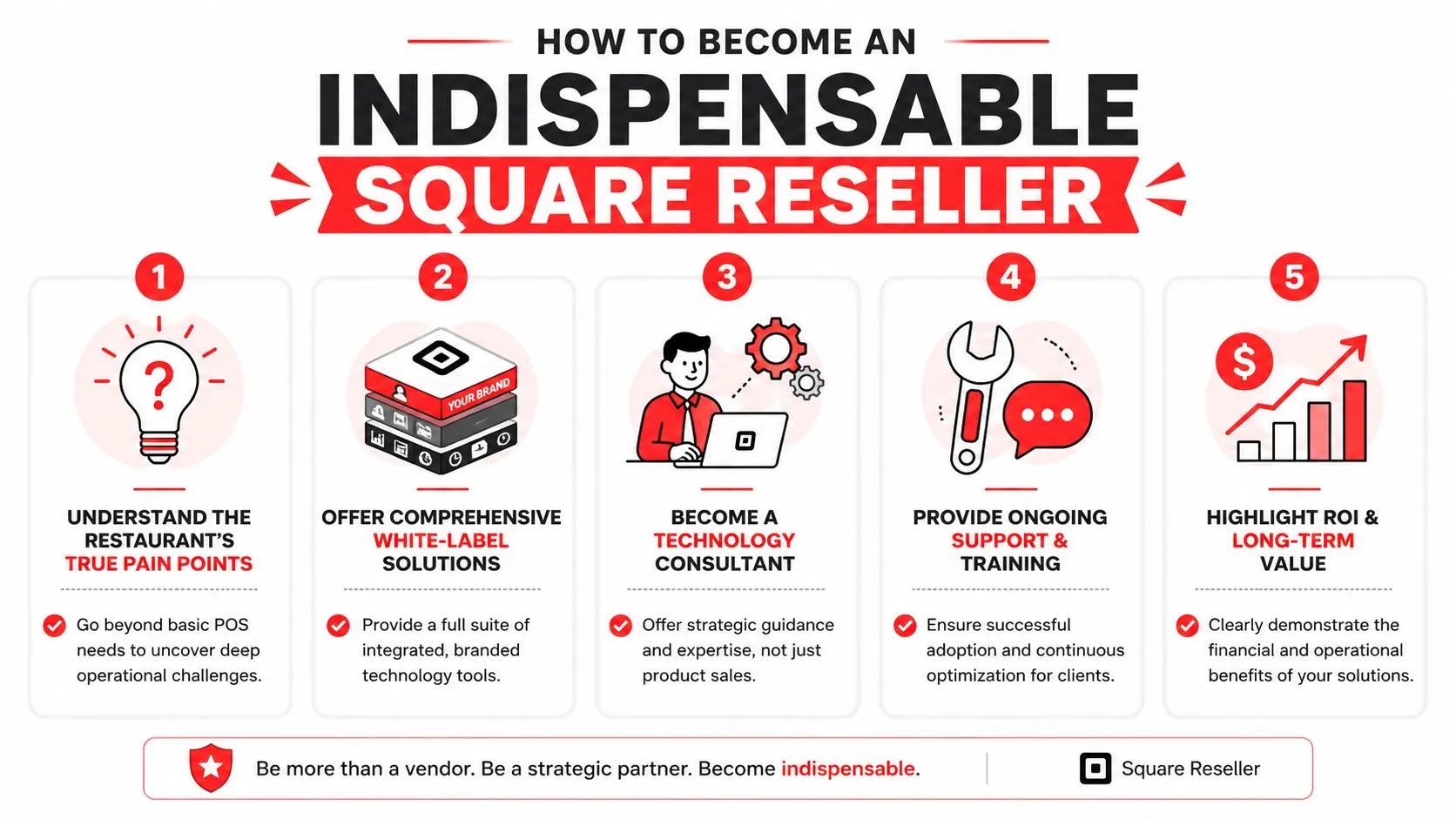
Most restaurant owners don’t need another sales pitch. They need someone who can walk in, identify where orders break, and recommend a cleaner operating model.
Run a restaurant tech-stack audit
Don’t start with hardware. Start with workflow questions.
Ask things like:
- Where do delivery orders enter the business today
- Who re-keys orders, and when does that usually break down
- How often do menu changes create mismatches across channels
- Who answers the phone during peak service
- What gets blamed on staff that is a systems problem
That audit gives you the raw material to build a package around real pain. It also changes the sales dynamic. You’re no longer pitching features. You’re diagnosing friction.
Bundle services around one operational promise
A restaurant doesn’t want five disconnected tools. It wants a simpler operation.
Your bundle should be built around one promise: orders enter once, land correctly, and move through service without manual cleanup.
That usually means combining:
- Square setup and optimization
- Delivery POS integration
- Menu mapping and modifier review
- Direct ordering options
- Phone-order capture
- Ongoing support and retraining
The reseller who owns implementation and support usually owns the account. The reseller who drops hardware and disappears gets replaced.
Position yourself as the adult in the room
Restaurant operators can smell fluff immediately. Be direct. Tell them where their current workflow is weak. Explain what has to change first. Push back when they want shortcuts on menu cleanup or testing.
You should also make your support model explicit:
| Service element | What the client should expect |
|---|---|
| Onboarding | Menu review, channel setup, workflow validation |
| Go-live support | Live testing across ordering channels |
| Staff training | Front-of-house and manager handoff |
| Ongoing management | Menu updates, issue review, system checks |
The more operational responsibility you can credibly own, the more durable your revenue becomes.
The Smart Way to Partner with the OrderOut Reseller Program
If your reseller model depends only on Square’s native economics, you should question the business, not just the sales process.
A blunt reality check comes from Reforming Retail’s analysis of the Square restaurant reseller program, which argues that partners who rely on native reseller economics alone are left with thin, hard-to-defend margins. On those terms alone, long-term viability looks weak.
That’s why the smarter model is to sell software-led operational value alongside the POS relationship. Recurring services tied to restaurant workflows are easier to defend than one-time hardware margin, and they create a reason for the client to keep calling you.
What a better partner model looks like
The right partner program should let you do three things well:
- Own the client relationship: You stay in front of the merchant as the advisor
- Sell recurring operational solutions: Not just devices and processing
- Avoid carrying the technical burden alone: Integration, support, and maintenance shouldn’t all sit on your internal team
That structure matters if you’re building a consultancy, ISO channel, or restaurant-focused agency. You need a stack you can package repeatedly without custom-building every deployment.
For lead generation and prospecting discipline, even simple resources like these digital marketing tips on a budget can help smaller partner teams tighten their outbound motion. But marketing only works if the offer is worth hearing. Commodity POS resale isn’t. Operational transformation is.
Why the partner angle matters more now
Restaurants are tired of fragmented systems. They also don’t want to manage five vendors for one problem. A reseller who can package ordering, delivery, and support into one accountable relationship is easier to buy from and easier to keep.
That’s the practical case for a dedicated restaurant technology reseller program. It aligns better with how restaurant operators buy. They don’t want a catalog. They want one partner who can make Square work inside the realities of delivery, direct ordering, and day-to-day service.
If you’re serious about building a profitable Square reseller business, stop chasing thin-margin transactions and start packaging recurring operational fixes.
Frequently Asked Questions
What does a Square reseller actually do for restaurants?
A Square reseller sells, sets up, and supports Square POS and payment tools for restaurant clients. The stronger partners also handle workflow design, delivery order integration, menu mapping, staff training, and ongoing support so the restaurant isn’t left stitching systems together alone.
Can a Square reseller build custom solutions for merchants?
Yes. Square’s partner ecosystem supports custom integrations and business-specific tools through its broader partner structure. In practice, that means a capable partner can go beyond standard setup and package services around delivery POS integration, online ordering, and other restaurant workflows.
Why isn’t hardware resale enough anymore?
Because restaurant pain usually sits outside the terminal. Delivery tablets, manual order entry, menu mismatch issues, and missed phone orders create daily operational problems that hardware alone doesn’t solve. The reseller who fixes those issues becomes far more valuable than the reseller who just installs devices.
How should a Square reseller sell to restaurant operators?
Lead with a workflow audit, not a product pitch. Ask where orders break, where staff re-enter data, and which channels create the most confusion. Then package a solution around fewer manual steps, cleaner order flow, and better day-to-day control.
What’s the next step if I want to add restaurant ordering solutions to my reseller business?
Start with a partner model built around operational software, not just POS deployment. Review the available reseller options, decide which services you want to package under your brand, and then onboard with a live implementation path you can use for client rollouts.
If you want to build a restaurant tech business around Square instead of just reselling terminals, start with OrderOut and request access to the OrderOut reseller portal. You can get set up for free in a few clicks, then package delivery-to-POS integration, direct ordering, and phone-order workflows into a cleaner partner offer.