
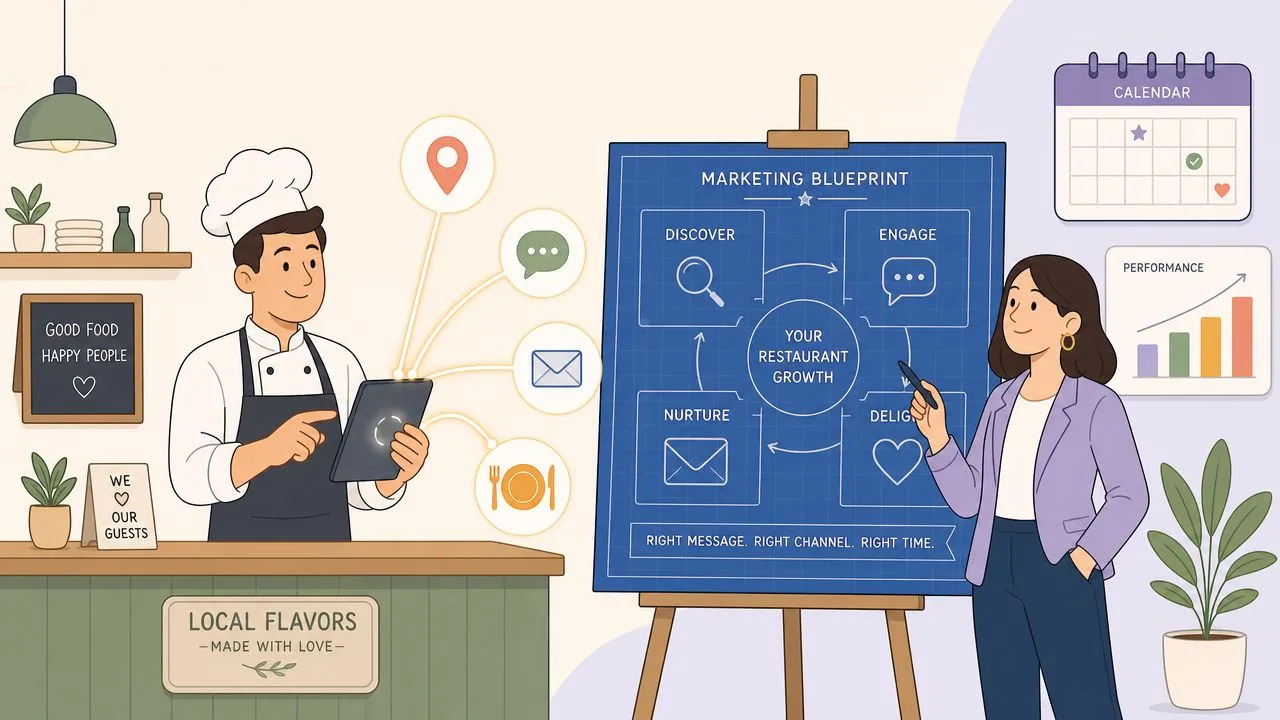
A restaurant marketing plan is the short document that tells your team who you’re trying to fill tables with, what channels matter, how much you’ll spend, and how you’ll know if it worked. Without that, most restaurants end up with a social calendar, a few boosted posts, and a lot of hope.
On a busy Friday, that gap shows up fast. Uber Eats, DoorDash, and Grubhub orders are landing on separate tablets, the host is taking a phone order, and somebody is asking whether last week’s Instagram push did anything. A real marketing plan for restaurants connects those moments, so the work online shows up in the POS, not just in likes and impressions.
You can see the difference in practice by comparing a content calendar to a plan. A calendar says what gets posted. A plan says what business result you want, which guest you want, which channel should do the work, and how the restaurant will measure it. If you want a solid outside example of that mindset, Boocoo’s restaurant marketing guide is a useful companion read, and OrderOut’s own restaurant marketing ideas page shows how operators usually turn those ideas into action.
What a Restaurant Marketing Plan Actually Does
A restaurant marketing plan is the decision-making layer between your goals and your daily tactics. It keeps you from spending money because a trend looked interesting, or because a slow Tuesday made everyone nervous. In operator terms, it answers four questions, what are we trying to grow, who are we trying to reach, where will we reach them, and how will we know if the spend helped.
That matters because marketing and operations are now tangled together. Delivery, loyalty, email, and online ordering all affect the guest experience before the guest ever walks through the door, and they keep affecting it after the first order. If your team still treats marketing as a separate department, you’ll end up with promotions that look active but never change the numbers that matter.
Why a calendar is not enough
A calendar can keep your feed active. It can’t tell you whether a DoorDash customer became a repeat guest, or whether a social post drove a dinner rush that held in the kitchen. A plan does that by linking the channel to a business outcome and giving the team a simple way to review it.
That’s why a good plan is shorter than people expect. It’s not a huge binder, and it doesn’t need to read like a brand manifesto. It should be clear enough that a manager can use it on a Monday without decoding marketing jargon.
Practical rule: if the document can’t help you decide where to spend the next dollar, it’s not a marketing plan.
The best plans also force consistency. Once you know the audience, offer, and channel, the team stops arguing about random promotions and starts executing against a shared target. That usually fills tables more reliably than an endless stream of disconnected ideas.
Define Goals, Audience, and Positioning
A restaurant can have busy nights and still have a weak marketing plan if it does not answer three questions clearly. What are we trying to grow, who is most likely to order, and what position should the restaurant own in the guest’s mind. Before channels enter the picture, the team needs SMART goals, a practical guest profile, and a position that can be repeated across menus, profiles, emails, and promotions. One industry guide lays out the basic pieces a restaurant marketing plan should include, a SMART objective, a target diner description, core offers, the channels to use, a budget with assigned owners, and KPIs reviewed weekly, as noted by Groupon’s restaurant marketing plan guide.
Start with goals that affect revenue
A goal like “grow awareness” sounds tidy in a meeting and disappears in operations. Goals work better when they tie to covers, repeat orders, or average check, because those are the numbers an operator can manage. Keep the list tight, usually three to five goals, then assign an owner and a weekly review rhythm so the work stays visible.
If a goal cannot be tied back to a menu item, a daypart, or a repeat visit, it belongs on the whiteboard, not in the plan. That standard keeps the team honest about what marketing is supposed to change.
Build the guest profile from what you already know
You do not need a large research project to get useful direction. Start with the customers who already buy from you, when they order, what they spend, whether they dine in or use delivery, and how they found you in the first place. If your POS, loyalty data, and delivery reports already show patterns, use them, and use customer data collection methods for restaurants to tighten what you capture next. If they do not show patterns yet, the problem is usually measurement, not a lack of opinions.
The guest profile should point to real behavior, not a vague demographic sketch. A lunch crowd that orders quickly has different needs from a late-night delivery guest, and a family that comes in on weekends responds to different offers than a solo regular who only wants speed. The more the plan reflects actual ordering patterns, the less money gets wasted on broad messaging.
Anchor the whole plan in positioning
A plan built around a clear position is easier to run than one built around scattered tactics. Choose one or two positioning pillars, such as speed, family-friendly service, late-night convenience, neighborhood identity, or chef-driven food, and make every channel reinforce them. If the restaurant tries to be everything at once, the message gets muddy and the budget gets split across too many directions.
Positioning should also fit the way the restaurant operates. A business built around fast pickup can say so everywhere, but only if the team can turn those orders quickly in the POS and at the expo line. A place that sells itself on comfort and hospitality needs the front-of-house experience, ticket pacing, and follow-up messages to match that promise.
A quick example makes the trade-off obvious. An independent pizzeria might position around late-night comfort and fast pickup, with goals tied to weekday orders and repeat visits. A fast-casual bowl concept might position around speed and repeatable lunch service, with goals tied to lunch traffic and direct reorder behavior.
Clear position, easier execution. When the guest can describe you in one sentence, your team can market you in one sentence too.
Choose Channels That Match the Plan
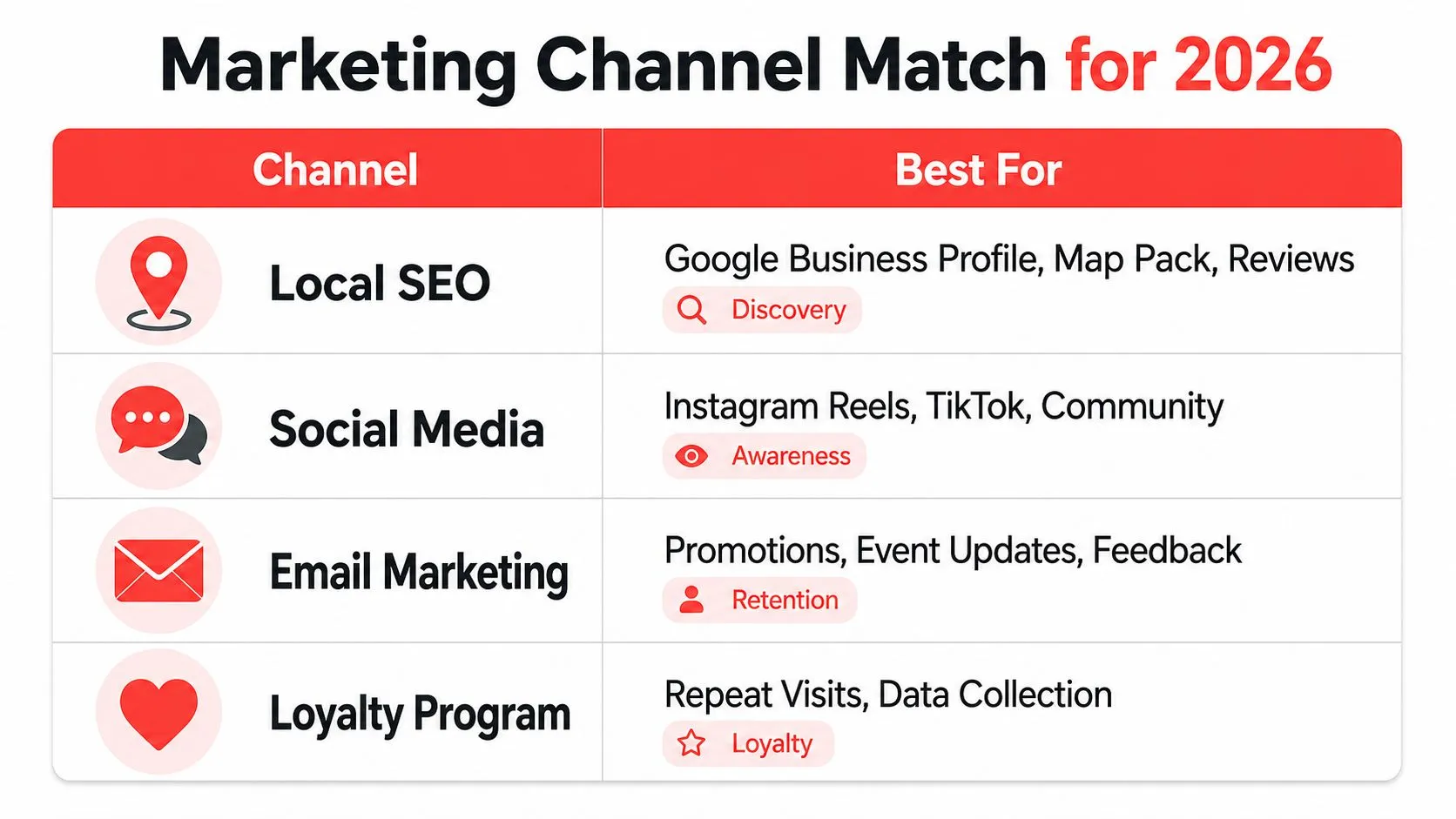
Channels should serve a clear job, not follow what looks busy in a pitch deck. Local SEO helps people find the restaurant when they already want food nearby. Social media helps the brand stay visible and gives new guests a reason to remember it. Email and SMS bring people back after the first visit. Paid ads help when the plan needs reach faster than organic effort can deliver. Delivery marketplaces help with discovery and convenience, but they keep the guest relationship unless the restaurant moves that guest into its own system later.
Own the audience when you can
Email, SMS, and branded ordering matter because they let the restaurant speak directly to the guest. They also fit the operational side of the plan better than channels that stay outside the restaurant’s own systems. When a promotion, a menu change, or a comeback offer runs through owned channels, the team can track the order all the way back to the message instead of guessing what worked. That matters because industry data shows 60%–80% of restaurant marketing spend is now directed to digital channels, and email remains one of the stronger tools in the mix, with an average open rate of 43.6%, a click-through rate of 1.13%, and an estimated return of about $44 for every $1 spent according to Restroworks restaurant marketing statistics. Those numbers explain why retention tactics deserve a real place in the plan, not whatever budget is left over.
The cost structure changes by channel. Local SEO and Google Business Profile work mostly take labor. Social takes time and consistency from the team. Paid ads require ongoing spend, and the bill keeps showing up if the campaign does. Marketplace discovery can help, but if every sale lives on someone else’s app, the restaurant keeps paying to win back the same guests instead of building a direct relationship.
Prioritize instead of fragmenting
Restaurant guidance consistently warns against trying to do everything at once. The strongest plans usually start with 1 to 3 channels, after a competitor review and a simple SWOT pass, as outlined in ZoomShift’s restaurant marketing plan guide and digital marketing for restaurant planning. That is the right trade-off for most operators, because fragmented effort creates decent-looking activity and weak results. A restaurant can post constantly, run ads, and still miss the channels that drive orders into the POS.
The practical decision aid is simple.
- If awareness is the bottleneck, put more effort into local SEO, social discovery, and selective paid reach.
- If repeat orders are the bottleneck, lean on email, SMS, loyalty, and direct ordering.
- If delivery margin is the bottleneck, reduce operational leakage and push more guests toward direct channels.
A mid-budget restaurant plan often works best when it stops treating marketplace traffic, website traffic, and in-store traffic as separate worlds. The goal is to own as much of the guest relationship as the business can, then use rented channels with purpose instead of by habit.
Wire Delivery and Online Ordering Into the POS
A delivery order that sits on a separate tablet slows the line down. Staff re-enter items, modifiers drift out of sync, and the manager loses a clean view of what sold. Once delivery and online ordering feed the POS directly, the marketing plan stops being a file and starts affecting daily operations.
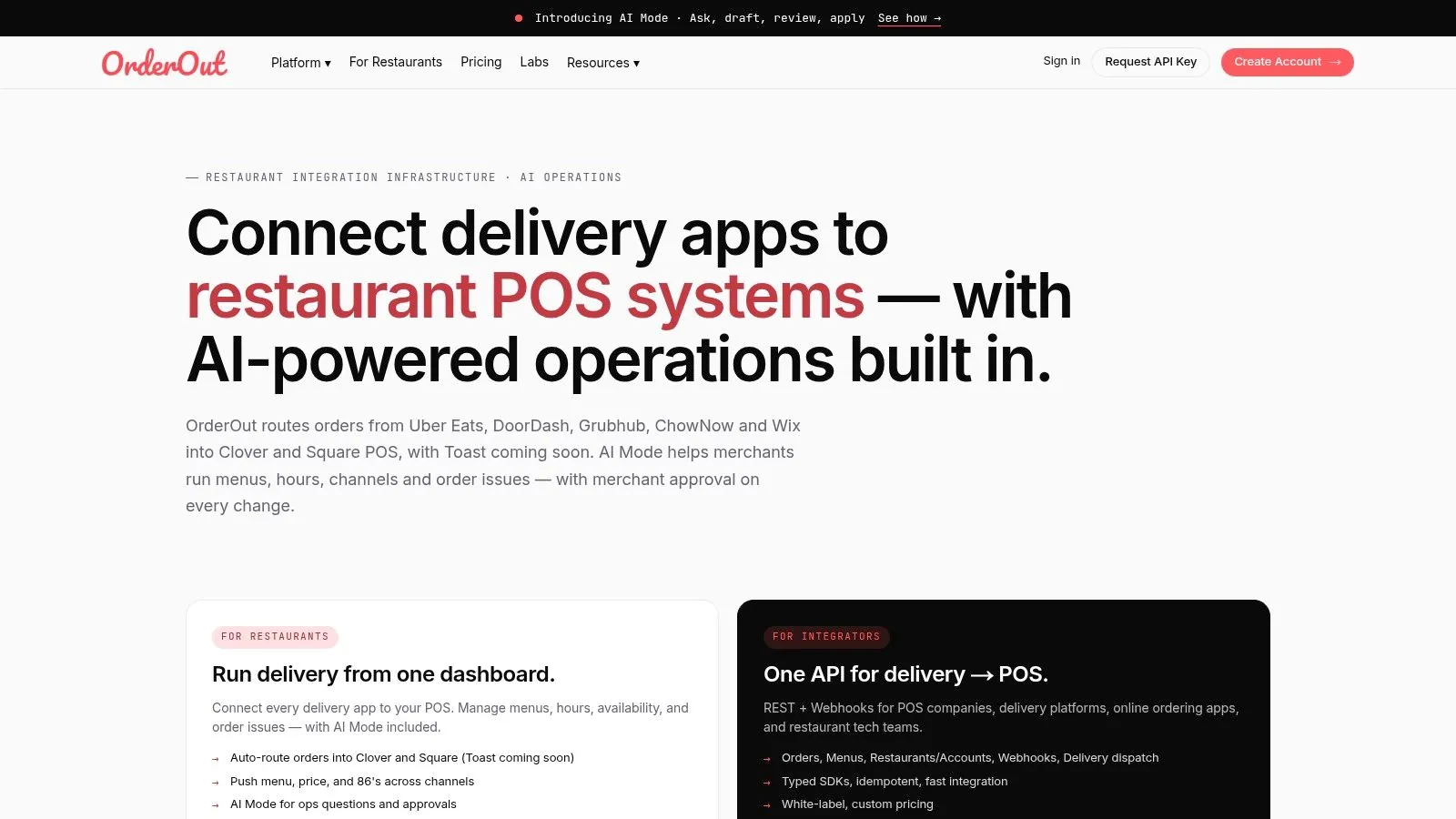
OrderOut is one option that pushes third-party delivery orders straight into Clover or Square, with no extra tablets and no manual re-keying. It maps each marketplace menu to a normalized POS schema, so the order lands in a format the kitchen can use without extra cleanup. For an operator, that means fewer entry errors, less clutter at the counter, and a source of truth inside the system the restaurant already relies on.
Why the POS has to be the source of truth
A marketing team cannot trust order data that lives in three places. If delivery, in-store, and online orders are tracked separately, the team ends up guessing at average check, repeat behavior, and channel value. When the POS is the operational center, the restaurant can connect promotions to real orders instead of reactions.
That matters even more if the plan includes commission-free online ordering or AI phone ordering. A branded ordering page gives the restaurant a place it owns, so guests can come back without starting over on a marketplace. For a practical overview of how that setup works, see a restaurant owner’s guide to a food online ordering system. AI phone ordering can catch calls during the rush, take the order, and drop it into the POS, which helps staff stay focused when the room is full.
A marketplace can bring the guest in. The POS is where the restaurant learns whether that guest is worth keeping.
Here is the practical flow. A DoorDash order comes in, it drops into Clover, the kitchen ticket prints, and the order is logged in the same record the manager can later use to segment a direct email or follow-up. That bridge between marketing and operations is what most plans miss.
For operators who want the broader setup, OrderOut’s 3rd-party order engine explains the delivery-to-POS layer, and the Clover delivery integration page shows the Clover-specific path. If the restaurant’s goal is to convert delivery traffic into direct repeat behavior, the commission-free online ordering page is the other piece to review.
At this point, the marketing plan should stop talking only about impressions and start talking about operational records. Clean order data gives the next campaign something real to learn from.
How the guest relationship stays usable
A delivery customer only becomes useful if the restaurant can recognize, segment, and follow up correctly. That is why clean menu setup, accurate modifiers, and a consistent POS record matter so much. The marketing message may start on Uber Eats, DoorDash, or Grubhub, but the restaurant’s real advantage begins when the order lands cleanly inside Clover or Square.
Budget, Calendar, and the 90-Day Execution Plan
Budget needs to follow revenue reality, not wishful thinking. The working range for many restaurants sits around 3% to 6% of revenue for marketing, with newer or growth-stage concepts often spending more during launch periods. Another operator guide places the standard range at 3% to 6% of sales and recommends putting money behind the channels that already drive business, as outlined by Aaron Allen’s restaurant marketing plan guide.
Put the money where the orders already are
If delivery drives a meaningful share of sales, the plan should pay for the work that keeps that channel profitable. If dine-in still carries the business, the budget should support in-store conversion, local discovery, and repeat visits. In practice, that means matching spend to the way guests already buy, then using the plan to fix the weak spots instead of spraying money across every channel.
The calendar works better in 90-day sprints. That keeps the work close enough to manage without turning every week into a new strategy. One month can focus on a hero campaign, another on retention, and another on a practical upgrade such as direct ordering, SMS, or better Google Business Profile maintenance.
Use a rolling quarter, not a static spreadsheet
The working calendar belongs beside the POS dashboard, not in a folder nobody opens. Monthly themes help the team stay aligned, but each week still needs a task list with a clear owner. That is how a restaurant avoids the common pattern where the plan looks good on paper and never reaches the floor.
A useful structure looks like this:
- Month 1, launch a slow-night push with a direct offer tied to a specific daypart.
- Month 2, use a local event week or neighborhood moment to build awareness and capture contact data.
- Month 3, run a retention campaign that targets guests who already ordered and invites them back.
The exact campaign matters less than the discipline behind it. The calendar should be specific enough that the team knows what to do on Tuesday morning, and it should map cleanly to the same operating records the kitchen and front-of-house already use. That is where restaurant data analytics for operators becomes useful, because the plan only improves when the team can see what happened inside the POS.
One practical note from the field. If the plan cannot be executed by the manager on duty, it is too complicated. The best calendars are visible, short, and tied to the operating record the team already trusts.
Week one checklist
Start with the basics.
- Assign owners for content, offers, and reporting.
- Choose one hero campaign for the next 30 days.
- Turn on one retention tactic, like email or SMS.
- Review menu and POS setup so delivery orders land cleanly.
- Set the next review date before the work starts slipping.
That is enough to create momentum without burying the team in admin.
Measure What Moves the P&L
A restaurant marketing plan should track a small set of KPIs tied to one business objective. Too many dashboards become decoration. The useful ones help answer whether the plan is moving guests, orders, and repeat behavior in the right direction.
Use revenue metrics, not vanity metrics
Impressions, likes, and follower counts can help with context, but they don’t tell the whole story. A stronger review set focuses on average check, repeat visit rate, covers by daypart, customer acquisition cost, and customer lifetime value. For restaurant execution, one practical framework recommends reviewing the last 90 days of reports to establish baseline metrics, then checking KPIs monthly, including average check, repeat visit rate, covers by daypart, and lifetime value, according to Rezku’s restaurant marketing framework.
Review weekly, not whenever someone has time
A weekly review cadence keeps the plan alive. The manager should be able to look at what changed, what sold, and what didn’t, then make a small adjustment without reopening the entire strategy. That works especially well when the POS is the source of truth and delivery orders are coming through cleanly.
Attribution will never be perfect, so don’t pretend it is. A guest might discover the restaurant on Instagram, order through DoorDash, and then walk in a month later. In that case, the right mindset is to credit the plan as a system, not to fight over one channel’s share of the win.
Measure the path, not just the last click. Restaurants grow through repeated touchpoints, not a single magical post.
When a channel underperforms, cut it decisively. Reallocate the budget to the channel or offer that moves orders, then write down the lesson so the next quarter starts smarter. That habit is worth more than protecting a weak campaign because the team already spent time on it.
For operators who want a deeper look at how this shows up in reporting, OrderOut’s restaurant data analytics guide is a practical companion to the KPI work. The main point stays the same, if the numbers don’t help the manager decide what to do next week, they’re not the right numbers.
What a clean review looks like
A good Monday review is short. It tells the operator whether the plan is pulling in the right guests, whether the average ticket is holding, and whether the repeat behavior is improving or slipping. That’s enough to steer the next campaign without turning measurement into another full-time job.
Frequently Asked Questions
How can a small restaurant run a marketing plan without a marketing hire?
Keep the plan narrow and operational. One person can own the basics if the work is limited to a few channels, a short calendar, and weekly reporting tied to the POS. The key is to stop treating marketing like a separate creative project and tie it to the daily business.
How often should a restaurant marketing plan be updated?
Review it weekly for execution and monthly for performance. A deeper reset belongs in the quarterly cycle, especially if sales mix, menu focus, or channel performance changes. That rhythm keeps the plan current without forcing constant reinvention.
How do you build direct customer relationships when delivery comes through a marketplace?
Use the marketplace for discovery, then move the relationship into channels the restaurant controls. That means clean POS records, direct-order options, loyalty where it makes sense, and follow-up that respects guest consent. The goal is to make the first order the start of a relationship, not the end of one.
How do you know if the marketing plan is working?
Look for movement in the business metrics, not just online activity. If the plan is healthy, you should see clearer repeat behavior, better channel visibility, stronger direct order flow, or improved performance on the dayparts you targeted. If the numbers aren’t changing, the plan needs a cut, a rewrite, or both.
Does OrderOut work with Clover and Square?
Yes, OrderOut is built to inject third-party delivery orders into Clover and Square so staff don’t have to manage extra tablets or manual re-entry. It also supports branded online ordering and AI phone ordering as part of the broader operational stack. For a restaurant that wants the marketing plan tied directly to real order flow, that keeps the POS at the center.
If you want your restaurant marketing plan to do more than sit in a folder, start by connecting your delivery channels, online ordering, and POS data into one operating view. OrderOut helps restaurants route Uber Eats, DoorDash, and Grubhub orders into Clover or Square, so the team can spend less time re-keying and more time filling tables, protecting margins, and following up with the guests who return.