
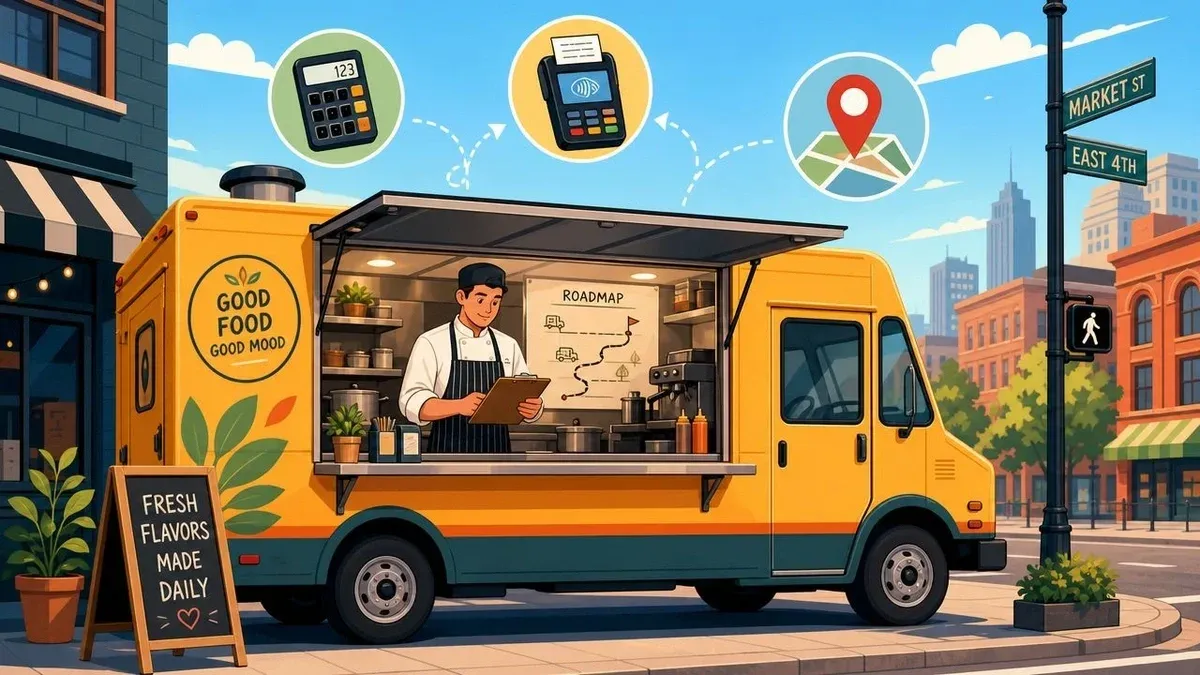
A lot of restaurant operators reach the same point. The dining room is steady, catering brings in bursts of revenue, and then the question shows up: should we take this brand on the road?
A food truck can look like the obvious next move. Lower fixed overhead, flexible locations, event revenue, and a faster path to market than a second brick-and-mortar. But food truck opening only works when you treat the truck like a compact restaurant with tighter margins for error, tighter labor, and almost no room for weak systems.
The operators who struggle usually don’t fail because the food is bad. They fail because the route mix is weak, prep is loose, ordering is fragmented, and nobody built the truck to handle real service volume. The operators who do well build the truck around repeatable restaurant operations first, then brand and promotion second.
Thinking Beyond the Curb Your Food Truck Vision
If you already run a restaurant, you probably aren’t looking at a food truck because it feels trendy. You’re looking at it because you want a more flexible sales channel. Maybe you want weekday lunch traffic near office corridors, weekend festival revenue, private events, or a lower-risk way to test a new concept without committing to another lease.
That’s the right starting point. A truck should solve a business problem.

The market is real, and so is the competition
Food truck opening isn’t a niche play anymore. The U.S. Bureau of Labor Statistics reported 44,119 workers in mobile food services in 2024, a 907% increase since 2000. That kind of expansion matters because it tells you the format has moved into the mainstream restaurant economy.
For operators, that cuts both ways. Consumer familiarity is higher, event organizers understand the model, and customers are comfortable buying from trucks. But a mature category also means customers compare you to polished competitors, not hobby vendors.
Practical rule: Don’t open a truck because it seems simpler than a restaurant. Open it because you know exactly what operating model it will support.
A truck is a mobile production system
The romantic version of a truck business centers on the menu and the wrap design. The practical version centers on throughput. How many tickets can your team handle in a compressed service window? How far can prep be pushed to commissary or base kitchen? What happens when in-person demand and delivery demand hit at the same time?
Those questions determine whether the truck becomes a growth engine or a stress machine.
A strong truck concept usually has these traits:
- Tight menu architecture: Fewer ingredients, shared prep, and fast assembly.
- Clear service identity: Office lunch, brewery evenings, festivals, catering, or neighborhood rotation.
- Operational portability: The food still travels well, holds well, and can be executed in a narrow line.
- Digital readiness: Customers can find you, order from you, and pay without friction.
Marketing still matters, of course. If you want to sharpen the visibility side, this guide on food truck marketing ideas for operators is useful. But promotion works only after operations are stable enough to support repeat demand.
Vision first, then constraints
Experienced restaurant teams have an advantage here. You already understand prep flow, labor pressure, menu engineering, and guest expectations. What changes is the environment. In a truck, every bad decision gets amplified because space is limited and service windows are short.
That’s why the best food truck opening plans start with a blunt question: what can this truck execute consistently, profitably, and fast, in the actual places you plan to sell?
If you answer that frankly, the rest of the build gets easier.
Drafting the Blueprint Your Business Plan and Budget
Most food truck business plans fail in one of two ways. They’re either too vague to guide decisions, or too optimistic to protect cash. A usable plan has to do more than secure financing. It has to tell you whether your concept works under mobile conditions.
The core numbers matter. In the U.S., food truck opening costs typically range from $50,000 to $200,000, with an average around $55,000. Average annual revenue can reach $346,000, but profitability depends on building a menu cost model that prices in all variables before launch. Revenue without disciplined costing is how operators stay busy and still lose money.
What your plan must include
A real truck plan should cover the same fundamentals as a restaurant plan, but with mobile-specific detail layered in. Independent guidance on opening a truck also stresses the need for startup costs, projected sales, market analysis, and financial projections. That’s not paperwork. That’s your operating map.
Build around these pieces:
-
Concept and customer fit
Define the menu, the service style, and where this truck will win. Festival food and weekday office lunch are different businesses. -
Menu engineering
Every item needs a purpose. If an ingredient only appears once, question it. If a dish slows the line, test whether it belongs. -
Route and channel strategy
Decide where sales will come from: recurring lunch stops, private bookings, brewery partnerships, event circuits, pickup, or app-based restaurant delivery. -
Financial model
Include startup spending, ongoing operating costs, and a breakeven view that reflects truck reality, not wishful volume.
If you want a cleaner framework for structuring the plan itself, this resource on guidance on UK business planning is worth reviewing because the logic around forecasts, market positioning, and assumptions translates well even if you operate elsewhere.
Build the budget around operating reality
The easiest mistake is budgeting for opening day instead of budgeting for the first difficult months. Don’t just price the truck and the equipment. Price the business you’re going to run.
Here’s a simple starting table.
Expense Category Estimated Cost Range Truck purchase or buildout $50,000 to $200,000 Permits and licensing Varies by market Kitchen equipment and smallwares Varies by concept Commissary or prep kitchen access Ongoing, varies by market Initial inventory Varies by menu Branding and menu boards Varies by design scope POS and payment setup Varies by system Fuel, maintenance, and repairs Ongoing, varies by route Launch marketing Varies by plan Cash reserve Based on operating model
Use the published range as a boundary, not a promise. A small coffee or snack concept may land differently than a fully hot line with fryers, refrigeration, and generator demands.
Your menu cost model is the real budget
Experienced operators distinguish themselves from first-time owners. Every item needs a full cost view, not just ingredient cost.
Include:
- Food cost: Every ingredient, garnish, sauce, and packaging component.
- Labor touch time: Not only service assembly, but prep time.
- Mobile overhead: Fuel, maintenance, generator use, commissary dependence, and location-related fees.
- Service friction: Longer pickup times, slower assembly, and menu items that break during delivery.
A truck menu that looks exciting on paper can wreck service once orders stack from the window and delivery apps at the same time.
Before you commit, compare your assumptions against realistic truck economics and setup choices. This breakdown of food truck rental cost considerations is helpful if you’re weighing temporary operation, pilot testing, or a lower-commitment launch path.
A strong business plan doesn’t just answer “can we open?” It answers “can we repeat this day after day without burning cash or burning out the team?”
Sourcing Your Truck and Kitchen Equipment
The truck isn’t just an asset. It’s your line, your storage room, your expo station, and your brand presence in one box. If the layout is wrong, your service speed drops. If the mechanical condition is weak, your launch calendar gets wrecked by repairs. If the purchase eats too much cash, every slow week feels dangerous.
That’s why sourcing decisions should follow cash strategy, not ego.
New, used, or leased
The cleanest truck isn’t always the smartest truck.
A new truck gives you more control over layout and usually fewer surprise repairs early on. It also ties up more capital upfront. That matters because successful operators recommend a cash reserve of at least 3 months of operating costs before opening, and one industry guide reports roughly 60% of food trucks are still operating after three years.
A used truck can reduce upfront pressure, but only if you inspect it like a production facility, not like a vehicle purchase. Equipment age, generator condition, electrical capacity, refrigeration reliability, and local code compliance matter more than cosmetic appearance.
A lease or rental path can make sense when you’re validating a concept, testing event demand, or launching as an extension of an existing restaurant. The trade-off is less control over buildout and potential limitations on equipment and branding.
Layout drives ticket times
The inside of the truck determines how many orders you can serve during peak windows. That’s why I push operators to sketch movement before they buy hardware.
Ask basic questions:
- Who handles the register or handheld ordering?
- Where does hot food finish?
- Can one person pass behind another without stopping production?
- Is cold storage placed for speed or just for fit?
- Does the menu require too many station changes?
One extra step repeated over a rush becomes a line problem. One badly placed fridge door becomes a labor problem.
For service design ideas, this look at food truck service window considerations helps operators think through guest flow and order handoff before build decisions get locked in.
Buy the must-haves first
Operators burn budget when they outfit the truck for every future possibility. Start with what supports your opening menu and your likely volume.
Prioritize:
- Core production equipment: What your top-selling items absolutely require.
- Reliable cold holding: Not optional. A breakdown here cripples service and food safety.
- Safe prep and handwashing flow: Compliance and speed live together.
- Power capacity that matches the menu: Underpowered systems create service failures that look like staffing problems.
- Durable smallwares and storage: Low glamour, high impact.
Buy equipment for your best-selling five items, not for a hypothetical menu you may never run.
The right truck feels a little boring on paper. That’s usually a good sign. It means you chose a machine that can execute.
Navigating Permits and Profitable Locations
A truck can be beautifully built and still sit idle because permits aren’t lined up or the route strategy doesn’t make money. Compliance and location planning have to move together. One gets you legal access to sell. The other determines whether selling is worth the effort.

Treat permits like a project plan
Food truck opening usually involves several approval layers. Business registration, health department approvals, food safety requirements, vehicle-related approvals, and event-specific permissions can all move on different timelines depending on your market.
A practical sequence looks like this:
-
Confirm local regulations first
City, county, and state rules can conflict. Check all three before you buy or build. -
Validate your truck build against local code
Don’t assume a truck built for another market will pass in yours. -
Lock in commissary or approved prep arrangements
Many operators underestimate this step and lose time. -
Map permit dependencies
Some approvals require earlier approvals or inspections to be complete.
If you need a broader operational view, this guide on regulations for a food truck can help frame the common compliance areas operators run into.
The best location is the one with repeatable economics
A packed event doesn’t automatically mean a good event. The right question isn’t “Will there be people?” It’s “Will the people there buy my food at a profitable pace under my service setup?”
There are a few common location models:
-
Recurring lunch stops
Better for predictability and routine. Harder if local demand is weak or parking rules are tight. -
Festivals and large events
Strong visibility. Higher risk if fees are high, logistics are rough, or your menu can’t handle bursts. -
Private catering and corporate gigs
Usually cleaner operationally because volume is planned in advance. -
Semi-permanent placements
Useful when you want route stability, but only if the host site consistently fits your customer base.
Profitable locations aren’t the busiest ones. They’re the ones where your menu, labor, setup time, and customer flow match.
Routing matters more than operators expect
Once the truck is live, movement itself becomes part of the business model. Distance, load-in complexity, fuel use, and setup windows all affect daily profitability. Operators who chase too many scattered stops create hidden costs and fatigue long before they notice margin erosion.
For teams managing multiple bookings or more complex route patterns, this article on choosing routing platforms for logistics is a useful reference point. It helps frame routing as an operations problem, not just a driving problem.
The strongest location strategy usually looks less ambitious than the weak one. It has fewer guesses, more repeatability, and tighter control over what each service window needs to earn.
Integrating Your POS and Restaurant Delivery Tech
This is the part most food truck opening advice gets wrong. Operators spend weeks on permits, wraps, and equipment, then treat tech as something to figure out later. Later usually arrives during a lunch rush when one staff member is taking window orders, a tablet is buzzing with Uber Eats, another is ringing from DoorDash, and somebody is retyping orders while fries die in the pass.
That setup breaks fast.
The operational gap is real. One industry guide notes that a major gap in food truck opening advice is post-launch digital operations, even though order accuracy and speed are central to profitability in today’s market. That lines up with what experienced operators already know. Small teams can’t afford duplicate work.

Your POS is the command center
In plain language, your POS system is where the truck keeps score. It should handle order entry, payment, menu management, modifiers, reporting, and ideally inventory visibility. In a truck, that matters even more because staff are multitasking and the service window is narrow.
A system like Clover or Square gives operators a familiar base for in-person ordering and payment processing. That’s the starting point, not the finish line.
The primary issue is what happens when orders come from more than one place.
Manual entry kills speed and accuracy
If your team has to read orders off separate tablets and re-enter them into the POS, you create three avoidable problems:
- Errors multiply: Staff mistype modifiers, miss allergies, or enter the wrong item.
- Service slows down: One person becomes a human bridge between systems.
- Reporting gets messy: Sales data lives in fragments, which makes menu and labor decisions weaker.
This is where restaurant delivery workflows matter. A truck that accepts digital orders needs one operational lane, not five disconnected ones.
Here’s a short visual overview of how connected ordering works in practice:
Build one order flow from day one
A better setup routes online orders directly into the POS so the kitchen sees them as part of the same production queue as walk-up orders. That reduces re-entry, keeps menus synced more easily, and gives the team a single source of truth during rushes.
The benefits are practical, not theoretical:
- Fewer handoffs: Staff spend more time making food and less time copying tickets.
- Cleaner menu control: Item availability and edits are easier to manage across channels.
- Better staff productivity: Smaller teams can handle more complexity without adding chaos.
- Stronger guest experience: Orders are more accurate, and pickup timing is easier to manage.
This is especially important if your truck serves dense lunch periods, recurring office locations, or event environments where demand compresses into short windows.
If you’re evaluating the stack behind that workflow, this guide on food delivery management software for restaurants is a useful place to compare what integrated operations should ideally solve.
The best truck tech doesn’t add another screen to watch. It removes one more task from the person already under pressure.
Don’t bolt on delivery after launch
Operators often ask whether they should start with in-person only and add delivery later. Sometimes that’s sensible. But if you know your market already depends on app-based ordering, delaying the system design usually means rebuilding your workflow after habits have formed.
It’s easier to launch with one clean order path than to untangle bad habits later. In food truck operations, speed is margin. Accuracy is margin. Staff focus is margin. Your POS and delivery setup touches all three.
Your Final Checklist for a Successful Launch
Opening week should feel controlled, not dramatic. If launch day depends on staff improvising, the business isn’t ready yet. The strongest openings are usually uneventful behind the scenes because prep, training, and systems were handled before the first service window.
The broader opportunity is there. The global food truck market was valued at over $5.04 billion in 2024 and is projected to grow at a 7.41% CAGR, with average revenues around $290,000 in the same market analysis. But operators only capture that upside when the launch is built on discipline, not momentum.
Staff for resilience, not just friendliness
A truck team needs people who can switch roles without losing composure. The best early hires aren’t always the most polished front-of-house personalities. They’re the people who can hold standards in heat, noise, tight quarters, and changing demand.
Train for:
- Position flexibility: Cashier, runner, assembler, and expo often overlap.
- Short verbal communication: Tight spaces reward clear, direct callouts.
- Order review habits: Every handoff should include a quick check.
- Basic tech comfort: Staff should know how to manage the POS, menu changes, and order status without hesitation.
Market the launch like a route business
A truck doesn’t benefit from passive discovery the way a storefront can. Customers need to know where you’ll be and when. That means your pre-launch marketing has to be location-specific and operationally accurate.
Focus on simple moves that compound:
- Publish your opening schedule clearly: Don’t make people hunt for it.
- Announce recurring stops early: Habit builds when customers know the pattern.
- Partner with hosts who already have traffic: Breweries, offices, venues, and community events can reduce your customer acquisition burden.
- Use the same menu language everywhere: Social posts, ordering pages, and boards should match.
Grand opening checklist
Before the first real service, confirm these items:
- Truck readiness: Equipment runs properly, refrigeration holds, and payment hardware is tested.
- Inventory discipline: Opening stock matches the menu, with backup for your highest-demand items.
- POS and ordering flow: In-person orders, online orders, modifiers, and payment handling have all been tested.
- Offline contingency: The team knows what to do if connectivity drops.
- Commissary and prep plan: Prep, cleaning, storage, and replenishment are scheduled.
- Location execution: Parking, setup, service window flow, and teardown are rehearsed.
- Post-event review process: After every service, capture what sold, what slowed service, and what failed.
Launch the smallest repeatable version of the business you want to scale. Then tighten it after every service.
Food truck opening rewards operators who think like restaurateurs, not hobbyists. Build the menu for speed, the truck for movement, the route for margin, and the tech stack for one clean order flow. That’s what makes the business durable.
If you’re setting up your truck’s ordering and delivery workflow, OrderOut helps connect delivery apps like Uber Eats, DoorDash, and Grubhub directly into POS systems such as Clover, Square, and others so your team can avoid manual entry and run a cleaner service line. You can start onboarding for free in a few clicks at OrderOut Dashboard.