
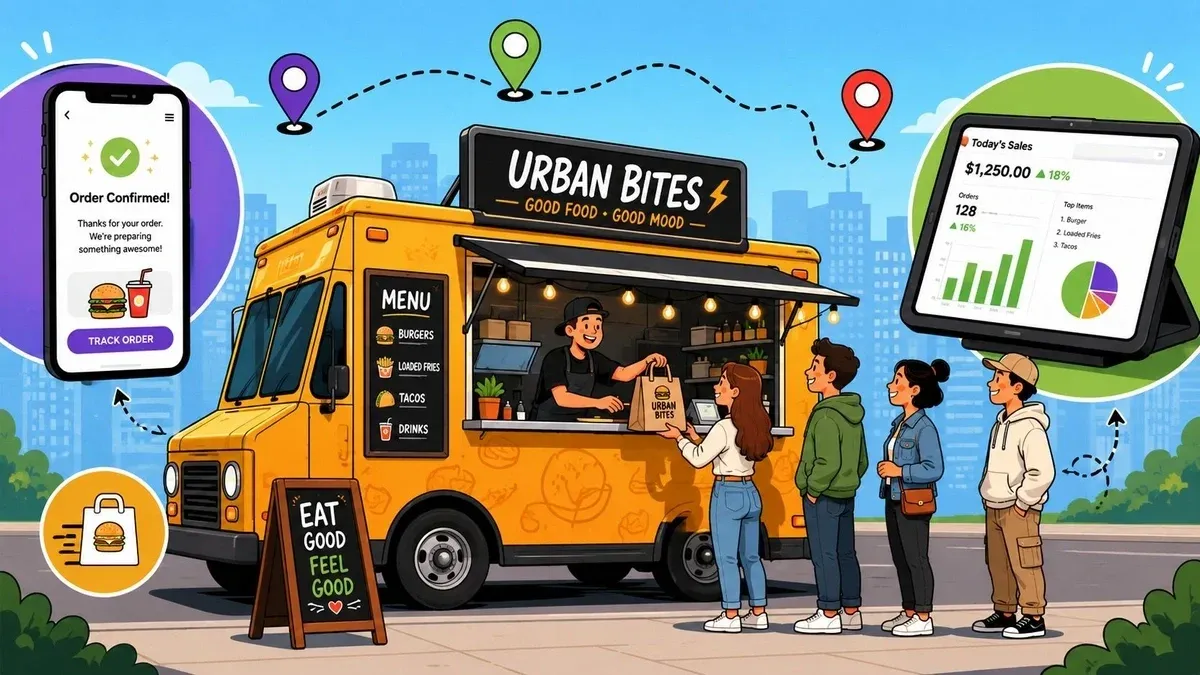
You’re parked for lunch, the line is building, one phone is buzzing with messages about your next stop, another app is firing off delivery orders, and someone on Instagram just commented, “Where are you today?” That’s the true food truck workload. You’re not just cooking. You’re running marketing, dispatch, customer service, and a tiny production line from a moving kitchen.
That’s why food trucks marketing has to do more than get attention. It has to help you serve faster, cut mistakes, and bring people back the next time you park nearby. If your marketing creates demand but your operation can’t absorb it, the campaign didn’t work. It just created chaos.
More Than a Meal on Wheels Your Modern Food Truck Marketing Plan
A lot of operators still treat marketing like a separate job. Post a few photos. Add a story. Hope people show up. That approach breaks down fast when your location changes, your team is small, and your busiest window may only last a couple of hours.
The opportunity is real. The U.S. food trucks industry reached 92,257 businesses in 2025, with industry revenue expected to reach $2.8 billion in 2026, according to IBISWorld’s food truck industry overview. More trucks means more demand, but it also means more competition for the same lunch blocks, event slots, and repeat customers.
Stop separating marketing from operations
Good food trucks marketing is an operating system. It answers four practical questions:
- Who are you for
- Where should you park
- How do people order
- How do you get them back
If one of those pieces is missing, the others get weaker. A strong social post won’t save a slow handoff. A packed event won’t help if your line stalls. A popular menu won’t matter if customers can’t easily find your current location.
Practical rule: Every marketing action should make ordering easier, not just make the truck more visible.
That’s why I push operators to connect marketing to the tools they already use every shift. Your POS, online ordering, kitchen workflow, and customer list should work together. When they do, your truck stops relying on constant manual effort.
Build a system you can actually run
For a small operator, the best plan is usually simple:
- Pick a repeatable weekly route: Give regulars a reason to expect you.
- Standardize your location posts: Same format, same timing, same ordering link.
- Use your POS as the record of truth: Track what sold, where, and when.
- Turn first-time buyers into saved contacts: Email, SMS, loyalty, or app-based reordering.
A lot of small business advice gets this right at a high level. Mr. Green Marketing’s expert advice is useful because it emphasizes consistent, channel-specific execution instead of random promotion.
You also can’t build a marketing plan without the basics of compliance and movement. If you’re still sorting out permits, service zones, and where you can legally operate, review these food truck regulations before you lock in your route.
Build a Brand That Travels Beyond the Truck
Branding for a food truck isn’t just your logo or wrap. It’s the promise customers remember when they’re deciding between your line and the truck parked two spaces over.
A strong brand does one job well. It tells people what you’re known for, why it’s worth the stop, and what kind of experience they’ll get. In a value-sensitive market, marketing should highlight convenience, speed, and menu focus, and a distinctive specialty concept often works better than broad menu expansion, as noted in this food truck business guide from AO Fund.
Focus beats variety
The mistake I see most often is menu sprawl. Owners try to be everything for everyone. That usually creates longer ticket times, more prep complexity, and more customer hesitation at the window.
A focused concept is easier to market and easier to run.
- A specialty travels better: “Korean fried chicken wraps” is clearer than “global street food.”
- A shorter menu trains customers faster: People know what to order before they reach the window.
- Cleaner builds reduce mistakes: Fewer modifiers means fewer order-entry issues and fewer remakes.
That’s not just a brand decision. It’s an operations decision. A focused menu is easier to map into online ordering, easier to configure in your POS, and easier for staff to execute during a rush.
Customers don’t reward a truck for having the longest menu. They reward the truck that makes choosing easy and delivers fast.
Communicate value without racing to the bottom
If customers are more price-conscious, discounting alone won’t protect your margin. Food truck marketing works better when you explain value in practical terms.
Try messaging like this:
- Speed: Ready for pickup on your lunch break
- Convenience: Order ahead before we reach your office park
- Specialty: One signature item done right
- Consistency: Same favorites, same quality, easy reorder
Those messages are clearer than “huge menu” or “something for everyone,” and they usually lead to better operations.
For owners refining visuals, messaging, and recognition, these brand awareness strategies from Bruce and Eddy are a useful complement to food truck execution.
Make your brand easy to order
A food truck brand only works if customers can act on it quickly. Your truck, social bio, printed signage, and ordering page should all say the same thing.
Ask yourself:
Brand element What customers should learn instantly Truck wrap What cuisine or specialty you serve Menu board Top sellers and fastest choices Social profile Where you are and how to order Online ordering page Clear item names, modifiers, pickup flow
If you’re using local creators or neighborhood personalities to extend that message, this guide to food influencer marketing can help you keep the campaign practical instead of vanity-driven.
A short visual walkthrough can help if you’re rethinking presentation and positioning:
Find Your Customers With Smart Route Planning
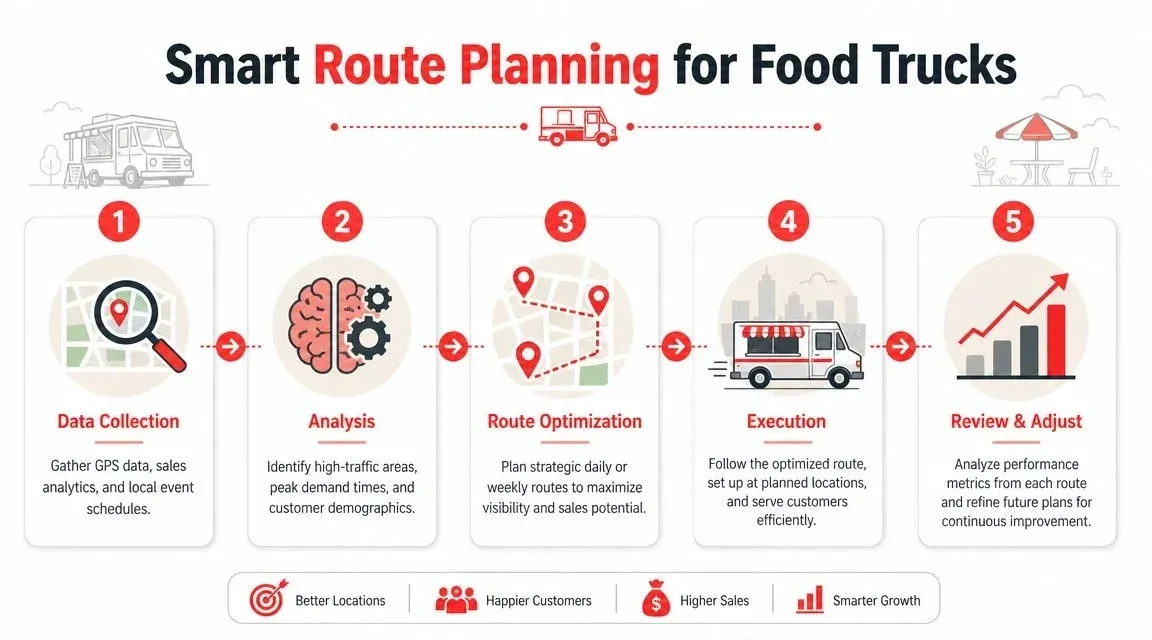
A profitable route isn’t built by guessing where people might be hungry. It’s built by matching daypart, audience, and operational capacity.
One documented example showed what happens when operators treat location like a measurable marketing lever. In that case, they used mobile data to identify high-traffic zones, rotated between downtown lunch periods and suburban evenings, then added online ordering and a loyalty program. The result was a 68% increase in average daily revenue in six months, according to this food truck case study collection.
Match the stop to the selling pattern
Different locations produce different order behavior. Office parks usually reward speed and pre-orders. Breweries often reward longer dwell time and shareable items. Neighborhood evening stops can favor family bundles or repeat regulars.
The route should reflect that.
Here’s a simple way to evaluate each stop:
- Lunch stop: Can customers order ahead and grab quickly?
- Event stop: Is the crowd aligned with your menu and service speed?
- Recurring partner stop: Will this location repeat often enough to build habit?
- Evening residential stop: Do locals have a reason to save your schedule?
Use your POS to find your real winners
Most route planning gets stuck at the “busy area” stage. Busy doesn’t always mean profitable. A stop with smaller lines but smoother tickets, better item mix, and fewer delays may outperform the flashy one.
Review sales by:
- Location
- Day of week
- Time block
- Top-selling items
- Average prep complexity
If one location produces constant modifier-heavy tickets and backs up your line, that stop may be hurting throughput even if sales look decent. If another location drives fast-moving core items, it may deserve more calendar space.
The best route is the one your team can execute cleanly, not the one that only looks good on social.
Build recurring revenue into the route
One-off events help with reach, but recurring stops build memory. Customers start to expect you. That’s when food trucks marketing gets easier because you’re no longer reintroducing yourself every day.
Good recurring partners include:
- Breweries and taprooms
- Office parks
- Apartment communities
- Schools and campuses where permitted
- Local event organizers with repeat programming
If you’re adding delivery coverage around those stops, this overview of a relay delivery app is worth reviewing because route planning and handoff logistics have to work together.
Your Digital Megaphone and Online Ordering System
Most food truck social media fails for one reason. It entertains but doesn’t convert.
A truck doesn’t need a complicated content strategy. It needs a reliable announcement system that helps people decide fast. For food trucks, 37% of owners cite events as their top customer acquisition source, followed by social media at 27%, and 86.9% of operators use Facebook, based on the figures summarized in GoFoodservice’s food truck marketing analysis. That tells you where attention starts. It doesn’t guarantee sales. The sale happens when ordering is simple.
Turn every post into an order path
Your post should answer three questions in seconds:
- Where are you?
- What’s worth ordering today?
- How do I order before the line gets long?
That’s why the best-performing posts are usually operational, not artistic. A great brisket photo is fine. A brisket photo plus location, service hours, sold-out warnings, and an order link is better.
Digital Marketing Channels for Food Trucks
Channel Best For Key Tactic Efficiency Gain w/ Integration Instagram Daily visibility and menu drops Post location, signature item, and order link in stories and bio Fewer DMs asking where you are Facebook Community updates and local groups Publish route schedule, event appearances, and pickup instructions Reduces repeated customer questions TikTok Discovery and personality Show prep, line energy, and limited specials with clear next-stop info Builds awareness you can direct to ordering Email or SMS Repeat traffic Send scheduled stop alerts and reorder prompts Faster repeat purchases with less manual outreach Marketplace listings Immediate demand capture Keep menu, hours, and availability current Orders arrive in a standard flow when connected
Keep the content calendar practical
Don’t create a plan your team can’t maintain. A workable truck schedule often looks like this:
- Morning: Post today’s stop and order-ahead link
- Pre-service: Share a menu highlight or limited item
- Mid-service: Update wait times or sold-out items
- Evening: Preview tomorrow’s stop or event
That takes less effort than filming elaborate content, and it supports actual demand.
Field note: If customers must jump through three steps to order, many won’t finish. Shorten the path.
Why online ordering matters more on a truck
On a fixed-location restaurant, a customer can walk in later. On a truck, the opportunity window is short. That makes order-ahead more valuable. It smooths the rush, gives staff clearer pacing, and helps customers commit before they get distracted.
This is also where restaurant delivery and POS integration stop being backend topics and become marketing tools. A customer sees your post, taps to order, and expects a clean pickup or delivery flow. If staff still have to copy orders between devices during service, speed drops and mistakes rise.
If you want to own more of that customer relationship over time, white-label ordering is worth exploring. This guide to white-label mobile applications is useful for operators who want repeat customers to order through a branded experience instead of relying only on third-party marketplaces.
Streamline Restaurant Operations with POS Integration
Lunch starts in ten minutes. One staffer is checking a delivery tablet, another is ringing in walk-ups, and a direct online order comes through with a modifier no one sees until the customer arrives. That kind of service breakdown usually gets blamed on the rush. The fundamental problem is the stack.
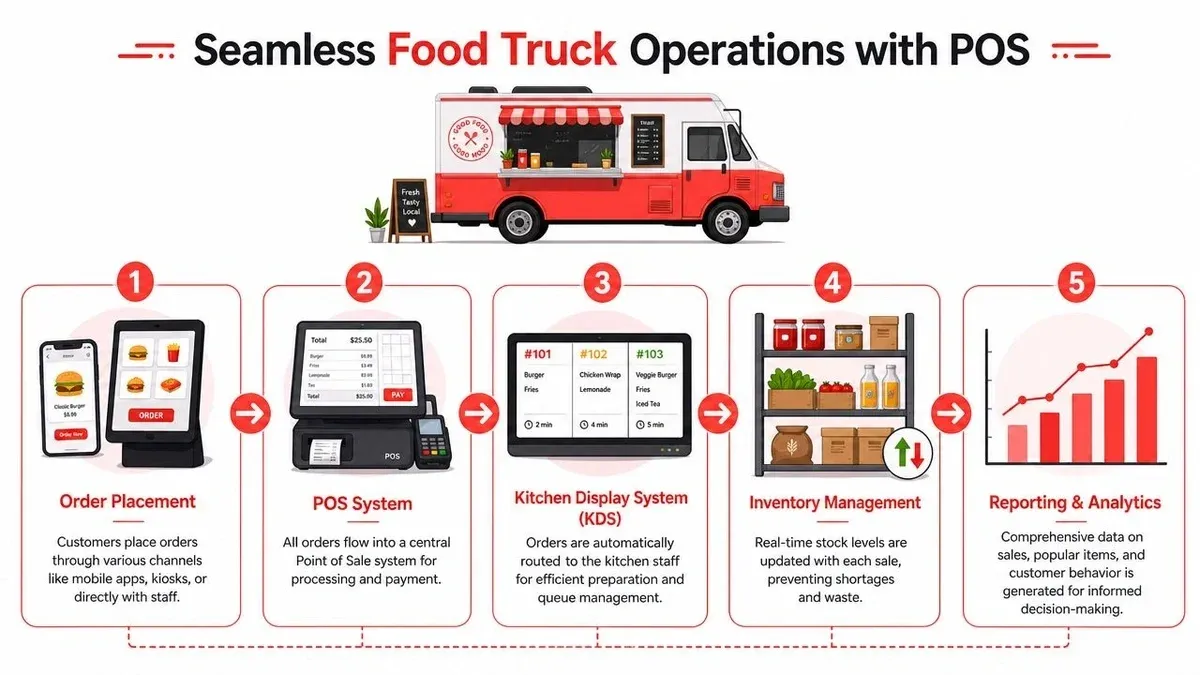
For food trucks, operations and marketing are tied together. A post drives demand. Order-ahead converts that demand. The POS decides whether the rush stays profitable or turns into rework, refunds, and long waits. If your team still has to copy orders between devices, your marketing is creating pressure your system cannot handle.
Many food truck marketing articles focus on visibility, as discussed in this food truck marketing ideas article. The harder and more valuable part is connecting the customer-facing side to fulfillment so every channel feeds one clean workflow.
What a connected workflow fixes
Truck crews work in tight quarters with limited labor. Extra taps matter. So do missing modifiers, duplicate tickets, and unclear pickup timing.
A connected setup improves the parts of service that usually break first:
- Less manual entry: Staff stop retyping the same order into multiple systems.
- Cleaner kitchen communication: Tickets arrive in a standard format with fewer missed details.
- Better queue control: Direct, pickup, and delivery orders land in one place instead of being split across screens.
- More usable reporting: Sales by channel, item, and service window are easier to review after the shift.
Operators using systems such as Clover often get the biggest benefit during peak windows. The trade-off is setup time. Integrations need to be configured correctly, tested with modifiers, and checked for how they handle outages or delayed marketplace updates. But once they are working, the line usually moves faster because staff are spending their attention on production and handoff instead of transcription.
Before and after the rush
Here is the practical difference:
Workflow What staff do Likely result Separate tablets Watch multiple devices and re-enter orders by hand Slower service, more input mistakes, harder rush management POS-connected ordering Receive orders in a single standardized flow Faster fulfillment, cleaner handoff, clearer reporting
That gap shows up fast on a truck. One person tied up entering tickets is one less person assembling orders, managing pickup flow, or catching mistakes before they reach the guest.
Food tech should remove work, not add another screen
OrderOut is useful here as a connector. It routes delivery app orders into supported POS systems so teams do not have to manually type each order from tablet to terminal. For a mobile operation, that usually means fewer order-entry mistakes and a steadier kitchen queue.
Mid-service edits are another common failure point. A customer changes a pickup time, removes an item, or updates a modifier after the ticket is already in motion. If you are reviewing how those updates hit the POS, this guide to change order integration for connected restaurant ordering flows is worth reading.
When the order path is clean, marketing produces more than traffic. It produces completed orders the team can fulfill well.
Turn Your Data into Repeat Business and Higher ROI
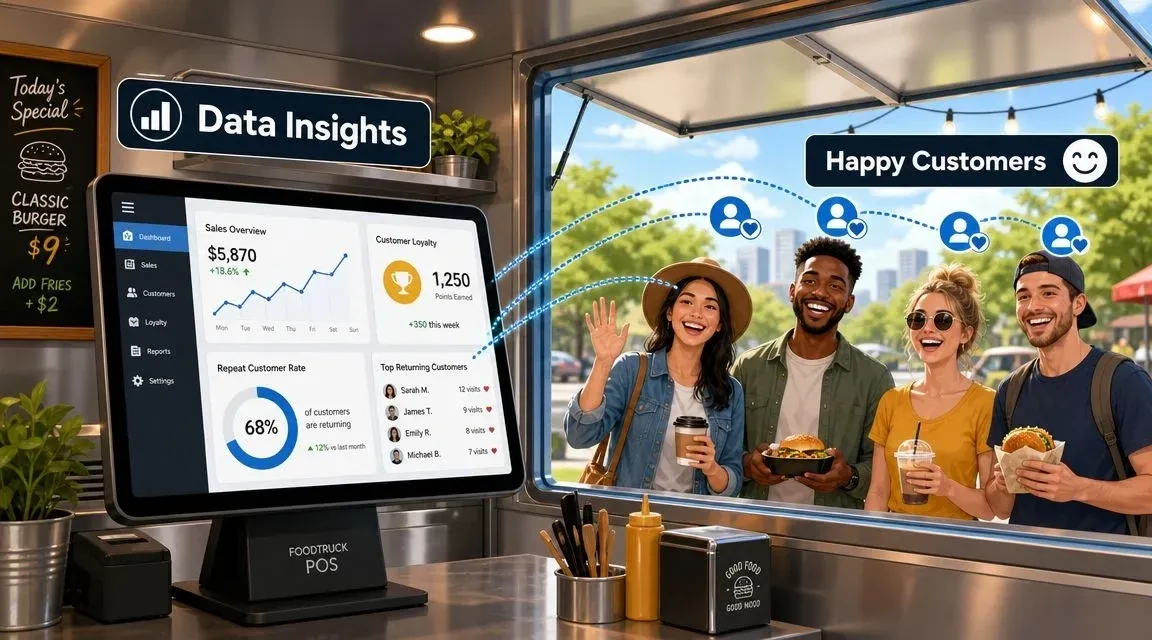
Marketing gets expensive when every sale has to be won from scratch. Food trucks don’t have much room for that. With about 60% of food trucks failing in their first year and average net margins around 6%–9%, marketing that improves repeat frequency and predictable demand matters far more than vanity metrics, according to this food truck failure rate analysis.
Track the numbers that change decisions
You don’t need a giant dashboard to run smarter food trucks marketing. You need a short list of metrics that affect schedule, staffing, and promotions.
Start with:
- Average ticket size: Which locations and channels produce stronger checks?
- Order volume by stop: Which recurring spots carry the week?
- Repeat customer behavior: Are people coming back, or just trying you once?
- Item mix: Which products sell fast without slowing the line?
- Channel mix: Are direct orders easier to fulfill than marketplace orders?
If all your orders run through a central POS, the answers become easier to trust. Operators on Square can use connected ordering data to see patterns more clearly than they can from disconnected tablets and handwritten notes.
Loyalty should be operationally simple
Loyalty programs fail when they add friction. The right version for a truck is easy for customers and staff.
Good options include:
- Digital punch cards: Simple and familiar
- SMS alerts for recurring stops: Useful when your route moves
- Reorder prompts after popular service windows: Catch customers while intent is fresh
- Offer-based campaigns tied to specific stops: Fill weaker dayparts without discounting everything
The goal isn’t to blast everyone. It’s to create predictable return visits.
A repeat customer who already knows your menu, ordering flow, and pickup process is usually more profitable than a new customer who needs to be won from zero.
Measure promotions by workload, not just sales
A campaign can increase orders and still be a bad decision if it overloads your line, creates modifier chaos, or attracts one-time bargain hunters. That’s why I tell operators to review promotions through an operations lens.
Ask:
- Did the promotion increase orders you can fulfill cleanly?
- Did it lift the right menu items?
- Did it produce repeat behavior after the campaign ended?
- Did staff have to do extra manual work to support it?
That’s the difference between buzz and ROI. Buzz fills a shift. ROI improves the business.
Your Next Step to a More Profitable Food Truck
A profitable truck shift starts before service. The prep is tighter, the order flow is cleaner, and the staff is not juggling tablets while a line forms at the window. Marketing plays a role in that, but only when it is tied to the systems that run the truck.
The operators who grow steadily usually stop treating marketing as a separate task. They connect brand, route timing, online ordering, delivery, and POS data so each promotion supports the way the truck works. That means fewer manual handoffs, fewer missed tickets, and more chances to turn a busy lunch into repeat business next week.
That is the standard to aim for.
If your current setup still depends on patching together apps, screenshots, and end-of-day guesswork, the next step is simple. Clean up the stack first. Then build campaigns on top of it. That approach gives you a smoother service window, better visibility into what sells at each stop, and a business that gets easier to run as volume grows.