
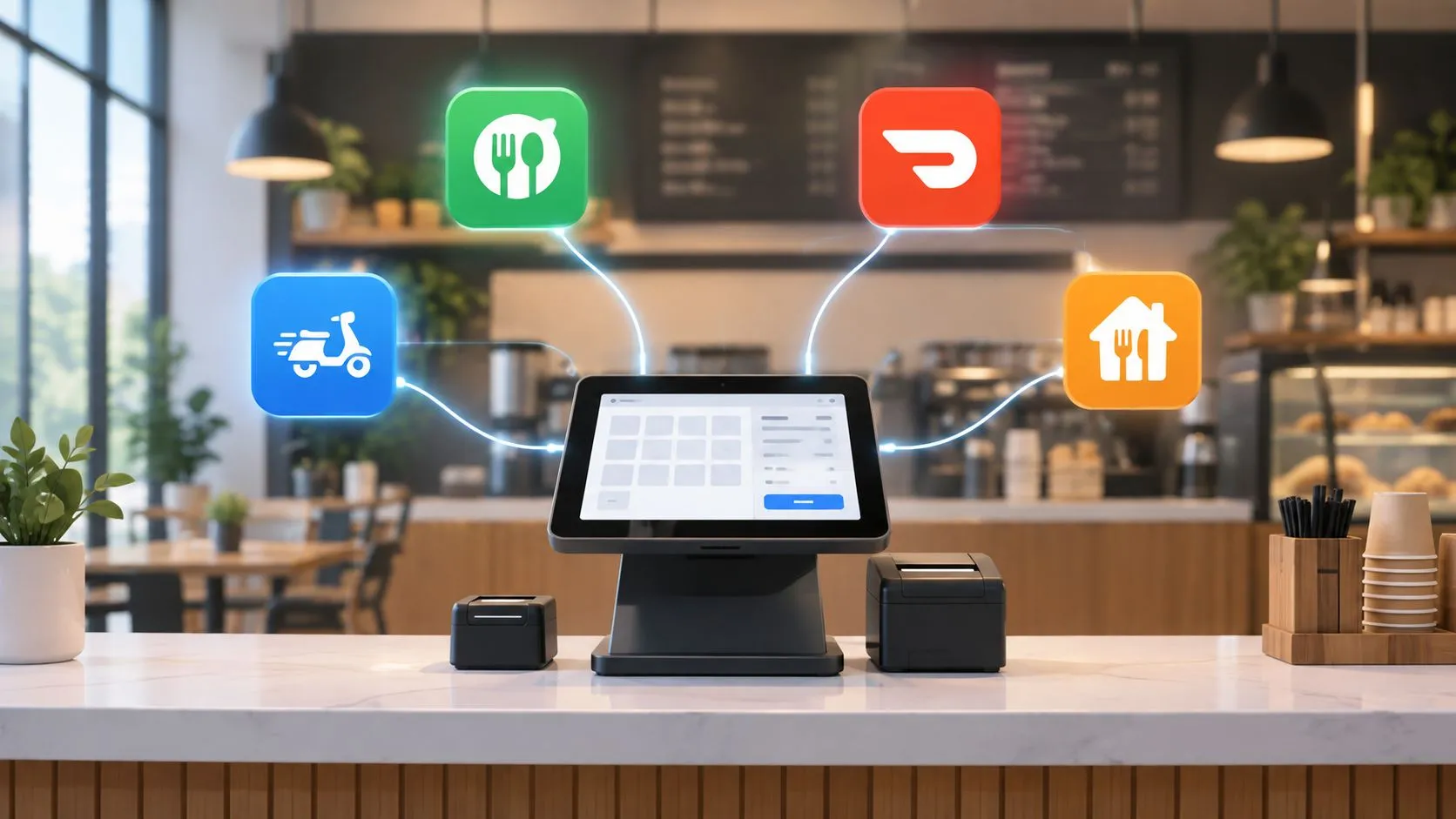
Delivery service comparison for restaurants should start with whether Uber Eats, DoorDash, and Grubhub orders reach Clover or Square cleanly, not with which app charges diners the lowest fee. The surprising operational truth is that marketplace choice matters less when every order still requires staff to watch another tablet, re-key items, and reconcile menu changes by hand. A platform mix only works when the kitchen, POS, and marketplace stay aligned.
For restaurant operators, the comparison is reach versus control. You need to weigh customer discovery, delivery coverage, contract terms, promotions, support, commission structure, and fulfillment reliability. Then you need to ask a harder question: can your team run those channels during a rush without creating duplicate tickets, unavailable-item mistakes, or unnecessary remake labor?
This guide evaluates Uber Eats, DoorDash, Grubhub, and regional delivery services from that operator perspective. It also explains why direct POS injection and two-way menu synchronization can change the economics of running multiple marketplaces. For broader comparison research, the PostPulse comparison guide offers useful context on how comparison content can frame competing services.
Delivery Service Comparison That Actually Helps You Decide
A useful delivery service comparison measures what happens after a guest places an order. Does the order enter the POS automatically? Does the kitchen receive one reliable ticket? Does an item marked unavailable on Clover or Square stop appearing on the marketplace? Can a manager see the order without juggling separate devices?
Most consumer guides stop at delivery fees, coverage, and app popularity. Those details matter, but they don’t show the cost of operational drag. A lower headline commission can become expensive when employees retype orders, miss modifiers, accept an unavailable item, or discover a marketplace ticket after the kitchen has already fallen behind.
Operator rule: Compare the complete order path, not just the customer-facing checkout.
The strongest platform for one restaurant may not be the strongest platform for another. An urban quick-service restaurant may prioritize discovery and dense delivery demand. An independent full-service restaurant may care more about menu control, accurate modifiers, and a manageable support process. A suburban operation may need broad reach but can’t justify a separate tablet for every marketplace.
Compare the channel and the workflow
Use the marketplace comparison to decide where demand comes from, then use the integration review to decide whether your team can fulfill that demand consistently. A service that generates orders but creates kitchen confusion isn’t a complete sales channel.
Your evaluation should answer these questions:
- Demand: Does the app expose your restaurant to customers you wouldn’t reach through direct ordering?
- Economics: What commissions, payment costs, promotions, refunds, and operational labor apply?
- Control: Can you manage menus, modifiers, availability, and hours from the POS?
- Execution: Do orders flow into the same system your staff already uses?
- Flexibility: Can you run multiple platforms without adding more devices and manual work?
OrderOut’s delivery service comparison for restaurants is a useful starting point for the marketplace side of that decision. The practical next step is to connect the chosen channels to the POS, so the platform mix doesn’t become a collection of disconnected workstations.
How Delivery Became a Core Restaurant Sales Channel
Online restaurant ordering started as an experiment, but the channel has become part of mainstream restaurant operations. Pizza Hut’s PizzaNet enabled the first online food order in 1994, World Wide Waiter launched in 1995 as one of the first online restaurant delivery services, and Grubhub was founded in 2004, according to Macquarie’s history of online food delivery.
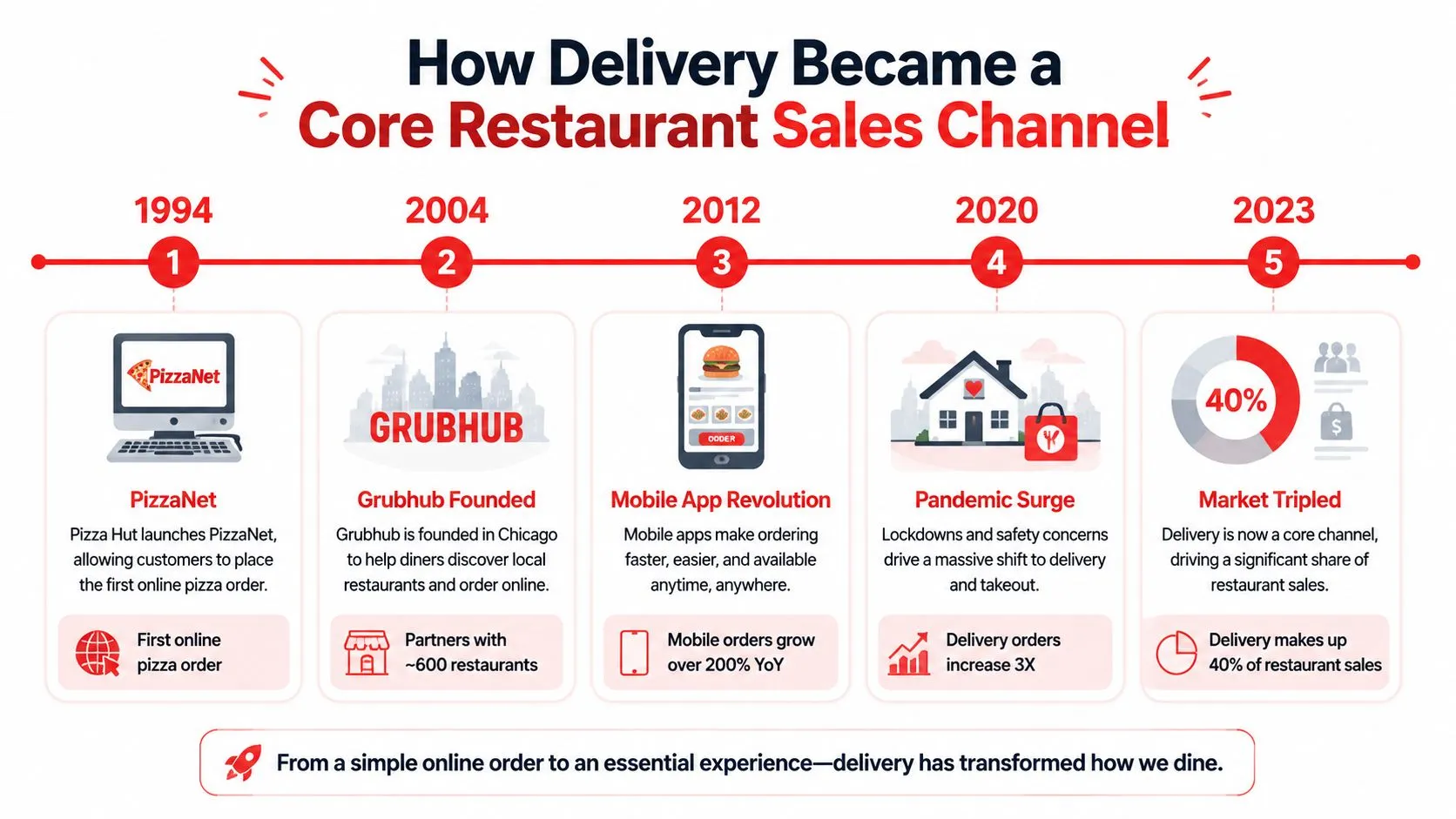
The important shift wasn’t just the arrival of ordering websites or mobile apps. Restaurants gained access to a new customer acquisition layer, while consumers gained a habit of browsing menus without visiting a restaurant’s own website. That changes the role of delivery marketplaces. They can function as checkout tools, discovery channels, or both.
By the early 2020s, Macquarie described global online food delivery as a market of more than US$150 billion that had tripled over five years. That progression shows why a restaurant’s delivery strategy can’t be treated as a side project. The channel moved from a novelty into a serious restaurant sales path within a relatively short period.
Scale creates an operations problem
McKinsey reported the worldwide food delivery market at €83 billion, equal to 1% of the total food market and 4% of food sold through restaurants and fast-food chains, with approximately 3.5% expected annual growth over the following five years at that time. More recent independent estimates cited in the verified industry data place the global online food delivery market at about US$288.84 billion in 2024, with a projection of US$505.50 billion by 2030. Those figures are reported in McKinsey’s food delivery market analysis.
For a single location, scale means more opportunity and more operational exposure. If customers discover restaurants inside delivery apps, being absent can reduce visibility. But being present on several apps without a clean order flow can burden the same staff responsible for dine-in, pickup, and phone orders.
A calm service depends on more than demand generation. Pebb’s discussion of calm restaurant operations provides useful context for why managers need consistent workflows, clear ownership, and fewer disconnected tasks.
The takeaway is simple. Delivery is too established to ignore, but marketplace presence alone isn’t a strategy. The restaurant needs a controlled way to accept, route, prepare, and update every order.
Uber Eats DoorDash and Grubhub Side by Side
Operators shouldn’t choose a marketplace because one app is universally “best.” Each platform has a different balance of reach, discovery, delivery operations, promotions, support, and commercial terms. The right mix depends on whether your priority is new customer acquisition, repeat ordering, margin protection, or a simpler kitchen workflow.
| Evaluation Criteria | Uber Eats | DoorDash | Grubhub | Regional Players |
|---|---|---|---|---|
| Commissions and fees | Review the plan, service fees, promotions, and contract terms offered to your restaurant | Review the plan, service fees, promotions, and contract terms offered to your restaurant | Review the plan, service fees, promotions, and contract terms offered to your restaurant | Terms vary widely by market and provider |
| Geographic reach | Broad marketplace presence, with local coverage to verify | Broad marketplace presence, with local coverage to verify | Broad marketplace presence, with local coverage to verify | Often strongest in selected cities or regions |
| Delivery reliability | Assess actual pickup coordination and handoff performance at your location | Assess actual pickup coordination and handoff performance at your location | Assess actual pickup coordination and handoff performance at your location | Can be strong where local dispatch density is high |
| Customer discovery | Marketplace browsing can introduce new customers | Marketplace browsing can introduce new customers | Marketplace browsing can introduce new customers | Local familiarity may support discovery |
| Marketing tools | Review sponsored placement, promotions, and customer offers | Review sponsored placement, promotions, and customer offers | Review sponsored placement, promotions, and customer offers | Often more relationship-driven |
| Contract terms | Confirm cancellation, exclusivity, pricing, and promotion conditions | Confirm cancellation, exclusivity, pricing, and promotion conditions | Confirm cancellation, exclusivity, pricing, and promotion conditions | Terms depend on the local provider |
| Support | Test escalation quality before relying on the channel | Test escalation quality before relying on the channel | Test escalation quality before relying on the channel | Direct local support may be available |
What to inspect before signing
Start with the commercial agreement, but don’t stop there. Ask how the platform handles refunds, missing items, delivery disputes, menu changes, temporary closures, and customer support. A contract that looks acceptable on paper can become difficult if your team has no efficient way to resolve an incorrect order.
DoorDash, Uber Eats, and Grubhub can each contribute demand, but running all three creates a synchronization challenge. Regional players may deserve a place in the mix when they have strong local demand or better relationships with nearby drivers. They shouldn’t receive automatic priority just because they promise lower fees.
The best marketplace mix is the one your staff can fulfill accurately without adding a second management system.
Use the same checklist for every channel. Record order accuracy, preparation consistency, menu update behavior, refund handling, and support response quality. A platform that produces fewer orders but requires little intervention may be more useful than a busy channel that consumes manager attention.
For a narrower marketplace breakdown, see the Uber Eats, DoorDash, and Grubhub comparison. Then test each channel against your actual POS workflow rather than relying on popularity alone.
How POS Integration Changes Operational Impact
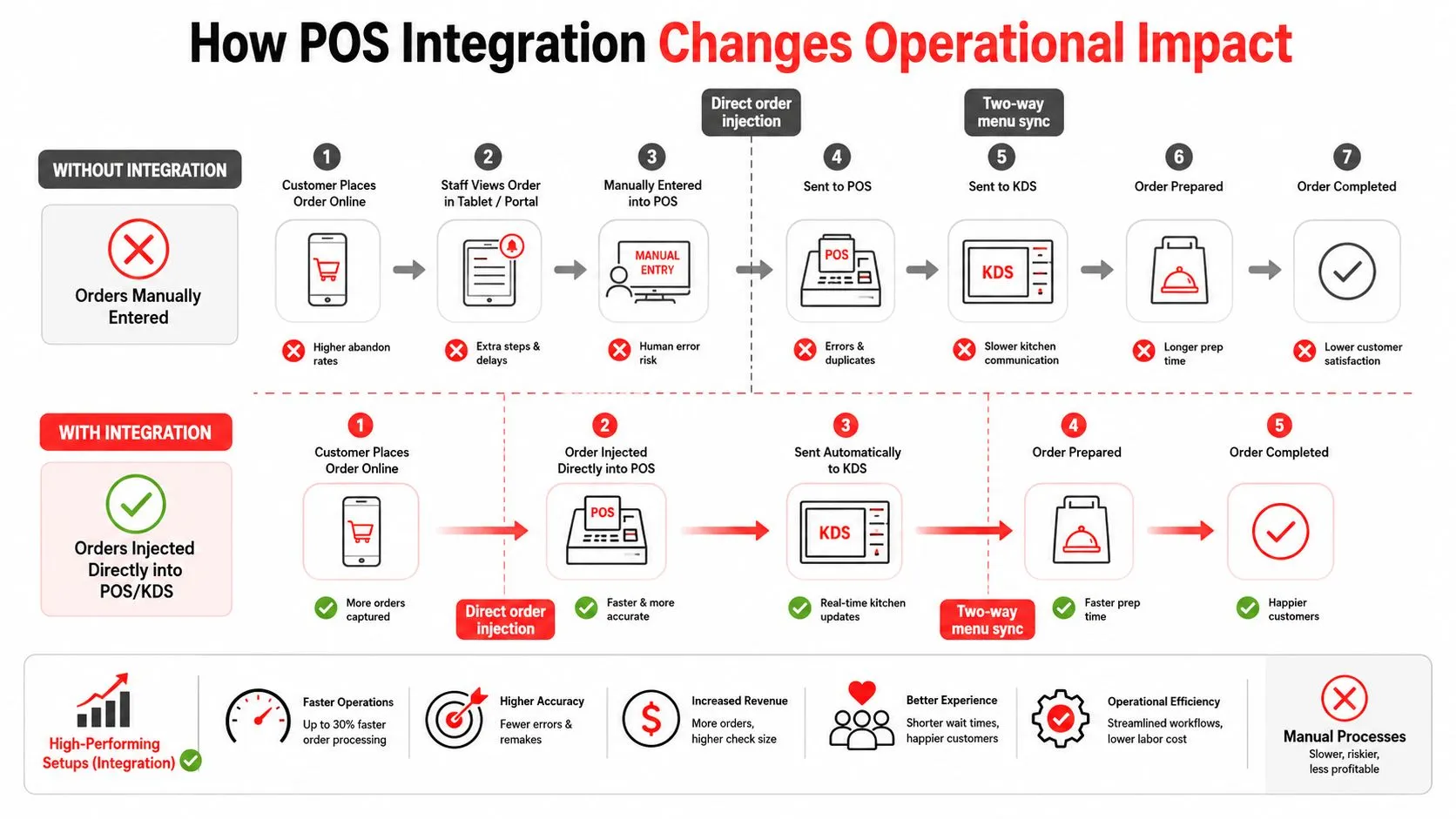
Marketplace selection determines where orders originate. POS integration determines whether your restaurant can handle them cleanly. Two technical features separate strong delivery setups from weak ones: direct order injection into the POS or KDS, and two-way menu synchronization.
Direct injection sends the marketplace order into Clover or Square without staff retyping it. Two-way synchronization carries item, price, availability, and modifier changes across connected channels. Together, those functions reduce duplicate entry and help the POS remain the operational source of truth.
The integration flow
Uber’s Marketplace APIs are designed for restaurant POS integrations. Uber’s developer documentation says partners can programmatically manage stores, menus, and orders, while POS integrations can synchronize menus, inject orders, and remove manual processes. Uber also states a 99% injection success-rate requirement for production integrations.
The operator-facing flow includes several technical steps:
- Authorization: A merchant authorizes the integration through OAuth.
- Provisioning: The integration partner uses the POS provisioning endpoint to set up the store.
- Access: Uber says the authorization enables continuing store, order, and menu API access until the merchant or Uber ends it.
- Mapping: POS products are linked to marketplace products so item and modifier relationships remain consistent.
- Routing: Orders can be automatically accepted and sent into the POS for kitchen printing.
Uber’s merchant POS integration guidance specifically describes menu mapping, including the ability for an item marked unavailable on the POS to propagate to Uber Eats. That matters during service. If a popular modifier or entrée sells out, staff shouldn’t have to update several systems separately.
OrderOut maps each marketplace menu to a normalized POS schema for Clover and Square. You can review the broader POS system integration approach when evaluating how menu mapping, order routing, and kitchen printing should work together.
Without integration, staff monitor marketplace tablets, accept orders, and re-enter each ticket. With injection, the POS receives the order and the kitchen works from the same operational queue used for other sales. DoorDash documents a similar setup path through its Merchant Portal, where merchants can choose an integration provider under Settings and Integrations, or select Other if their provider isn’t listed, as described in DoorDash’s integration guidance.
True Cost Beyond Commission and Fees
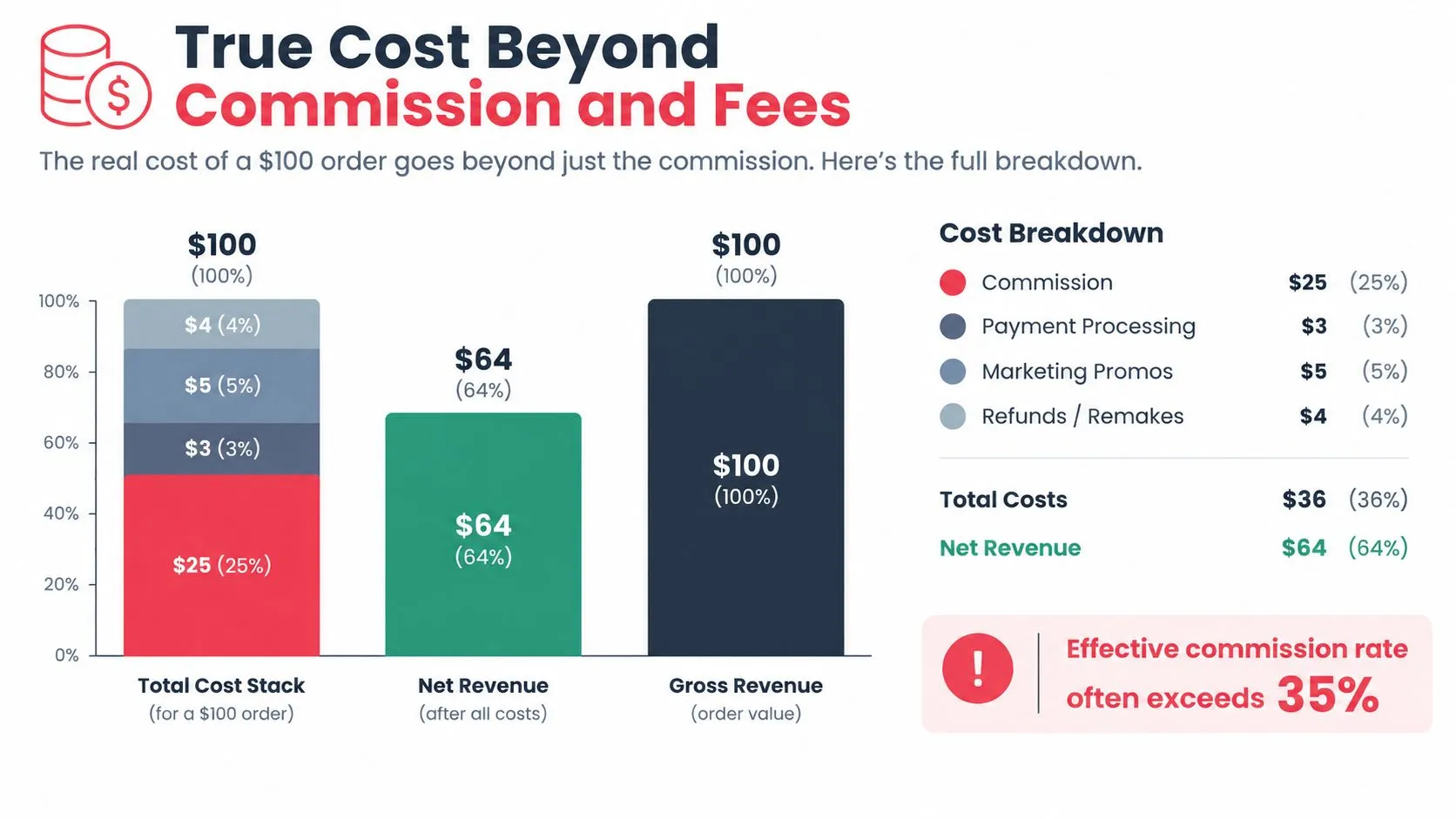
A commission comparison is incomplete if it ignores the cost of fulfilling the order. The full stack can include marketplace commission, payment processing, paid promotions, refunds, remakes, tablet management, manual re-keying, and lost sales caused by stale availability.
The useful question isn’t “Which service has the lowest fee?” It’s “Which channel leaves the most reliable net contribution after the restaurant fulfills the order correctly?” A platform with a slightly higher commercial cost may be easier to operate if it creates fewer corrections, fewer refunds, and less manager intervention.
Model the invisible labor
Build a simple per-platform review around these categories:
- Marketplace charges: Record the commission and every service charge that affects the restaurant.
- Promotional spend: Separate optional discounts and sponsored placement from unavoidable costs.
- Payment handling: Include processing costs where they apply.
- Correction work: Track refunds, remakes, missing modifiers, and customer recovery.
- Staff attention: Estimate the management time spent monitoring tablets, re-entering orders, and resolving mismatches.
- Availability loss: Note orders affected by items that remained live after the kitchen sold out.
Suppose two platforms produce similar sales. One sends clean orders into Clover or Square, while the other requires manual entry and often presents outdated modifiers. The first may produce a better operating result even if its headline fee isn’t the lowest, because the second channel creates correction work and exposes the restaurant to avoidable refunds.
Vendor-reported benchmarks illustrate why injection quality deserves attention. One platform reports a 99.98% order injection rate, while another describes native API integrations that send marketplace orders directly to the KDS with a 98.5% order accuracy rate, as reported by Deliverect’s order management documentation. These are vendor-reported figures, not a universal industry benchmark, but they show how mature integrations are evaluated. Small differences can matter when order volume accumulates.
Hidden charges also affect customer confidence, so operators should review hidden fees and customer trust when judging the wider checkout experience. For a restaurant-focused look at marketplace charges, use the delivery app fees guide.
KPIs to Track and How to Negotiate Your Platform Mix
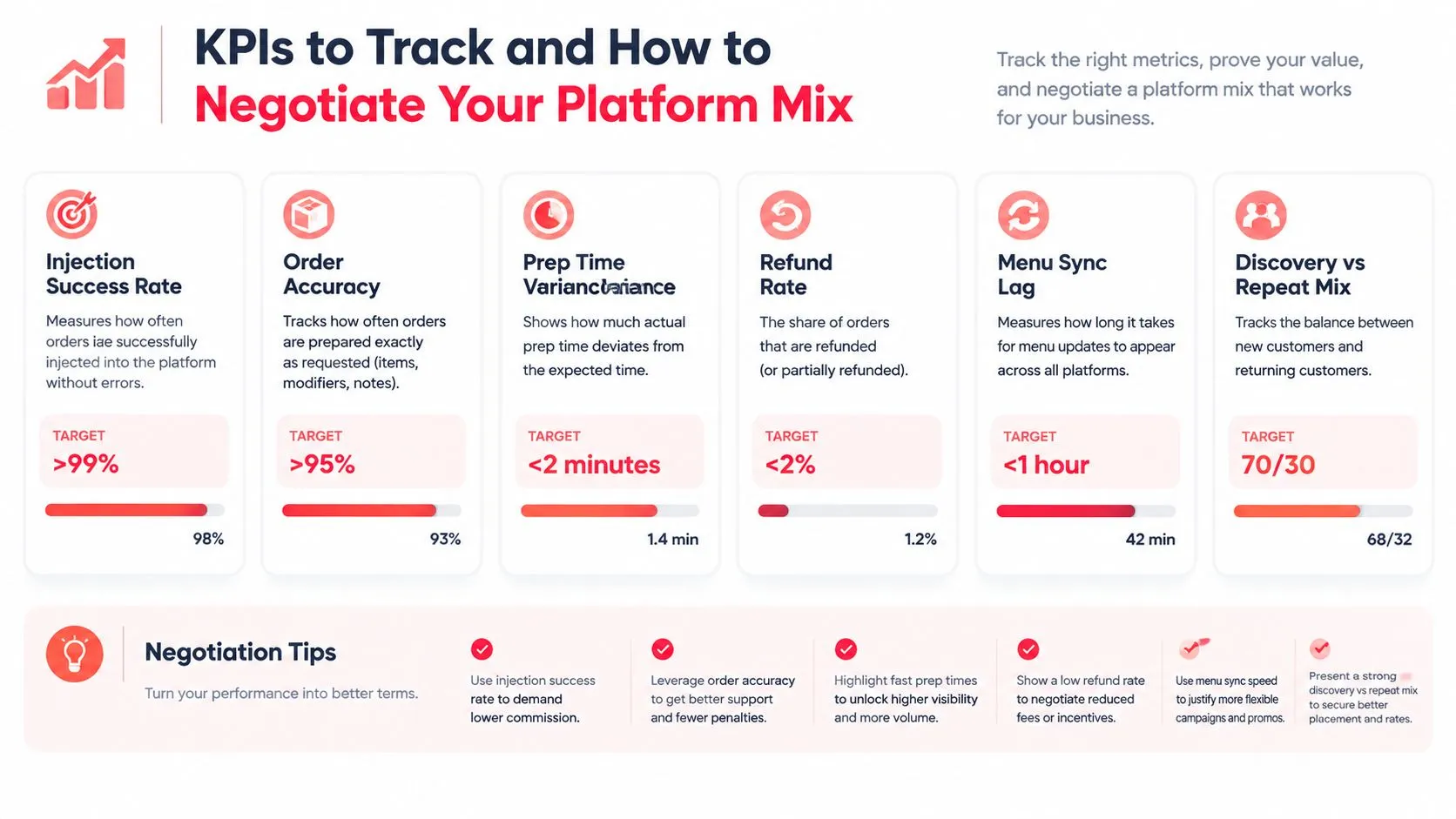
Run each marketplace like an operating channel, not a passive listing. The most useful dashboard combines technical reliability with customer behavior. A platform can look attractive because it generates discovery while still creating avoidable kitchen work.
Track these measures by channel:
- Injection success rate: Count how often orders reach the POS without intervention.
- Order accuracy: Compare marketplace tickets with what the guest ordered and what the kitchen produced.
- Prep-time variance: Watch the gap between promised preparation and actual kitchen readiness.
- Refund rate: Separate refunds caused by delivery issues from those caused by menu or order-entry errors.
- Menu sync lag: Record how long an availability or modifier change takes to appear across channels.
- Discovery versus repeat mix: Distinguish new marketplace discovery from returning customers who already know your restaurant.
The supplied visual asset URL must be used exactly as provided in the brief. The correct asset is shown below.
Independent data gives operators a reason to look beyond brand familiarity. InTouch Insight’s third-party delivery report says third-party platform accuracy improved by only 1 percentage point in 2025, while the restaurant-versus-convenience-store accuracy gap narrowed from 13 points to 7. The same report says first-party apps outperformed third-party platforms on speed, accuracy, and customization.
That doesn’t mean every restaurant should abandon marketplaces. It means your negotiation should include operational evidence. If a platform produces strong discovery but weak accuracy, ask for support, menu controls, or commercial terms that reflect the extra work. If a channel creates repeat demand with clean POS flow, protect that relationship.
Make the platform mix deliberate
DoorDash’s 2026 reporting says 37% of consumers discover restaurants through delivery apps, more than 55% of first-time DoorDash orders in 2025 came from browsing, and DoorDash holds over 65% of the U.S. food delivery market, according to the reporting summarized by Digisoft Solution. The same source cites a separate 2026 consumer report saying 51% discover restaurants through Google and 64% would prefer one app for delivery, pickup, and reservations.
That combination supports a balanced strategy. Marketplaces can provide discovery, while a branded direct channel can improve control over repeat ordering. Use the third-party delivery fee negotiation guide to turn your measured performance into specific talking points.
Which Delivery Service Fits Your Restaurant Right Now
A high-volume quick-service restaurant should usually prioritize broad discovery and fast operational flow. Running Uber Eats, DoorDash, and Grubhub can make sense if each channel adds meaningful demand, but only when orders enter Clover or Square without forcing the line to re-key tickets.
An independent full-service restaurant should be more selective. Keep the marketplaces that bring useful discovery, remove channels that create disproportionate support work, and maintain a branded ordering page for repeat guests. Commission-free online ordering gives the restaurant a direct path that it controls instead of relying on a marketplace for every transaction.
A ghost kitchen needs menu discipline above everything else. Frequent item changes, shared ingredients, and modifier-heavy menus make two-way synchronization especially important. Suburban restaurants should verify local demand and delivery coverage before adding another marketplace, because a broad national brand doesn’t guarantee efficient service at one address.
The strongest setup is often a channel mix rather than a single winner:
- Marketplaces provide discovery and access to customers browsing delivery apps.
- Direct online ordering gives repeat guests a branded route to place pickup or delivery orders.
- AI phone ordering captures calls during rush periods and sends orders into the POS when configured for that workflow.
- POS integration keeps Clover or Square as the central operational record.
OrderOut connects Uber Eats, DoorDash, and Grubhub to Clover or Square by mapping marketplace menus to a normalized POS structure. It also offers commission-free online ordering and AI phone ordering, so operators can preserve marketplace discovery while building more controlled ordering paths.
The practical move is to audit every tablet, menu, and error source, then consolidate the channels that earn their place. Start with one POS integration, clean the menu and modifiers, and measure the resulting order flow before expanding the mix.
Frequently Asked Questions
Does OrderOut work with Clover?
OrderOut connects delivery marketplaces such as Uber Eats, DoorDash, and Grubhub to Clover. Orders are mapped into the POS so staff don’t have to re-key each marketplace ticket.
Does OrderOut work with Square?
Yes. OrderOut supports delivery-to-POS routing for Square, including marketplace menu mapping and order injection. The restaurant can use Square as the operational source of truth for connected orders.
Can I run Uber Eats DoorDash and Grubhub together?
You can run multiple marketplaces together, but the restaurant needs a reliable integration and disciplined menu management. Direct order injection and synchronized item availability help reduce the manual work created by a multi-platform setup.
Does POS integration remove delivery marketplace fees?
No. POS integration changes how orders are received and managed. It doesn’t remove the commercial terms set by Uber Eats, DoorDash, Grubhub, or another marketplace.
Is OrderOut free to install on Clover?
OrderOut is free to install on the Clover App Market. Restaurant owners can begin through the Clover App Market listing, then complete onboarding for their connected ordering channels.
Visit OrderOut to connect Uber Eats, DoorDash, and Grubhub with Clover or Square, remove extra delivery tablets, and keep marketplace orders flowing into the POS. Start onboarding at OrderOut’s merchant dashboard, where restaurant owners can get set up free in a few clicks.