
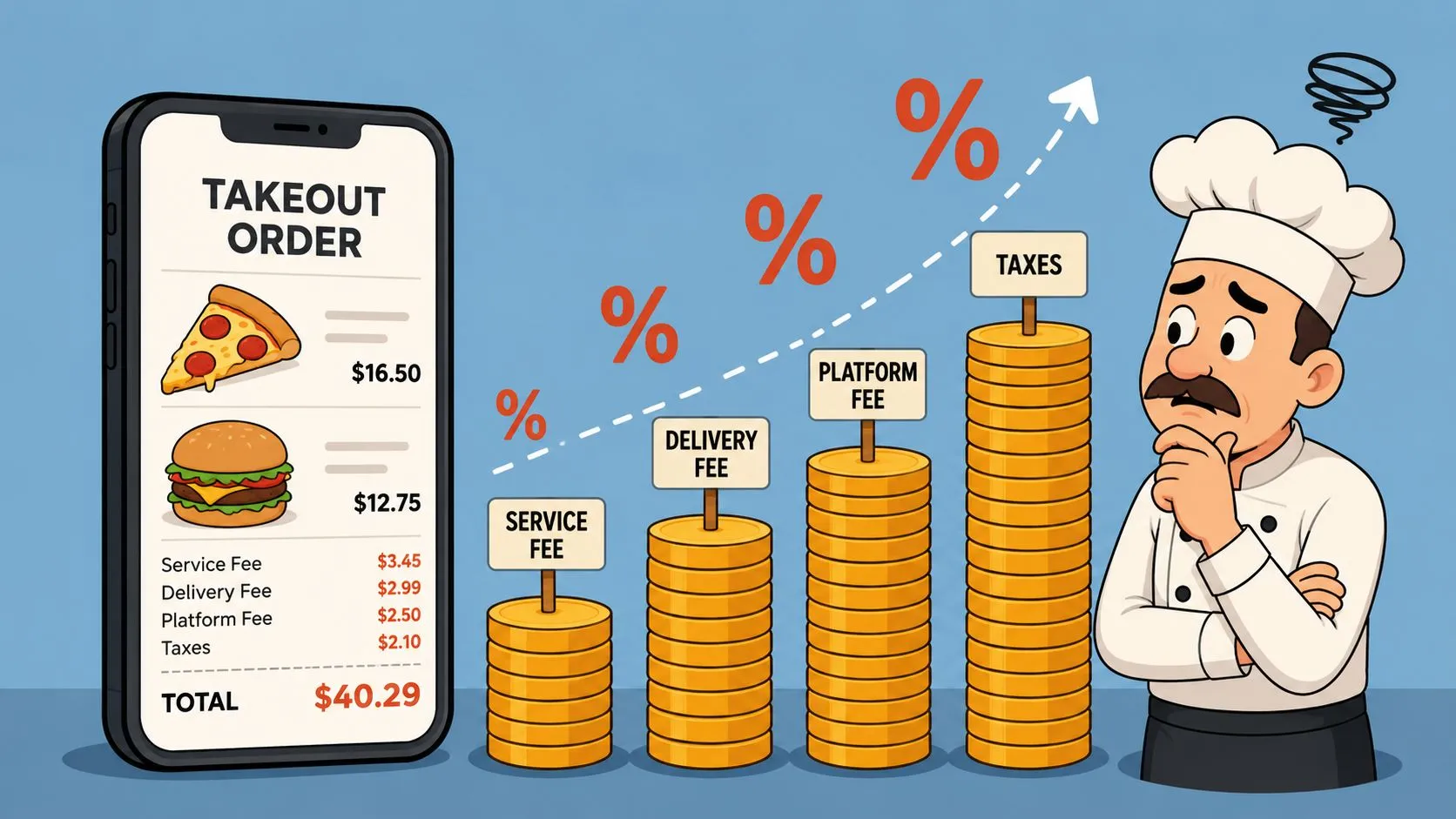
Delivery app fees are the layered charges marketplaces apply to each restaurant order, with commissions alone typically running 15% to 30%. The all-in cost often reaches 25% to 35% after delivery, payment processing, and marketing charges are included.
That difference changes the decision. A restaurant can appear busy on DoorDash, Uber Eats, or Grubhub while giving up roughly one-quarter to one-third of gross order value before paying for food, labor, packaging, and overhead, as documented in restaurant delivery commission analysis. The commission line is easy to notice. The operational costs around it are where many owners lose control.
What Delivery App Fees Actually Are
Delivery app fees are the charges a marketplace applies to facilitate, process, promote, or deliver a restaurant order. DoorDash, Uber Eats, and Grubhub typically charge a commission of 15% to 30% per order, depending on the plan, service level, market, and contract. Published 2026 rate-card summaries list DoorDash’s United States delivery plans at 15% for Basic, 25% for Plus, and 30% for Premier, with pickup orders around 6% for eligible partners according to DoorDash fee comparisons.
The headline commission doesn’t tell you what the order costs. The full stack can include:
- Marketplace commission, calculated as a percentage of the order subtotal.
- Payment processing, applied to the transaction or settlement.
- Marketing charges, including promoted listings, sponsored placement, or discounts funded by the restaurant.
- Delivery-related charges, depending on the service arrangement.
- Packaging, refunds, cancellations, and reconciliation work, which may not appear as one obvious fee line.
An all-in fee is the combined amount of every percentage and flat charge removed from an order before you calculate the restaurant’s usable revenue. Independent reporting places that blended cost at about 25% to 35% once delivery, payment processing, and marketing fees are included, as reported by CNBC’s coverage of rising food delivery fees.
Practical rule: Never judge a delivery channel by its commission rate alone. Judge it by contribution margin after every cost tied to that order.
This matters most during busy periods. A high order count can hide weak economics when the restaurant pays premium commissions, funds promotions, absorbs refunds, and spends staff time correcting tickets. If you watch only the commission line, you can set menu prices too low, approve unprofitable promotions, and mistake gross sales for profit.
The useful question isn’t “What percentage does this app charge?” It’s “What remains after the entire order has passed through the platform and the restaurant?”
Every Fee Type Explained
A delivery app’s advertised commission is only the first line in the calculation. Your statement may use different labels, so match every charge to the contract, settlement report, and order data instead of relying on the platform’s starting rate.
The core percentage charges
| Fee Type | Who Pays | How It’s Calculated | Typical Range |
|---|---|---|---|
| Commission | Restaurant | Percentage of the order subtotal or contracted order value | 15% to 30% for marketplace delivery, according to CloudKitchens’ restaurant delivery fee overview |
| Service fee | Customer, sometimes shared through the platform model | Customer-facing charge set by the marketplace, with restaurant economics affected by the plan | Varies by market and contract |
| Delivery fee | Customer, sometimes partly absorbed by the restaurant | Based on delivery distance, demand, plan, or customer offer | Varies by market and order |
| Marketing or promotion | Restaurant, customer, or both | Percentage, flat campaign charge, or discount subsidy | Varies by campaign |
| Card processing | Restaurant or platform pass-through | Percentage plus a possible flat transaction charge | A percentage plus a possible flat transaction charge, depending on the arrangement |
| Onboarding or activation | Restaurant | One-time setup or activation charge | Contract-specific |
| Small-order fee | Customer, sometimes affecting restaurant economics | Applied when an order falls below a platform minimum | Contract-specific |
| Cancellation or adjustment fee | Restaurant, customer, or platform allocation | Applied after cancellation, refund, dispute, or order correction | Contract-specific |
Commission gets the most attention because it is easy to spot. A lower-rate plan may cover marketplace access, while a higher tier can include delivery support, visibility tools, or promotional exposure. The headline rate still says little about what the restaurant keeps after the other deductions.
Marketing charges often create the largest blind spot. Promoted listings, featured placement, boosts, and restaurant-funded discounts can add cost to an order that already carries commission. Review each campaign by contribution margin, not by order volume.
Charges that hide in the settlement
A customer-facing delivery fee is not automatically the restaurant’s expense. The contract determines whether the restaurant absorbs part of delivery, promotion, or another platform charge. Payment processing may appear as a separate pass-through, which makes the commission look lower until the settlement is reconciled.
Pickup needs a separate check. Some plans still charge a commission on pickup orders, even though the platform does not provide a driver. That charge may be lower than delivery economics, but it still reduces the revenue from an order requiring no platform delivery service.
The operational costs sit outside the fee table. Staff may re-key orders from marketplace tablets into the POS, correct mismatched modifiers, reconcile refunds, and resolve duplicate tickets. Those errors consume labor and can create waste or missed orders. A guide to third-party delivery services can help compare service models, but the signed agreement and settlement report determine your actual cost.
Before renewal, export settlement detail and identify every fee code. Compare those codes with the rate card, then calculate the full cost per channel, including packaging, corrections, refunds, and reconciliation time. That is the number to use for pricing, promotion decisions, and channel reviews.
How Fees Stack on a Real Order
A worked example exposes the problem faster than a commission headline. Consider a $25 subtotal with a 25% commission, a 10% marketing charge, 3% processing calculated after commission, and a $0.50 small-order adjustment.
The commission removes $6.25. The marketing charge removes $2.50. The post-commission amount is $18.75, so 3% processing removes $0.56, and the adjustment adds $0.50. The total reaches $9.81, before food, labor, packaging, refunds, or overhead. That is close to 40% of the subtotal, but this calculation is an illustrative scenario, not a universal platform rate.
| Ticket Size | Commission | Marketing Fee | Processing + Other | Total Fees | % of Subtotal |
|---|---|---|---|---|---|
| $25 | $6.25 | $2.50 | $1.06 | $9.81 | About 40% |
| $40 | $10.00 | $4.00 | $1.70 | $15.70 | About 39% |
| $18 | $4.50 | $1.80 | $1.04 | $7.34 | About 41% |
The same structure hits smaller tickets harder because flat charges consume more of the order. A $40 ticket still loses substantial dollars, but the restaurant has more revenue left to cover fixed operating costs. A low-ticket order has less room for packaging, labor, and mistakes before its contribution margin disappears.
The important accounting distinction is gross sales versus contribution margin. Gross sales show the order value. Contribution margin shows what remains after platform charges and the variable costs directly connected to fulfilling that order.
Track marketplace deposits against the original order detail, not just the bank statement. This guide to reconciling delivery-order differences can help operators identify where settlement totals diverge from the POS and marketplace records.
Comparing DoorDash, Uber Eats, and Grubhub
No platform is permanently cheapest for every restaurant. Your true cost depends on the plan, included services, promotion settings, local market, and contract language. Compare the full settlement, including indirect work created by multiple tablets and manual order entry.
| Platform | Commission Range | Marketing Add-On | Service/Delivery Fee | Subscription Plan |
|---|---|---|---|---|
| DoorDash | 15% to 30% | Boosts and sponsored visibility can add a separate charge | Varies by customer offer and agreement | Storefront and other plan terms vary |
| Uber Eats | 15% to 30% | Promoted Listings and restaurant-funded promotions can add cost | Varies by customer offer and agreement | Plan availability and pricing vary |
| Grubhub | 15% to 30% in the broad marketplace range | Self-serve advertising and promotional participation can add cost | Varies by customer offer and agreement | Basic, Plus, Corporate, and Enterprise terms vary |
DoorDash’s published rate-card summaries show tiered delivery pricing at 15%, 25%, and 30%, with pickup around 6% for eligible partners, as reported in DoorDash, Uber Eats, and Grubhub fee comparisons. The lowest commission is not automatically the best deal. A cheaper tier may provide fewer delivery, visibility, or promotional tools. A higher tier may bring more discovery while leaving less margin per order.
Uber Eats can create the same tradeoff through Promoted Listings and other advertising tools. Grubhub’s self-serve advertising adds another cost to audit. Platform names are useful for organizing the comparison, but the enabled services and settlement terms determine the result.
What matters is the settlement report, not the published rate card. Check the actual deductions after commissions, processing, marketing, delivery allocation, refunds, and pickup adjustments. POS integration also belongs in the comparison. Re-keying marketplace orders increases error risk and labor, while separate tablets add device, training, and monitoring work.
Ask every representative for a plain-language fee breakdown before signing. This side-by-side look at Uber Eats, DoorDash, and Grubhub provides a useful framework for that conversation, but your own settlement records should decide which offer protects margin.
How Restaurants Can Reduce and Offset Fees
Fee control starts with deciding which orders deserve marketplace access and which should move to a direct channel. Don’t raise every menu item blindly. Start with contribution margin, travel quality, packaging needs, and customer demand.
Improve the menu before changing the contract
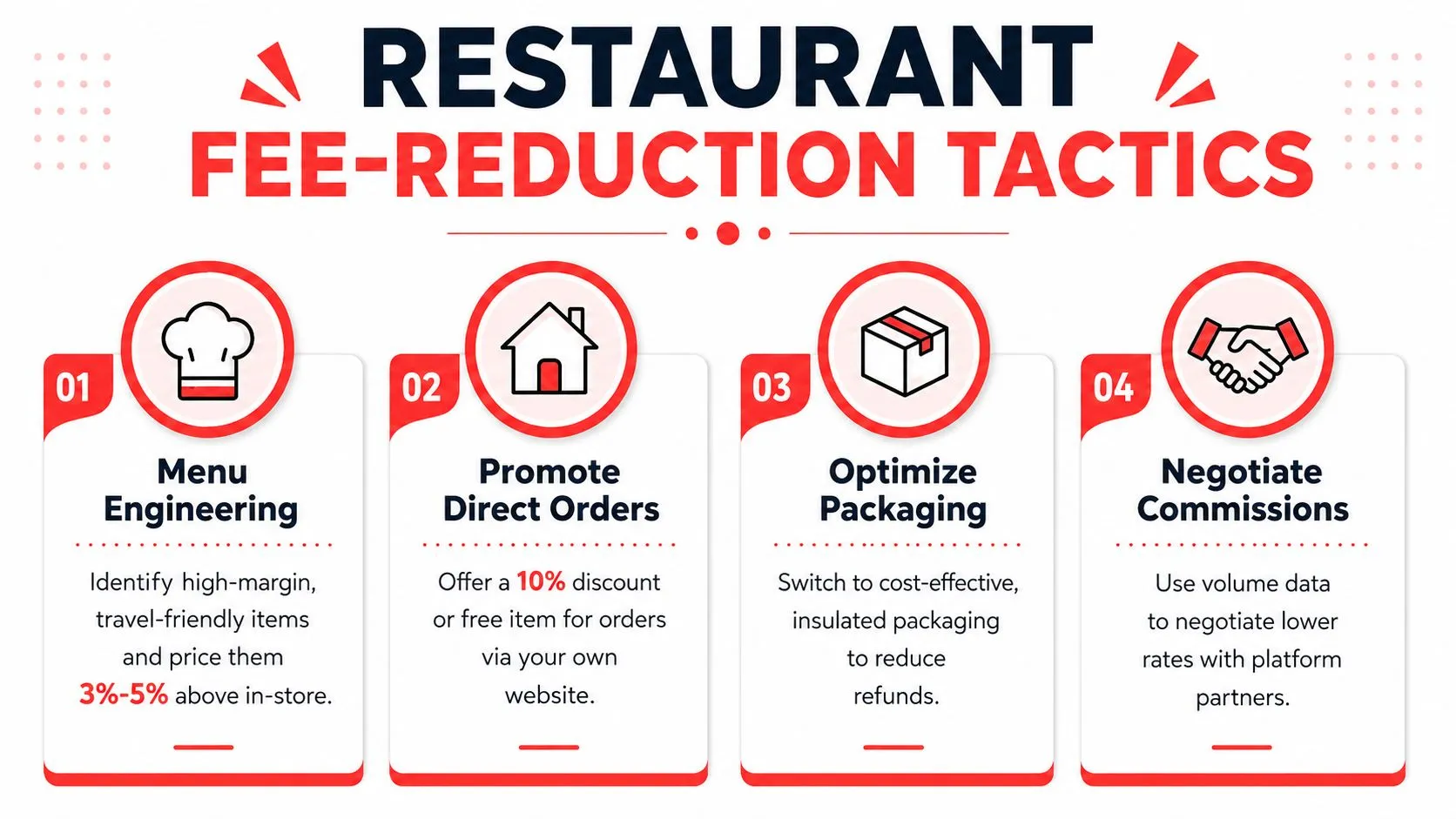
Identify dishes that travel well, hold their quality, and carry enough margin to withstand marketplace costs. Use bundles and add-ons to increase order value without discounting the items that already sell well. The brief price test many operators consider is 3% to 5% above in-store pricing, but review marketplace rules and any most-favored-nation language before publishing different prices.
Packaging also matters. A container that leaks or loses heat can create refunds, remakes, and customer complaints. Test packaging against actual delivery conditions, then remove items that repeatedly arrive poorly.
Move repeat customers to owned ordering
Marketplaces are useful for discovery, but repeat customers are more valuable when the restaurant can serve them through its own ordering page. Offer a direct-order incentive such as a 10% discount, a free item, or a waived fee when the customer orders through the restaurant’s website. These are verified examples of tactics, not guaranteed savings.
A branded ordering page gives you more control over menu presentation, promotions, and customer communication. OrderOut’s commission-free online ordering solution is designed for orders that flow into the POS without a per-order marketplace commission.
Use bag inserts, receipt messaging, packaging stickers, and a clear website link. The message should be simple: the next order can come directly from the restaurant.
For card costs, review your processor agreement and use this resource on smart ways to cut card fees to identify contract and processing questions worth raising with your provider.
Negotiate from actual order data
Bring settlement reports to renewal discussions. Ask about lower commission tiers, marketing credits, pickup terms, processing pass-throughs, and exclusivity carve-outs. Don’t accept a bundled promotion until you know which orders it affects and whether the restaurant funds the discount.
Average ticket size is another lever. Moving a sample order from $25 to $32 doesn’t remove the commission, but it spreads fixed processing and packaging costs across more revenue. Model that change with your own menu and cancellation history. This guide to dynamic pricing strategy can help you evaluate channel-specific pricing without treating price increases as the only answer.
Why POS Integration Lowers Your True Cost
The commission appears on the settlement statement. The indirect cost often appears elsewhere, in voids, refunds, remakes, delayed tickets, staff interruptions, and customer complaints.
Without integration, a cashier or manager reads an Uber Eats, DoorDash, or Grubhub tablet and re-enters the order into the POS. That extra handoff creates opportunities to miss a modifier, type the wrong quantity, overlook an unavailable item, or send an incorrect total to the kitchen. The resulting cost isn’t labeled “re-keying fee,” but the restaurant still pays it.
Multiple tablets also fragment attention. Staff must monitor separate devices, confirm orders in different interfaces, and keep menus current in more than one place. During a rush, that work competes directly with guest service, production, and order accuracy.
What direct POS delivery integration changes
A delivery POS integration routes marketplace orders into Clover or Square, where the restaurant already manages its tickets and operations. OrderOut maps each marketplace menu to a normalized POS schema, which helps preserve item and modifier structure as orders enter the system.
That mapping is why menu hygiene matters. Item names, modifiers, pricing, and availability need to be organized consistently before the connection can inject orders cleanly. When the setup is accurate, the restaurant works from one operational source of truth instead of treating each delivery tablet as a separate order lane.
OrderOut’s third-party delivery to POS engine connects Uber Eats, DoorDash, and Grubhub orders with Clover and Square workflows. It removes extra delivery tablets and manual re-keying, which can reduce avoidable interruptions and give staff more time for production and service. OrderOut is free to install on the Clover App Market, and owners can start with the OrderOut Clover App Market listing.
The commission still belongs to the marketplace. Integration doesn’t erase that charge. It attacks the second layer of cost, the operational friction that turns a paid order into a correction, remake, refund, or lost staff minute.
For a closer look at how connected systems support restaurant workflows, review this explanation of an integrated POS system.
Contract Basics and Legal Considerations
The headline commission does not define the agreement’s real cost. Clauses covering fee changes, promotions, renewal, data, and termination determine whether the deal still works after order volume grows. Read the contract against the full operating cost, including staff time spent correcting marketplace orders and managing separate tablets.
Clauses to flag before signing
Fee-change rights allow the platform to alter rates, add charges, or revise services under stated conditions. Check the required notice period, where notice is delivered, and whether continued use counts as acceptance. A fee plan that works today can become unprofitable after a contract-based change.
Minimum commitments and termination terms can limit your options. Look for required order volume, minimum marketing spend, early-termination charges, and obligations to keep service active during a notice period. Put the notice deadline on the operating calendar before signing.
Exclusivity and most-favored-nation provisions may restrict pricing or promotions on other channels. Confirm whether the language covers delivery, pickup, direct ordering, menu prices, promotions, or only certain geographic areas.
Promotion disclosures should state who funds discounts, how sponsored placement is billed, and whether a campaign continues automatically. A promotion can reduce the customer’s price while leaving the restaurant responsible for the discount and the marketplace commission calculated on the reduced order.
Auto-renewal language also deserves a calendar reminder. Confirm the renewal period and written-notice deadline. Review data ownership, access to customer information, indemnification, liability limits, dispute resolution, and chargeback responsibility before renewal arrives.
Legal questions operators should answer
- Can the platform raise fees? The answer depends on the fee-change clause and its notice procedure.
- Can the restaurant terminate? Check notice requirements, minimum terms, and early-termination provisions before assuming you can leave immediately.
- Can the restaurant keep direct-order promotions? Review exclusivity and MFN language before launching channel-specific prices or discounts.
- Are sponsored promotions transparent? Contract terms and campaign settings should identify the funding source, billing method, and duration.
- How are disputes handled? Find the governing law, arbitration or court provisions, chargeback process, and responsibility for customer claims.
These clauses affect margin, pricing control, and exit options. Ask counsel to review language that restricts pricing, data use, or termination rights before renewal.
OrderOut connects third-party delivery orders directly to Clover or Square, reducing the need to re-key tickets from separate marketplace tablets. Visit OrderOut to review the delivery-to-POS workflow and decide whether cutting re-keying errors, tablet sprawl, and related staff time belongs in your fee plan.
Frequently Asked Questions
What are delivery app fees?
Delivery app fees are the layered charges marketplaces apply to restaurant orders. They can include commission, processing, marketing, delivery-related allocations, promotions, refunds, and other contract-specific adjustments.
How much do restaurants typically pay in delivery app commissions?
Restaurant-side marketplace commissions commonly fall between 15% and 30%, according to CloudKitchens’ overview of delivery app fees. The all-in cost often reaches 25% to 35% after delivery, payment processing, and marketing charges are included, as described in restaurant delivery commission reporting.
Does OrderOut work with Clover?
Yes. OrderOut is available to install for free on the Clover App Market and can inject supported third-party delivery orders into Clover without an extra delivery tablet or manual re-keying.
Does OrderOut remove DoorDash, Uber Eats, or Grubhub commissions?
No. Marketplace commissions are set by the delivery platforms and remain separate from OrderOut. OrderOut addresses the operational cost by bringing marketplace orders into the POS workflow.
How can a restaurant reduce delivery app fees?
Start by calculating the all-in cost by order type, then review menu pricing, promotions, packaging, pickup terms, contract language, and direct ordering. Moving repeat customers to a restaurant-owned ordering channel can reduce reliance on marketplace commissions while keeping delivery apps available for discovery.
Stop judging delivery app fees by the commission line alone. Review your settlement data, clean up the fee stack, connect DoorDash, Uber Eats, and Grubhub to your Clover or Square POS, and start onboarding OrderOut for free at dashboard.orderout.co.