
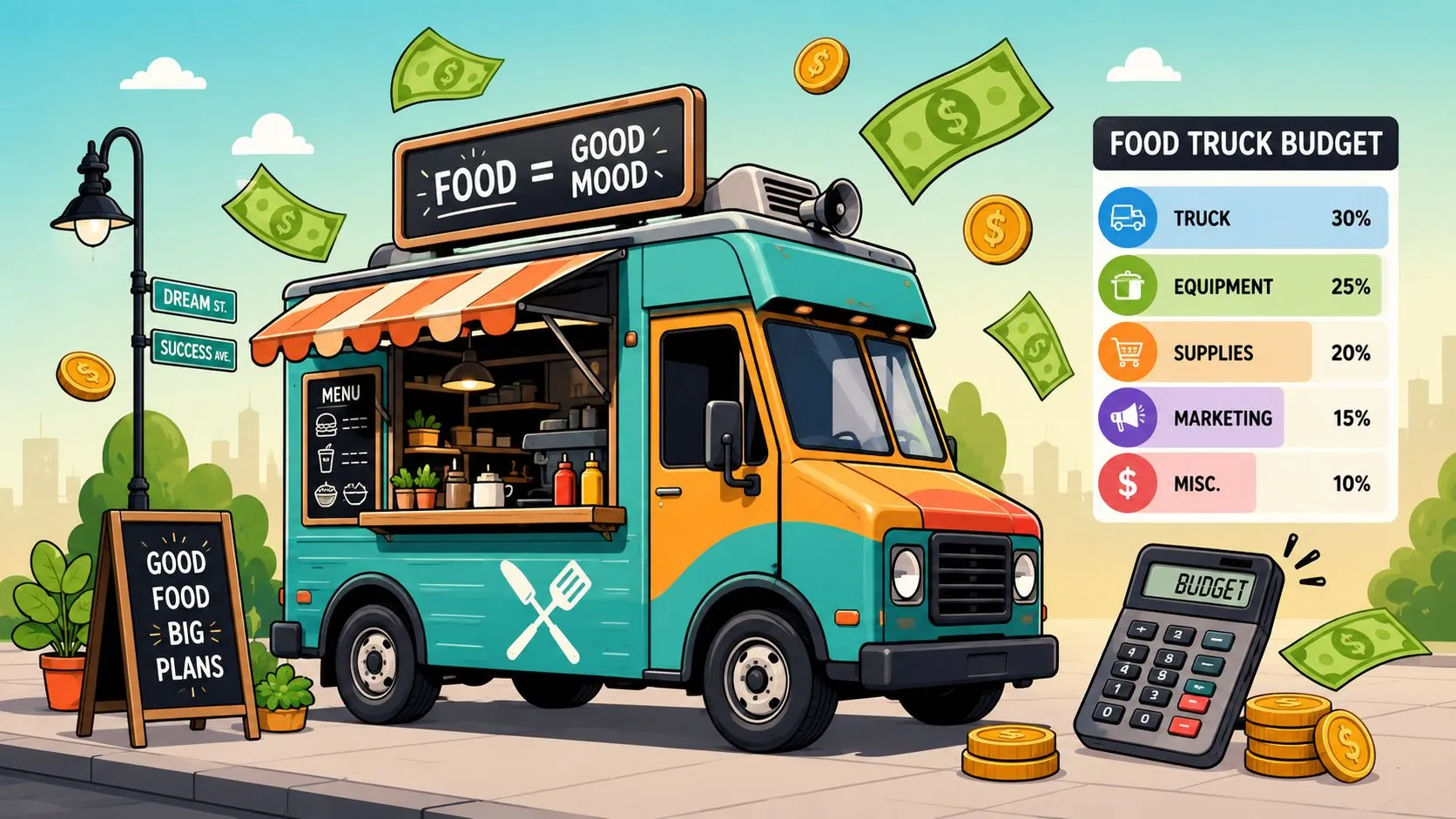
The cost of food truck start up usually lands between $50,000 and $200,000, and Square’s 2025 breakdown puts the truck itself at $40,000 to $150,000. If you’re trying to launch in 2026, plan for a real all-in number closer to six figures once you add buildout, permits, commissary access, and cash you can’t spend on day one.
Most first-time owners look at the truck price and stop there. That’s the mistake. The budget has three buckets, one-time capital expense, recurring operating expense, and runway reserve, and the last two are what wreck a launch when they’re underfunded.
The Real Cost of Food Truck Start Up in 2026
A food truck isn’t cheap just because it’s smaller than a restaurant. The headline number sits in the $50,000 to $200,000 range, but that range only makes sense when you treat the truck, permits, and inventory as the visible layer, not the whole launch. Square’s 2025 breakdown places the truck itself at $40,000 to $150,000, permits and licenses at $1,864 to $28,276, and startup inventory at $2,000 to $3,000.Square’s food truck cost breakdown
The bucket you’re really funding
The better way to think about the launch is simple. The truck and buildout are capex, fuel, ingredients, labor, and parking are opex, and the money you keep untouched for delays and slow weeks is your runway reserve. Owners get in trouble when they count reserve cash as “startup money” and spend it on fabrication.
The hidden pressure comes from recurring compliance and commissary access. A truck can be built on time and still be unlaunchable if the approvals drag, the shared kitchen isn’t ready, or the local process is slower than the fabricator promised. That’s why a cheap truck doesn’t mean a cheap launch.
Practical rule: if a vendor quote doesn’t say whether the number includes compliance and working capital, assume it doesn’t.
What that means in plain English
If you want a truck that can open and survive the first stretch, don’t budget like a hobbyist. Budget like an operator who expects paperwork delays, prep-space fees, and a few ugly weeks before sales stabilize. That framing keeps you from spending every dollar on the shiny part of the business and leaving nothing for the part that keeps it alive.
If you’re still mapping the launch, use OrderOut’s food truck opening guide as a planning reference alongside your truck quote. It’s much easier to negotiate with fabricators, lenders, and commissary operators when your numbers are organized into the same buckets they use.
Buying the Truck and Buildout
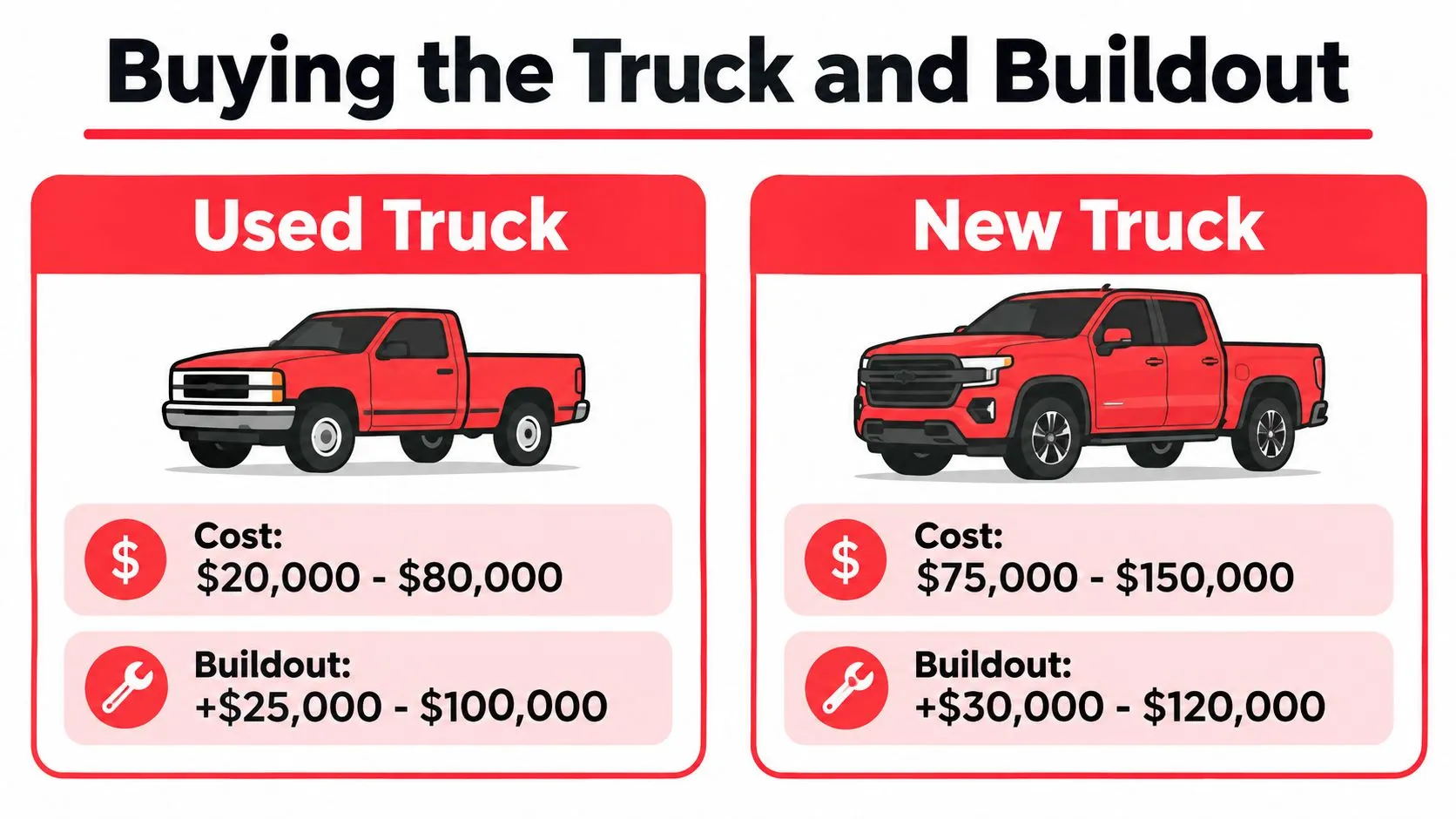
A truck’s sticker price will mislead you fast. The chassis is only the starting point, because the main spend shows up when you turn that vehicle into a code-compliant kitchen, with plumbing, electrical, ventilation, refrigeration, and fire suppression all installed so the truck can function.
The market usually falls into two buckets. Used-truck setups commonly land around $40,000 to $100,000, while fully custom new builds often reach $120,000 to $250,000 because retrofit work gets expensive the moment you need a true mobile kitchen.
The price gap is real, but it does not tell the full story. A cheaper truck can still become the more expensive launch if the build needs rework, inspections take longer than expected, or the original quote leaves out the items that make the truck usable on day one.
Why the cheap truck gets expensive
Ask the better question: what does the truck cost after it is safe, inspected, and ready for daily service? A bargain chassis can turn into a costly fabrication job once the hood, suppression system, sinks, refrigeration, and power setup are added.
Some choices are flexible. Others are not. Paint, wrap design, menu boards, and cosmetic finishes can move around. Ventilation, fire suppression, food-safe surfaces, and power capacity cannot.
A cheap shell is not a cheap kitchen. The invoice stays small only until the compliance pieces start getting welded in.
What to ask before you sign
Ask every builder the same blunt questions. What is included, what is excluded, and what will trigger a change order? Have they built to the inspection standards in your city, and can they show you a truck that already passed? If they dodge those questions, keep looking.
You should also ask how the build affects your first months of operation, because startup money disappears fast once fabrication ends and real-world expenses begin. Review the ABC POS food truck startup guide against the quote so you can separate the truck price from the spend that keeps it launch-ready. If the seller cannot explain the difference cleanly, the number on the page is too low to trust.
Do not skip the insurance conversation either. Compare the build plan with the coverage options for Florida restaurants so you know what the truck may need before the first service window opens. That is where a lot of owners find out their “ready” build still needs more work, more paperwork, and more cash.
For a broader setup checklist, OrderOut’s food truck opening resources are useful alongside the build quote so you do not lose sight of the front-of-house gear while you are focused on the kitchen spec.
Equipment, Generator, and the Onboard Tech Stack
The equipment package decides whether a truck runs smoothly or limps through service. A griddle, fryer, hood, refrigeration, generator, and water system all affect speed, food quality, and how much you’ll pay to keep the truck moving every day.
Build the truck around the menu
Start with the menu, then select the equipment. A truck built for smash burgers needs a different loadout than one doing coffee and pastries, and every extra appliance adds complexity, heat, and power demand. Bigger power systems can improve uptime, but they also push up purchase cost and, later, operating cost.
The front of house needs the same discipline. A solid POS, payment hardware, receipt printer, and order workflow matter as much as the kitchen gear because they decide how cleanly tickets move from the customer to the line.OrderOut’s iPad for POS systems in restaurants
Don’t let tech become clutter
Many trucks overbuy. They stack gadgets before they’ve settled the basics, then end up with a busy counter and a confused staff. Keep the POS simple, make sure it’s reliable, and choose software that fits the way your team takes orders, sends modifiers, and closes checks.
If you want a truck stack that won’t fight your crew, OrderOut’s POS integration guide is a useful reference for how the operational layer should behave. The point isn’t to buy more software, it’s to keep the tools from creating more work than they remove.
Permits, Licenses, Commissary, and Insurance
This is the cost layer most founders underestimate, and it is also the layer that stalls openings. The truck may be ready, but permits, license renewals, commissary access, and insurance can keep you from serving a single ticket if you do not line them up early. Independent breakdowns put commissary or shared-kitchen fees at about $300 to $2,500 per month, and some operators spend heavily on permits, licenses, and legal compliance before the truck ever sees a busy service window.Restroworks on food truck cost
Compliance is a cluster, not a line item
Treat permits, licenses, commissary access, and insurance as one block. Food trucks often need approvals in more than one jurisdiction, which means renewals, inspections, and paperwork do not stop after opening week. The first-year cost can climb fast in stricter markets because every approval has a clock attached to it, and every missed renewal turns into a delay.
Here is the practical table I would put in front of any founder.
| Line item | Typical range | Frequency | Notes |
|---|---|---|---|
| Permits, licenses, legal compliance | Qualitative, often material | First year | Varies heavily by market |
| Commissary or shared-kitchen access | $300 to $2,500 per month | Monthly | Often required for prep and storage |
| Insurance | Qualitative | Annual or monthly | Quote it as mobile food-service coverage, not generic kitchen coverage |
Don’t shop insurance like a normal restaurant
A mobile business needs a mobile policy. For a practical example of how coverage gets framed for a local market, coverage options for Florida restaurants show how operators should think about liability and business risk when they are weighing policy structure. Use that mindset when you talk to insurers, because the truck, the route, and the parking setup all matter.
If you want to stay ahead of the permit mess, OrderOut’s food truck regulations guide is a good companion while you are gathering city requirements. Get this layer right early, or the rest of the launch schedule will slip.
POS, Payments, and Delivery Integrations
A food truck lives or dies on software as much as steel. The POS holds tickets, modifiers, reporting, and inventory. Payment hardware keeps the line moving and stops the cash drawer from turning into a mess.
The stack you need
For most operators, the stack should stay simple. Use a POS your crew can learn fast, a card reader that does not choke in a parking lot, and a delivery setup that does not force staff to babysit separate tablets. That matters even more if you sell through Uber Eats, DoorDash, or Grubhub, because those orders can stack up fast while the line is already under pressure.
OrderOut handles that by mapping each marketplace menu to a normalized POS schema so orders inject directly into Clover or Square, which removes extra tablets and manual re-keying. It is also free to install on the Clover App Market, so it fits operators who want to launch without another large software bill.
Why this matters on a truck
Manual re-entry eats staff attention at the exact moment you can least afford it. One missed modifier, one wrong ticket, and the line slows down while the customer waits. Direct injection keeps the POS as the operational source of truth, which helps the crew focus on cooking instead of typing.
A lunch rush makes the problem obvious. If a DoorDash order comes in while the window is slammed, the crew should see it in Clover with the right modifiers, not on a separate tablet that someone has to babysit. That is the difference between a clean service flow and a pile of disconnected tasks.
If you are comparing software setups, OrderOut’s delivery-to-POS integration guide shows how the order flow should work before you commit to hardware. If Clover is the main register, OrderOut’s Clover delivery integration shows the path operators use to connect delivery orders to the counter setup.
The part most founders miss is the cash run, not the app fee. Software, card processing, hardware replacements, and account setup all sit on top of the truck cost, and that stack gets expensive fast if you keep adding tools that do the same job. Keep the payments setup boring, keep the delivery flow inside the POS, and buy only the hardware you can support when the lunch line gets ugly.
Financing Options for Food Truck Owners
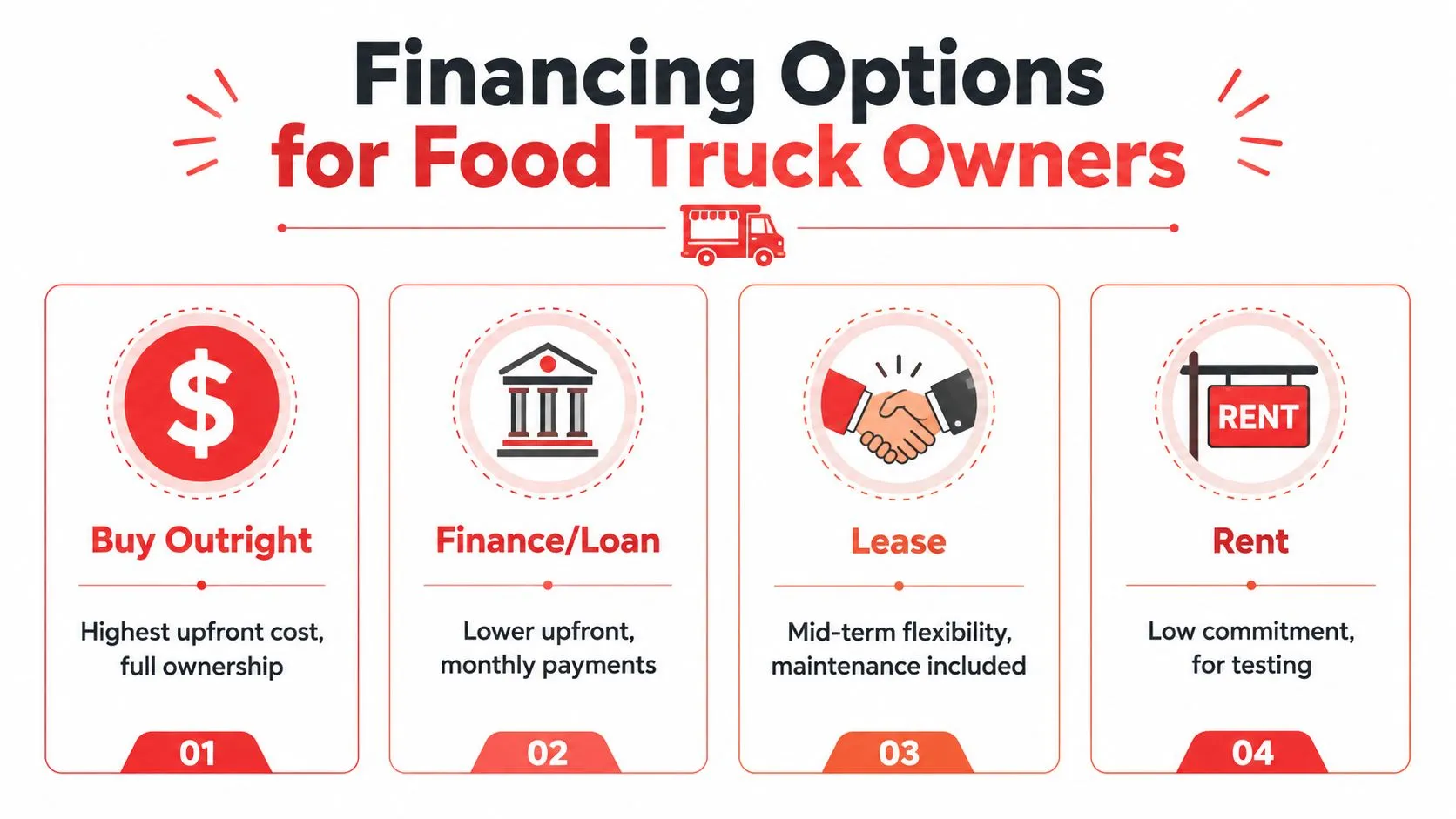
The financing choice should follow your cash position and your monthly burn, not your optimism. If you have enough cash to buy the truck, cover buildout, handle permits, and keep a reserve for the first slow months, buying outright keeps the ownership structure clean. If that would drain the bank account, financing spreads the hit, leasing reduces the launch burden, and renting gives you the least committed way to test the concept before you sink real money into a full build.
Compare the options without the sales pitch
Buying outright makes sense when you can pay for the truck and still keep enough cash to absorb compliance, repairs, and the opening runway. Financing or a small-business loan works when you want to preserve working capital and turn a large upfront cost into monthly payments you can plan around. Leasing fits operators who want flexibility more than ownership. Renting is the least risky way to test demand before you commit to a full build.
Renting is the cleanest concept test because it shifts spending from a large upfront purchase to an ongoing expense. One industry guide puts rental-based startup costs at $46,700 to $187,440, and another says rentals start at about $1,800 per month.MobiMunch on food truck rental cost
Match the capital path to the business plan
If you are launching one truck under one brand, judge the deal by the cash runway, not just the monthly payment. A cheap payment on a weak truck is a bad trade if it leaves you with no reserve for repairs, commissary fees, renewals, or a slow first season. Financing usually makes sense once the concept is proven and you are buying an operating asset, not betting on an idea that still needs validation.
If you want a parallel example from another vehicle category, financing your dream RV shows the same rule in plain terms, protect enough working cash to run the business after the purchase. Keep the tech setup simple and match it to the register you already plan to use. If Clover is the counter system, OrderOut’s Clover delivery integration shows how delivery orders can be routed into that setup without forcing the crew to work around another disconnected screen.
Sample Budgets and Cost-Saving Strategies
A lean launch still takes real money, and that is where a lot of first-time owners get trapped. Keep the budget honest. If you only price the truck and the buildout, you will run out of cash right after opening, when commissary bills, renewals, fuel, and slow sales start hitting the account.
Three launch lanes
A lean used-truck launch usually lands near the lower end of the startup range because you are controlling the truck price and cutting back on custom work. That route only makes sense if the inspection is clean and the repair history is under control. A mid-range new build costs more, but the cleaner layout can save you from constant fixes and awkward service bottlenecks once the truck starts running full days. A premium custom build is for operators who need a highly customized build and are ready for a longer fabrication timeline and a heavier cash commitment.
The burn does not stop after opening day. The Restaurant Store lists recurring operating expenses for a working food truck at $300 to $1,000 per month for fuel, $1,000 to $5,000 per month for ingredients, $2,000 to $4,000 per month per employee for labor, and $300 to $1,000 per month for parking or storage.The Restaurant Store on food truck startup costs Those are the line items that chew through runway fast, especially if you also carry commissary fees, licensing renewals, and insurance updates that do not care whether you had a busy weekend.
| Budget type | What it usually means | What to watch |
|---|---|---|
| Lean used | Lower truck cost, tighter scope | Repairs, inspections, and hidden buildout fixes |
| Mid-range new | Better layout, cleaner compliance path | Scope creep on equipment and finishes |
| Premium custom | Highly customized build | Long fabrication lead time and larger reserve needs |
What saves money without cutting corners
Buy used only if the truck passes inspection and the local health history is clean. Otherwise, the “cheap” deal turns into downtime, rework, and surprise service calls. Share commissary access when you can, because a shared prep base can keep the operating footprint from swallowing early cash. Phase non-critical gear only if service quality stays intact, and keep reserve cash separate from spendable working capital.
Keep three months of fixed cost in reserve before you open, then protect it like inventory.
Use your launch budget as an operating model, not a shopping list. OrderOut’s restaurant profit and loss example is a useful reference when you are turning rough estimates into a real P&L and checking whether the numbers can support the truck once the first rush fades.
Frequently Asked Questions
How much does it cost to start a food truck?
A realistic launch usually falls between $50,000 and $200,000, and some custom builds push higher once you include compliance and runway. The truck is only part of the bill, so treat permits, commissary access, inventory, and reserve cash as mandatory.
What is the biggest hidden cost in a food truck launch?
The biggest hidden cost is the compliance and operating layer, not the metal box itself. Permits, licenses, legal compliance, commissary access, and the cash you need to survive delays are what make a “cheap” truck expensive.
Do I need a commissary for a food truck?
In many markets, yes, because trucks need a licensed prep and storage base. Even when rules vary, commissary access is often a practical necessity for cleaning, loading, and keeping the operation legal.
Does OrderOut work with Clover and Square?
Yes. OrderOut is built to inject third-party delivery orders from Uber Eats, DoorDash, and Grubhub directly into Clover or Square, so staff don’t have to re-key orders or juggle extra tablets.
Is OrderOut free to install on Clover?
Yes, OrderOut is free to install on the Clover App Market. That makes it easy to test delivery-to-POS integration without adding another upfront software hurdle.
If you’re mapping a food truck launch right now, don’t let delivery orders become another manual task on day one. Visit OrderOut to see how it connects Uber Eats, DoorDash, and Grubhub straight into Clover or Square, then start onboarding so your POS is ready before opening week.