
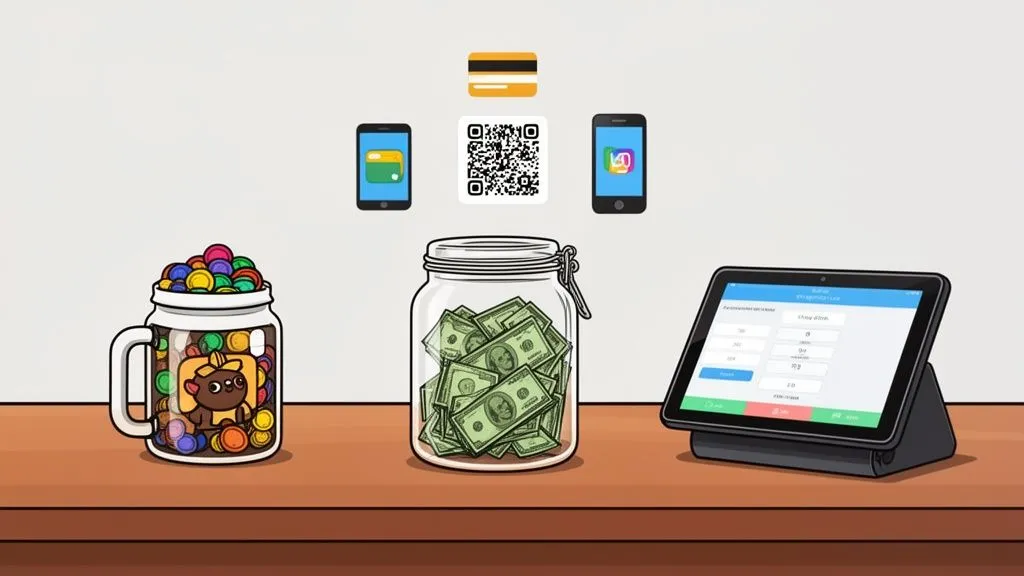
In the modern restaurant, the classic glass tip jar is quickly becoming obsolete. As customers shift to digital payments and online ordering, traditional cash tipping creates operational friction and leaves money on the table. For restaurant owners and managers, this isn’t just about staff earnings; it’s about efficiency. Outdated tipping methods mean manual data entry, complicated payroll, and a disconnected customer experience.
Modern tip jar ideas must be more than just clever signs. They need to integrate directly into your restaurant’s technology—specifically, your Point of Sale (POS) system and delivery service integrations. This connection is what matters. It turns tipping from a manual afterthought into a powerful tool. By linking tips to your POS, you capture more gratuities, motivate staff with real-time data, and simplify your financial workflow, reducing back-office hours and minimizing errors.
This article breaks down eight actionable and digitally-focused tip jar ideas that you can implement quickly. Each idea is tied directly to the core goals of improving restaurant operations, streamlining delivery, and maximizing your POS integration.
1. Digital Tip Screen Integration with POS Systems
The simplest, most effective modern tip jar idea is to build tipping directly into your payment process. A digital tip screen on your POS terminal prompts customers to add a gratuity when they pay by card, making it a frictionless part of the transaction.
Here’s how it works from a technical standpoint: When a customer pays, the screen on your POS terminal—like those from Clover or Square—presents pre-set tip percentages (e.g., 18%, 20%, 25%) and a custom option. Why this matters for restaurant efficiency is its ability to centralize earnings. When you integrate delivery apps like DoorDash and Uber Eats into your POS, all tips—whether from in-house diners or delivery customers—are automatically captured in one system. This eliminates the need for manual reconciliation, reduces payroll errors, and gives you a single source of truth for all revenue, saving significant administrative time.
Putting It Into Practice
To maximize this feature for better restaurant operations, you need a smart approach.
- Customize Your Prompts: Set lower suggested percentages for simple pickup orders (e.g., 10%, 15%) and higher ones for complex catering or large delivery orders.
- A/B Test Percentages: Experiment with different defaults. See if changing the defaults from 15%/18%/20% to 18%/20%/22% impacts your average tip amount over a few weeks.
- Analyze Your Data: A key benefit of an integrated POS system is the data it provides. Review tipping trends across platforms to see if DoorDash customers are more generous than Uber Eats customers, and adjust your marketing focus accordingly.
Key Takeaway: Digital tip screens automate and integrate the act of tipping. This simple change increases tip frequency, reduces manual accounting, and boosts staff productivity by ensuring they’re compensated for every order.
2. Gamified Tip Challenges for Restaurant Delivery and Food Tech
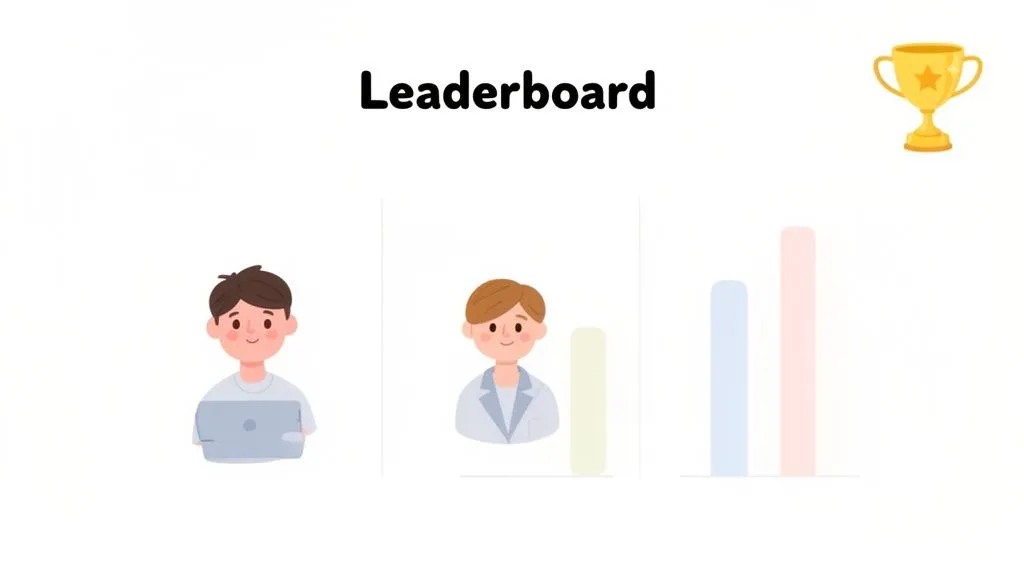
Injecting friendly competition into your team is a powerful way to motivate staff and improve service. This strategy involves creating gamified challenges based on tip earnings, with results displayed on a digital leaderboard for your delivery drivers and in-house staff to see.
This is a simple, actionable insight: when performance is visible, people are more motivated to excel. From a food tech perspective, the key is to pull tip data automatically from your POS system. For example, using a POS integration for delivery services like DoorDash and Uber Eats allows you to create a fair leaderboard that combines tips from every single order source. This ensures a driver’s hard work on an Uber Eats order is recognized just as much as one from DoorDash. This data-driven approach avoids manual tracking, which is prone to errors and saves managers time. For an even bigger boost, integrating a loyalty gamification platform can make the experience more rewarding for both staff and customers.
Putting It Into Practice
A successful leaderboard system needs thoughtful implementation to keep staff engaged.
- Integrate Directly with Your POS: Fairness is everything. Pull tip data automatically from your Clover or Square POS. This prevents manual entry errors and guarantees all tips, from in-store payments to third-party delivery apps, are counted equally.
- Offer Meaningful Recognition: Beyond cash bonuses, consider offering the winner a premium parking spot, first choice of shifts, or a “Driver of the Month” trophy.
- Reset the Competition: Keep the challenge fresh by resetting leaderboards weekly or monthly. This gives everyone a chance to win and prevents top performers from dominating.
- Track Both Individual and Team Goals: Foster collaboration by creating team-based challenges. For example, set a collective tip goal for the entire delivery team, with a shared reward like a pizza party.
Key Takeaway: Gamification turns tipping into a motivational tool. By creating transparent, POS-integrated competitions, you can inspire better service, which directly increases staff earnings and boosts restaurant efficiency.
3. QR Code Tip Jars with POS Integration
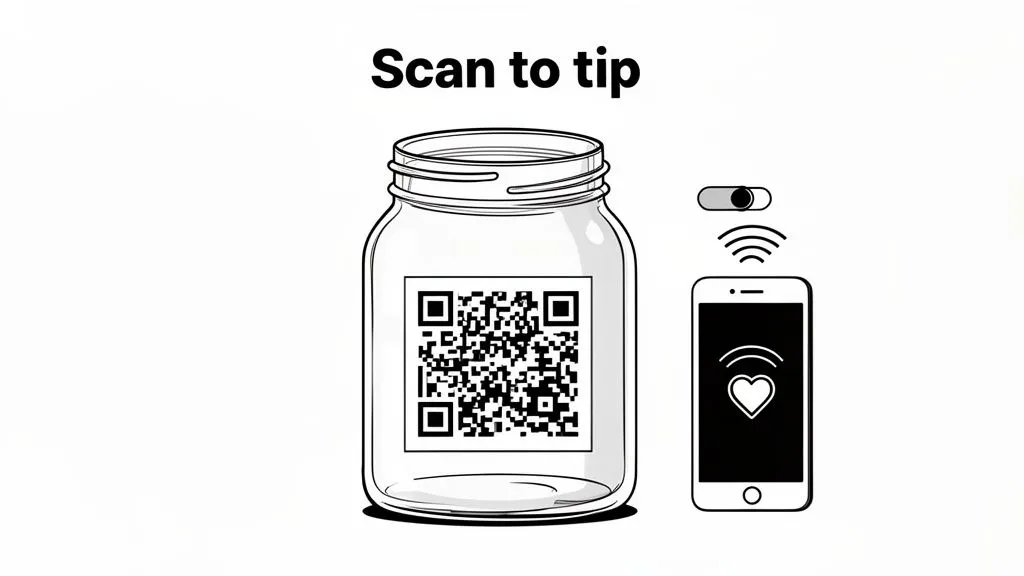
QR code tip jars provide a completely contactless way for customers to tip, which is perfect for today’s cashless consumer. You can place a scannable QR code on a physical jar, at the counter, on receipts, or on delivery bags. When scanned, it links customers to a digital payment platform like Venmo or PayPal for a quick, cash-free transaction.
The real benefit for restaurant operations comes when you take it a step further. Instead of just linking to a payment app, the QR code can link to a page that also asks for feedback or encourages them to join your loyalty program. Why it matters: this simple scan can do more than just collect a tip; it can collect valuable customer data. A real-world example is a coffee shop that uses a QR code to not only tip the barista but also to rate their drink. This feedback is then tied back to the order in their Square POS, providing managers with actionable insights on staff performance and menu quality.
Putting It Into Practice
To make QR codes an effective tool for improving restaurant operations, a thoughtful strategy is key.
- Strategic Placement: Place the QR code at every customer touchpoint: the register, on tables, printed on receipts, and included in order confirmation emails for delivery customers.
- Tell a Compelling Story: Use clear signage next to the QR code. A simple message like, “Scan to tip our amazing team & leave a review!” gives customers a clear call to action.
- Ensure Security and Usability: Use high-contrast, clearly printed QR codes. Regularly check that the link works and consider using a dynamic QR code service that allows you to update the link without reprinting the code.
Key Takeaway: QR codes make tipping immediate for cashless customers. By integrating them with your POS and feedback systems, they become a powerful tool for increasing gratuities and gathering operational data simultaneously.
4. Service Quality-Triggered Dynamic Tip Suggestions and POS Integration
This is an advanced tip jar idea that uses real-time data from your restaurant operations to suggest tip amounts. Instead of static percentages, the system adjusts tip suggestions based on service quality metrics like delivery speed and order accuracy. For example, an exceptionally fast delivery might prompt higher suggestions (20%/25%/30%), while a delayed one might show standard options.
Here’s the technical side: This system works by connecting your POS data with delivery performance data. When an order from DoorDash is marked as delivered, the system pulls the delivery time and compares it to the estimate. This data-informed approach creates a direct link between staff performance and earnings, making tipping a transparent reward for excellent service. This reduces the “obligation” feeling for customers and rewards your most productive staff members, directly impacting staff retention and service consistency. This process turns raw data into a tool for real-time incentive and performance management.
Putting It Into Practice
Implementing a dynamic system requires a clear framework and transparent communication.
- Establish Clear Metrics: Define what great service looks like in numbers. Focus on POS data like order accuracy, prep time, and delivery speed. A POS integration that unifies data from apps like DoorDash and Uber Eats is essential for this.
- Communicate with Your Team: Explain the system to your staff, showing them how their performance directly impacts potential earnings. Transparency is crucial for motivation.
- Use Rolling Averages: Base your dynamic suggestions on 30-day rolling averages to avoid penalizing staff for one bad day. This reflects consistent performance.
- Combine Multiple Data Points: A fair system will weigh several factors, including order accuracy and customer feedback, to create a balanced score. The goal is to build a system similar to how dynamic pricing examples work in other industries.
Key Takeaway: Dynamic tip suggestions tie gratuity directly to measurable service quality. This data-driven approach creates a powerful incentive for staff, reduces operational bottlenecks, and offers customers a fairer way to tip.
5. Tiered Loyalty-Based Tip Matching Programs
This advanced idea turns tipping into a powerful customer retention tool. A tiered, loyalty-based tip matching program means the restaurant matches a portion of a customer’s tip, but only for members of its loyalty program. This gives customers a direct incentive to join the program and order repeatedly.
Here’s why it matters for restaurant efficiency: This system works by connecting your loyalty program data with your POS system. When a loyalty member orders through DoorDash, the system recognizes their status. At checkout, they see a message that the restaurant will match their tip by 50%. This not only encourages a higher tip (boosting staff productivity and morale) but also strengthens the customer’s connection to your brand. From a cost/time savings perspective, this is a marketing expense that directly rewards your staff, serving as a dual-purpose investment in both customer loyalty and employee retention.
Putting It Into Practice
Implementing a tip-matching program requires careful planning to be effective and financially sustainable.
- Start with a Modest Match: Begin with a 25% or 50% match for your top loyalty tier. This keeps costs manageable while you gather data on its impact on order frequency and tip size.
- Promote the Perk Heavily: Communicate this unique benefit in your loyalty sign-up pages and email newsletters. Frame it as a partnership: “Join our rewards program, and we’ll help you thank our team by matching 50% of your tip.” This is a key tactic for digital marketing for restaurants.
- Track Your ROI: Use your POS data to compare tips from loyalty members versus non-members. This allows you to analyze if the program is leading to higher customer lifetime value and better staff retention.
- Unify Data for Consistency: For restaurants on multiple delivery services, POS integration is essential. It ensures your tip-matching rules are applied consistently whether the order comes from your website, DoorDash, or Uber Eats.
Key Takeaway: Tip matching turns tipping into a strategic marketing tool. By rewarding loyalty members, you foster a stronger community, boost staff morale, and give customers a compelling reason to order again.
6. Staff-Customized Digital Tip Jars with Personal Stories
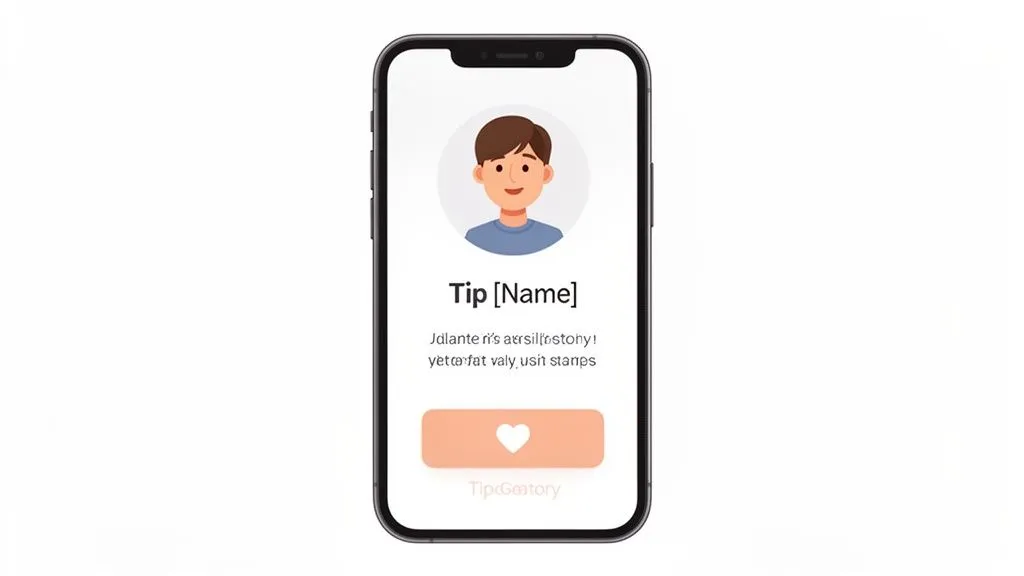
This approach personalizes the tipping process by connecting customers directly with the staff members preparing or delivering their food. By featuring staff profiles with a photo and a brief, authentic story on your POS screen or ordering app, you transform tipping from a transaction into a personal acknowledgment.
From a restaurant operations perspective, this simple feature can significantly improve staff morale and reduce turnover. When employees feel seen and appreciated, they are more productive and provide better service. For example, a delivery app like DoorDash often shows the driver’s photo and name. You can take this further by featuring a “Barista of the Week” on your Clover payment screen. This human connection encourages generosity and builds a stronger community around your brand, turning a simple transaction into a memorable interaction.
Putting It Into Practice
Successfully implementing this idea requires a thoughtful and respectful approach to showcasing your team.
- Make Participation Voluntary: Always allow staff to opt in. Forcing participation can lead to inauthentic stories and uncomfortable team members.
- Keep Bios Authentic and Brief: Encourage staff to share a genuine detail, like a hobby, a goal they’re saving for, or their favorite menu item.
- Rotate and Update Regularly: Feature different team members on a rotating basis to give everyone a chance in the spotlight.
- Train Staff on Boundaries: Provide clear guidance on maintaining professional boundaries and online safety.
Key Takeaway: Personalizing the tipping experience by showcasing your staff’s stories creates an emotional connection. This human element can distinguish your brand and directly lead to higher tips and improved staff morale.
7. Cashless Tip Recycling and Round-Up Programs
A “round-up” program offers a simple, low-friction way to capture small tips during card transactions. This method prompts customers to round their bill to the nearest dollar, with the difference allocated to staff tips. It’s an effective idea for today’s cashless customers, turning digital spare change into meaningful earnings for your team.
This approach integrates directly into your POS system, presenting the round-up option as a final step before payment. Why this matters for restaurant efficiency: it’s an automated process that requires zero manual effort from your staff. It captures a steady stream of micro-tips that add up significantly over time. For example, many quick-service restaurants using a Square POS can easily enable a “round-up for charity” feature. By directing this to staff, you create a painless way for customers to show appreciation. When applied consistently across all incoming delivery orders via a POS integration, no opportunity is missed, and all funds are tracked automatically, reducing accounting complexity.
Putting It Into Practice
For a round-up program to work, clarity and transparency are essential.
- Clearly Label the Prompt: Be specific. Use phrases like “Round up for our kitchen crew” or “Add 50¢ for our drivers.” Ambiguity reduces participation.
- Show the Impact: If possible, display a running total near the POS showing how much has been raised. This creates a sense of collective achievement.
- Offer Choices: For charitable round-ups, consider letting customers choose between a couple of local causes. For a deeper understanding of how to manage these funds versus standard tips, learn the difference between a service charge vs. a tip.
Key Takeaway: Round-up programs capture the digital equivalent of “keep the change.” They create a consistent, automated stream of micro-tips that add up over time without feeling like a major expense to the customer, all while simplifying your accounting.
8. Delivery Excellence Bonus Pools with Transparent Tracking
This idea moves from individual tips to a team-based model by creating a shared bonus pool for delivery staff. Instead of tips going directly to one driver, they are aggregated into a central fund and then distributed based on clear, pre-defined rules. Customers are informed that their gratuity supports the whole delivery team.
From a restaurant operations standpoint, this model promotes teamwork and ensures that all staff who support the delivery process are rewarded. This can improve order accuracy and prep times, as everyone is working toward a common goal. The technical key is to use a centralized platform with a POS integration to consolidate orders from apps like DoorDash and Uber Eats. This allows you to automatically and fairly calculate distributions from every single order, ensuring no tip is lost and saving hours of manual calculation. This system shifts the focus from individual performance to overall team excellence, which is a powerful driver of efficiency.
Putting It Into Practice
Implementing a bonus pool requires careful planning and clear communication to maintain staff trust.
- Establish Clear and Written Rules: Before launching, define exactly how the pool will be distributed (e.g., by hours worked). Put it in writing and have every team member acknowledge it. Consult a labor attorney to ensure your policy is compliant with local laws.
- Balance Incentives: Consider a hybrid model, such as an 80/20 split, where 80% of a tip goes to the individual driver and 20% enters the team pool.
- Track and Display Totals: Use data from your food delivery management software to transparently track the pool’s total and show staff how distributions are calculated.
Key Takeaway: A transparent bonus pool turns tipping into a team-building exercise. It encourages collaboration, improves overall service quality, and simplifies tip accounting, which can lead to better staff retention and a more efficient delivery operation.
8-Way Tip Jar Ideas Comparison
| Solution | 🔄 Implementation Complexity | ⚡ Resource Requirements & Speed | ⭐ Expected Effectiveness | 📊 Expected Outcomes | 💡 Ideal Use Cases / Tips |
|---|---|---|---|---|---|
| Digital Tip Screen Integration with POS Systems | Medium — requires POS compatibility, setup & training | Moderate — POS software/hardware; instant at checkout | ⭐⭐⭐⭐ — Proven ↑ tip capture (up to ~30%) | Higher tip rates, real‑time tracking, less cash handling | Best for POS‑enabled restaurants; A/B test prompts; use OrderOut for consolidated reporting |
| Gamified Tip Challenges and Leaderboards | Low–Medium — digital displays + program rules | Low — inexpensive displays; ongoing management | ⭐⭐⭐ — Boosts engagement and tipping | Improved staff morale, higher average tips, performance data | Good for delivery teams; tie leaderboards to POS tip data; reset regularly and enforce fair rules |
| QR Code Contactless Tip Jars with Donation Tracking | Low — create & place QR signage | Low — printing and payment links; instant scan-to-tip | ⭐⭐⭐ — Convenient for cashless customers, charity boosts participation | Increased remote tipping, transparent donation tracking, reduced cash handling | Ideal for pickup/delivery receipts and bags; show cause story and include in OrderOut confirmations |
| Service Quality‑Triggered Dynamic Tip Suggestions | High — data integration and algorithm development | High — analytics platform, continuous tuning | ⭐⭐⭐⭐ — Aligns tips to service quality; promotes fairness | More data‑driven tips, motivates better service, risk of lower tips when metrics dip | Best for chains with strong data; use rolling averages and clear staff communication via OrderOut data |
| Tiered Loyalty‑Based Tip Matching Programs | Medium–High — loyalty + POS integration and rules | Moderate–High — matching funds and tracking systems | ⭐⭐⭐⭐ — Increases loyalty participation and repeat orders | Higher AOV, stronger driver relations, measurable marketing ROI | Fit for brands with loyalty programs; start with small match (25–50%) and track ROI using OrderOut |
| Staff‑Customized Digital Tip Jars with Personal Stories | Medium — profile system & consent workflows | Moderate — content management and display integration | ⭐⭐⭐⭐⭐ — Strong personal connection often raises tips 30–50%+ | Improved retention, authentic customer engagement, higher individual tips | Use voluntary profiles, keep stories professional, rotate spotlights; sync profiles across apps with OrderOut |
| Cashless Tip Recycling and Round‑Up Programs | Low — POS rounding feature or minor config | Low — minimal dev cost; instant at checkout | ⭐⭐⭐⭐ — Very high participation, small per‑order amounts | High participation, cumulative funds for staff/causes, simple UX | Great for cashless QSRs; show running totals, offer opt‑out, apply consistent logic via OrderOut |
| Delivery Excellence Bonus Pools with Transparent Tracking | High — legal review, payroll integration, pooling rules | High — admin, compliance, dashboarding | ⭐⭐⭐ — Encourages teamwork but may blunt individual incentives | Equitable distributions, simplified accounting, potential disputes if unclear | Use for large/high‑volume ops; consult labor counsel, publish rules, use OrderOut for single source of truth |
Your Next Step: From Ideas to Integrated Tipping
We’ve moved far beyond the simple glass jar. The central theme is clear: modern tipping is about engagement, convenience, and most importantly, integration. The most effective strategies are not standalone gimmicks; they are systems woven directly into your restaurant’s operational fabric—your Point-of-Sale (POS) system and delivery workflows.
The real power is unlocked when these ideas function automatically within your existing food tech. Implementing a dynamic tip suggestion becomes manageable when the data flows directly from your POS. This is where systems like Clover and Square excel. POS integration removes the burden of manual tip reconciliation, reduces payroll errors, and provides a clear, accurate picture of performance, which directly impacts staff productivity and cost savings.
From Good Ideas to Great Operations
A strong tipping culture is a reflection of your restaurant’s overall efficiency. It shows that your team is motivated, customers are satisfied, and your operations are running smoothly. The best tip jar ideas create a positive feedback loop:
- For Staff: They feel recognized, leading to better service and higher retention. This reduces hiring and training costs.
- For Customers: Tipping becomes a frictionless, convenient part of their experience.
- For Management: You gain a data-driven tool for measuring performance and making informed decisions, all while simplifying back-office accounting and reducing administrative hours.
The key takeaway is that your tipping strategy is a critical component of your operational plan. By selecting ideas that align with your brand and integrating them with your POS, you create a system that benefits everyone. The first practical step is to ensure your foundation is solid: all order and tip data from every platform, like Uber Eats and DoorDash, must flow into one central hub. This unified view is the prerequisite for building an effective and automated tipping program that saves time, reduces errors, and boosts productivity.
Ready to build the integrated foundation for a better tipping system? Centralize all your delivery orders into a single dashboard and print them directly to your kitchen. Stop juggling tablets and start building a smarter, more profitable operation. You can start onboarding for Free in a few clicks at https://dashboard.orderout.co.