
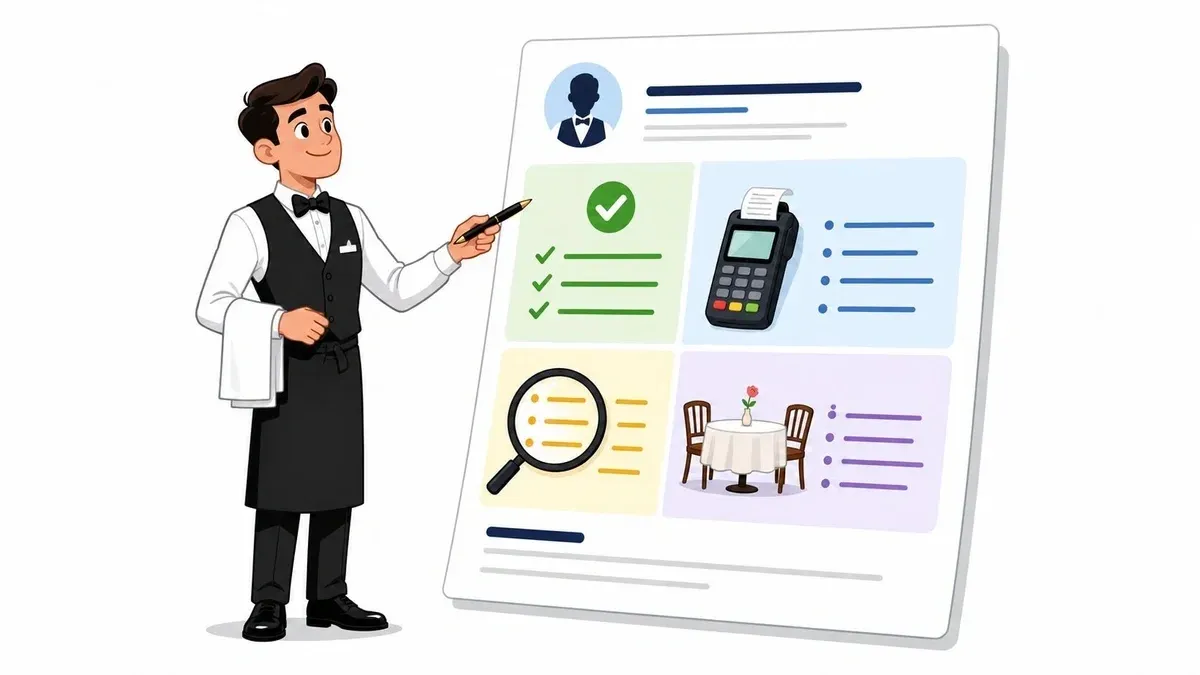
Restaurant managers make expensive hiring mistakes when they read waiter resumes like a checklist. A server who lasted three years at a busy spot can still slow your line, misfire modifiers, and create delivery bottlenecks if they cannot work cleanly inside your ordering stack.
Read every sample resume of a waiter as an operations document. Your goal is to spot candidates who can keep dine-in service stable while Uber Eats, DoorDash, phone orders, and walk-in traffic hit at once. That means looking past generic claims like “customer service” and checking for evidence of POS fluency, ticket accuracy, kitchen communication, and comfort with integrated ordering workflows. If you need a quick refresher on how modern restaurant systems work, review this guide to POS meaning in restaurant operations.
Strong resumes make this easy.
They name the systems the candidate used, the pace they handled, and the tasks that protected speed and accuracy. Weak resumes stay vague. They talk about friendliness, reliability, and teamwork without showing whether the person can manage modifiers, reconcile digital orders, split checks correctly, or keep service moving when tablets, printers, and the kitchen are all under pressure.
That difference affects margin. The right hire reduces missed items, order-entry errors, remakes, and manager intervention. The wrong hire creates friction between the floor, the expo line, and delivery demand. Use the examples in this guide to identify applicants who do more than take orders. Hire the ones who can support a tech-driven service operation.
1. Chronological Waiter Resume with POS System Proficiency
The reverse-chronological format is still the strongest default because it lets you see the candidate’s most recent operating environment first. That matters when you want to know whether they’ve worked with modern ordering workflows, not just whether they’ve carried trays. Current resume guidance for waiter roles recommends reverse-chronological work history, listing the restaurant name, location, and dates, and keeping the resume to one page for most candidates, with a two-page version mainly for highly experienced applicants. The same guidance cites U.S. Bureau of Labor Statistics data showing average annual pay for waiters and waitresses at $31,940 in May 2023, with employment projected to decline 3% from 2022 to 2032 while still producing about 440,000 openings per year on average, which tells you hiring volume remains significant even in a tighter market (resume format and labor outlook for waiter roles).
What changes in a tech-driven restaurant is what should appear inside that familiar format. A strong candidate won’t only list “served guests” or “handled payments.” They’ll name tools, systems, and front-of-house responsibilities tied to speed and accuracy.
What to scan for in restaurant operations
Look for the software layer in each job entry. If the resume mentions POS systems, handheld ordering, menu modifier handling, split checks, void management, or coordination with kitchen screens, you’re looking at someone who understands execution, not just hospitality.
- Named systems: Candidates should identify the POS or tablet workflow they used, not hide behind “computer skills.”
- Order-entry discipline: Resumes should hint at clean modifier use, allergy communication, and payment accuracy.
- Shift-readiness: The best entries show they can jump into your stack with less retraining.
A useful benchmark is whether the resume reads like someone who understands the operational backbone of service. If your team is still explaining basic order flow on day one, you hired for personality only.
Practical rule: If a waiter resume never mentions the tools used to take, route, edit, or close orders, assume the candidate may struggle in a POS-heavy environment.
If you want your managers to read these resumes more sharply, align your review process with how a restaurant POS actually works in daily service. That makes it easier to separate candidates who can greet tables from candidates who can protect ticket accuracy when the floor gets crowded.
A real-world example is a restaurant running Clover with marketplace orders flowing beside dine-in traffic. In that setup, the server who knows how to enter modifiers cleanly and recover from a misfire without freezing is far more valuable than the one with a longer but older resume.
2. Functional Waiter Resume Focused on Multi-Platform Delivery Management
A functional resume can be a major green flag when the candidate’s biggest value isn’t where they worked, but how they handle chaos. For restaurants juggling Uber Eats, DoorDash, call-in pickup, and walk-in service, this format can surface the exact skills your operation needs. It’s especially useful when the applicant comes from catering, retail, hotels, or event service rather than a traditional full-service dining room.
That matters more than many managers think. Resume guidance notes an underserved hiring angle in waiter content: transferable experience from adjacent service sectors. It also notes that U.S. food services and drinking places employed about 12.2 million people in April 2026, while operators continue hiring from nearby service roles because turnover stays structurally high (transferable experience in food-service hiring). If you reject every non-restaurant applicant on sight, you’re shrinking your talent pool for no operational reason.
Skills that solve delivery chaos
A skills-first sample resume of a waiter should group capabilities into practical clusters. You want to see language like order coordination, guest communication, cash handling, time management, and digital order processing. If they’ve worked events, hotel banquets, or busy retail counters, they may already know how to manage line pressure and last-minute changes.
A candidate reveals whether they’ve lived through “tablet hell.” They might have coordinated pickup shelves, confirmed order names, handled special instructions, or balanced in-person guests against app-driven urgency. Those are operational skills.
- Cross-channel calm: Look for evidence they can prioritize multiple inbound order sources at once.
- Transferable transaction skills: Cash handling, queue management, and customer recovery all carry over.
- Digital comfort: Tablet use, app-based workflows, and fast, accurate entry matter more than perfect restaurant pedigree.
Restaurants using Uber Eats and DoorDash don’t need resumes with prettier wording. They need evidence that the person can keep orders moving when channels collide.
For managers, a functional resume becomes easier to assess when you compare its skill clusters to the pain points in your own food delivery management software workflow. If your operation gets clogged by duplicate tablets, missed modifiers, or pickup confusion, hire the candidate whose skills map directly to those choke points.
A practical example is a candidate coming from hotel room service or high-volume catering. They may never have worked in your exact concept, but they often understand timing, guest communication, and order handoff discipline better than a casual server who’s only worked low-tech dining rooms.
3. High-Volume Restaurant Waiter Resume with Performance Metrics
Numbers change the hiring conversation. A waiter resume that uses measurable outcomes tells you the person understands performance, not just tasks. That’s what you need in a high-volume room where dine-in turns, takeout pickups, and delivery handoffs all hit at once.
Resume guidance for waiter roles consistently recommends quantifying performance with outcomes such as upselling, customer service, training impact, and reliability. One sample includes a 20% increase in upselling during peak hours, a 15% reduction in onboarding time after training new staff, and 99% cash-handling accuracy. The same guidance recommends practical metrics like tables served per shift, shifts worked per week, menu items mastered, and reductions in complaints or errors (quantified results on waiter resumes).
Which metrics matter to managers
Don’t get distracted by generic “hardworking” language. Look for numbers tied to throughput, accuracy, training, or sales behavior. Those metrics connect directly to restaurant operations.
A useful resume bullet might mention tables served per shift, guest volume handled, upselling success, or training support. Each one gives you a hint about where the candidate can help your business.
- Throughput metrics: Tables served or guest counts show pace.
- Sales metrics: Upselling tells you whether they can raise check value without slowing service.
- Accuracy metrics: Cash-handling or complaint reduction signals operational discipline.
- Training metrics: Faster onboarding points to leadership potential.
A strong high-volume server resume should also stay concise. Recruiter-oriented guidance for restaurant server resumes recommends a one-page format for most applicants and roughly 3 to 6 bullet points per role, focused on responsibilities plus customer-satisfaction achievements and operational metrics like table turnover or service quality (high-volume restaurant server resume structure).
Manager shortcut: If a candidate gives you zero metrics, you’re guessing. If they give you role-relevant metrics, you’re evaluating.
In a real-world setting, this matters when your staff is balancing in-house guests with third-party demand. A server who can keep pace while preserving accuracy is valuable even if they aren’t the flashiest interview. For a busy concept connected to delivery and online ordering, measurable consistency beats vague charm every time.
Managers who want a sharper lens can compare resume metrics against the expectations in a server job description built for restaurant service. The closer the resume gets to real operating outcomes, the stronger the hire.
4. Fine-Dining Waiter Resume Adapted for Restaurant Tech Integration
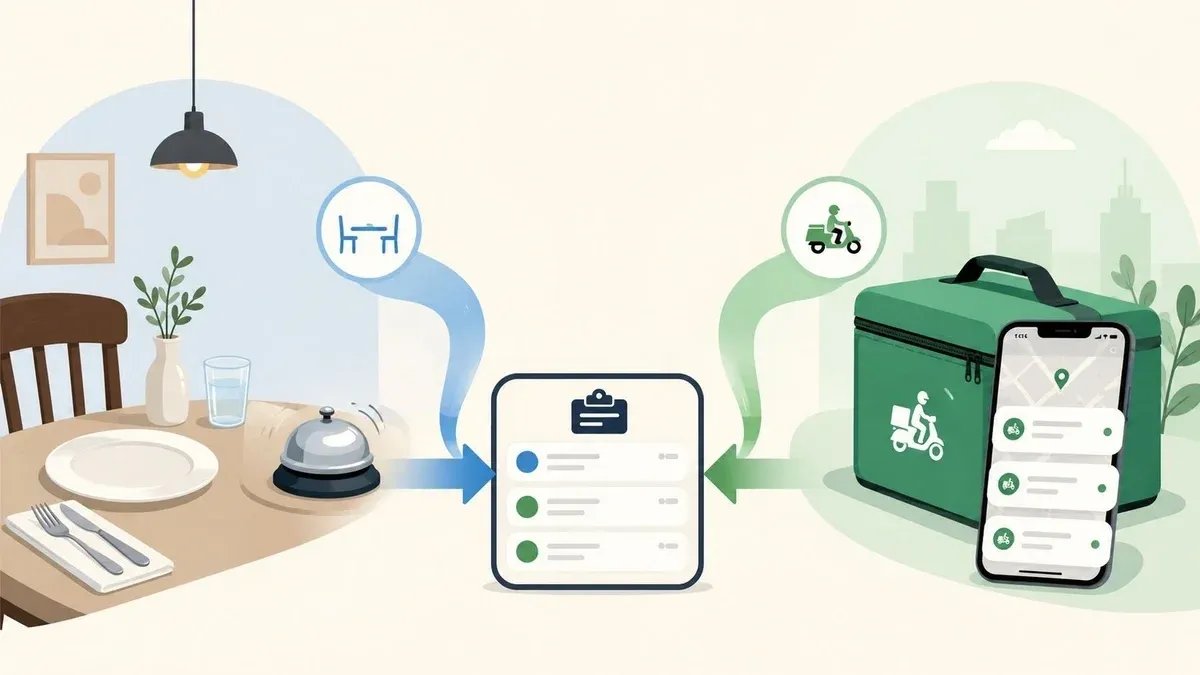
Fine-dining experience still carries weight, but only if the candidate can translate polish into modern execution. Some managers assume upscale servers won’t fit a tech-driven environment. That’s a mistake. The better question is whether the resume shows both service detail and digital adaptability.
A strong fine-dining sample resume of a waiter should show precision with coursing, allergy handling, menu knowledge, and guest communication. Then it should connect those strengths to systems. If the applicant can maintain brand standards while handling digital tickets, app pickups, and special instructions, they’re useful far beyond the dining room.
High-touch service still needs food tech discipline
Tech-forward front of house is no longer limited to fast casual. Resume guidance points out that a big gap in waiter resume content is how to reflect modern front-of-house technology, including integrated ordering, handheld devices, QR menus, and delivery-app workflows. The same guidance argues that managers increasingly screen for digital fluency alongside hospitality and suggests emphasizing POS accuracy, tablet-based order entry, menu-modifier handling, and coordination with expo or kitchen teams, plus outcomes like fewer voids, faster ticket times, or stronger upsell rates (restaurant tech integration on waiter resumes).
That’s exactly what premium operators should watch for. In practice, the “guest” may be a diner at table twelve, a pickup customer at the host stand, or a DoorDash driver waiting for a sealed bag. The server who treats all three touchpoints with the same accuracy protects your brand.
- Detail under pressure: Fine-dining candidates should show flawless communication habits.
- System maturity: Look for comfort with structured service steps and digital inputs.
- Brand protection: They should understand that a delivery handoff affects reputation too.
A restaurant using Square for in-house service and marketplace orders in parallel needs servers who won’t see delivery as a lesser task. They need people who can preserve pacing, course control, and item accuracy even when the order originated on a phone.
If you’re hiring for premium service, compare the resume language with your own step of service standards in the dining room. The strongest candidate won’t separate hospitality from technology. They’ll treat both as part of one guest experience.
5. Quick-Service Waiter or Runner Resume with an Efficiency Focus
Quick-service and fast-casual resumes should feel different on the page. If you’re hiring for a counter-service concept, a runner role, or a hybrid floor position, don’t reward elegance over speed. Reward clarity. The right resume should make it obvious that the person can process volume, move fast, and keep errors down when orders hit from multiple channels.
This kind of candidate often comes from busy lunch spots, stadium service, campus dining, chain environments, or delivery-heavy counters. Their value is operational rhythm. If the resume hides that behind generic guest-service language, it’s weaker than it should be.
Fast resumes for fast restaurants
Read these resumes like a throughput document. You want short, clean bullet points that show pace, handoff discipline, and comfort with repetitive high-volume tasks. The best quick-service applicants understand that every extra touch in the workflow creates friction.
Look for signs they’ve handled counter orders, pickup queues, handoff shelves, expo communication, and simple issue resolution without slowing the line. In a quick-service setting, those skills matter as much as table manners.
- Line speed: Can they take and route orders without bottlenecks?
- Handoff control: Do they understand name checks, bag checks, and pickup flow?
- Repetition without sloppiness: Accuracy under constant volume is the skill.
- Kitchen coordination: Runners and counter staff need tight communication with expo.
A quick-service resume should answer one question fast. Will this person keep the line moving when online orders spike?
A practical example is a fast-casual concept managing counter guests while DoorDash and Uber Eats pickups stack up near the entrance. The candidate you want is the one whose resume shows handoff discipline, clear communication, and comfort with task switching. They don’t need a luxury dining background. They need controlled speed.
If your pickup area gets congested, screen resumes against the workflow implied by an order-ready screen used to organize handoffs. Candidates who think in terms of queue control and timing usually onboard faster into quick-service systems.
6. Entry-Level Waiter Resume Highlighting Tech-Savviness
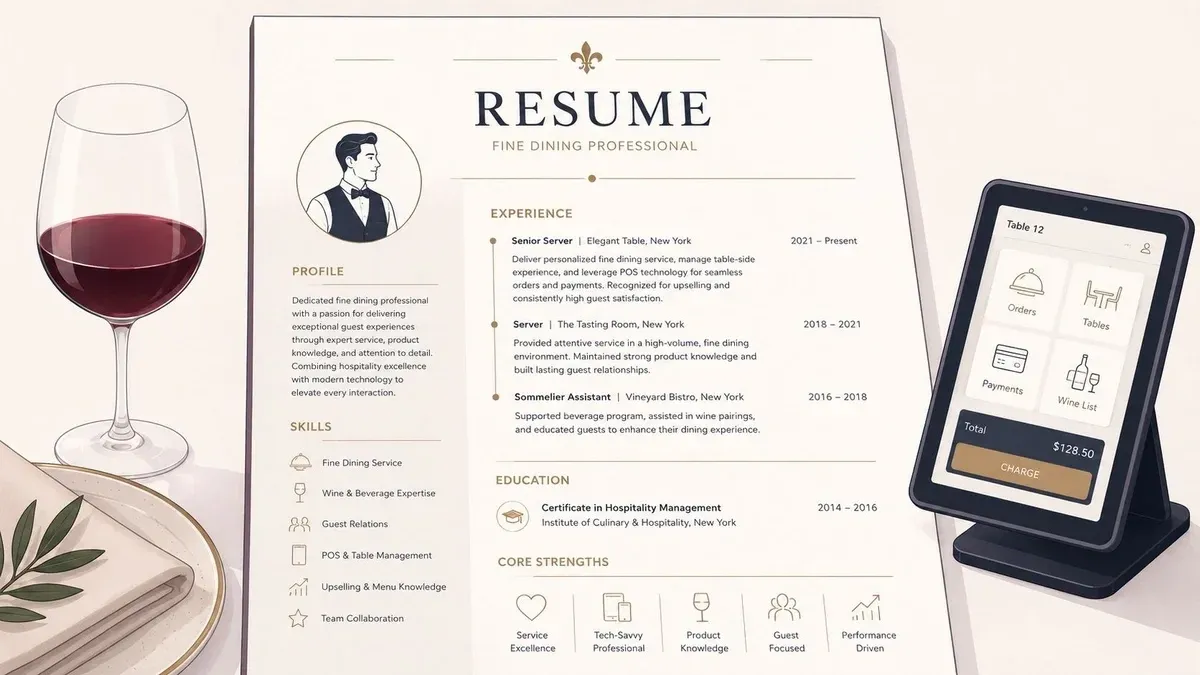
Managers often reject entry-level resumes too quickly. That’s expensive when your operation uses tablets, integrated online ordering, digital payment flows, and app pickups. In many cases, a candidate with limited serving experience but strong software comfort can become productive faster than a veteran who resists every screen in the building.
You’re not hiring an empty resume. You’re hiring pattern recognition, typing speed, app fluency, communication habits, and trainability. If the candidate has worked retail, coffee, reception, events, or campus service, they may already understand queues, transactions, and customer pressure.
What to value when experience is thin
Read the skills section closely. Terms like tablet-based software, order apps, payment systems, cash handling, and customer-facing communication all matter. Education can help too, but only if it supports operational readiness rather than filling space.
A good entry-level resume also translates adjacent experience properly. Retail shifts can become evidence of line management. A barista role can show order accuracy and speed. Volunteering at events can reflect crowd handling and task discipline.
- Digital confidence: Comfort with screens, apps, and structured workflows.
- Transferable service habits: Queue management, payments, and issue handling.
- Training upside: Candidates who learn software quickly reduce manager burden.
- Resume discipline: A clean one-page document usually signals focus.
For managers, the question isn’t “Has this person done my exact job before?” It’s “Can this person learn my system quickly without creating avoidable errors?” In a food tech environment, that distinction matters.
A real-world example is a first-time restaurant hire who already uses phone-based ordering apps daily, types quickly, and has worked a busy retail register. That person may adapt well to Square terminals, pickup verification, and modifier-heavy tickets because the interface logic won’t feel foreign.
If you hire entry-level talent often, it helps to compare their presentation with a broader guide for new graduate CVs. You’re looking for signal, not polish. A short resume that proves adaptability is often more valuable than a padded one full of empty service buzzwords.
7. Bilingual Waiter Resume for Diverse Customer Markets
A bilingual resume should immediately catch your eye if your restaurant serves a mixed customer base or runs a multilingual team. This isn’t just a nice extra. It can reduce mistakes, speed up clarification, and smooth handoffs between front and back of house.
The most useful bilingual candidates do more than list a second language at the bottom. They show where it mattered. Maybe they handled guest questions, clarified modifications, supported phone orders, or bridged communication during busy shifts. That’s operational value.
Language skills can protect order accuracy
In a restaurant that handles dine-in and delivery, language gaps can create expensive friction. A misunderstood allergy note, pickup name, modifier, or address clarification can turn into a remake, a refund, or a one-star review. A bilingual server can reduce that risk by catching confusion early.
This matters even more in neighborhoods with regular app-based ordering from diverse customers. If the resume suggests the candidate can communicate with guests and teammates in more than one language, that can strengthen both service quality and execution.
- Guest clarity: Fewer misunderstandings at the table, counter, or phone.
- Team communication: Faster coordination with kitchen, hosts, and runners.
- Delivery precision: Better handling of notes, substitutions, and pickup issues.
- Market fit: Language alignment can improve comfort for repeat customers.
In diverse markets, bilingual ability isn’t decoration on a resume. It’s a tool for reducing friction.
Consider a busy urban restaurant where Spanish-speaking kitchen staff, English-speaking managers, and multilingual customers overlap all shift. A bilingual server can help connect those moving parts without slowing service. The benefit gets even clearer when a DoorDash driver arrives early, a guest asks for a substitution, and the expo line is already under pressure.
When reviewing a sample resume of a waiter for bilingual value, prioritize applied language use over labels. “Spanish” alone is less useful than “explained menu items, confirmed order modifications, and supported guest issue resolution in Spanish and English.”
8. Career-Progression Waiter Resume from Server to Tech Lead
Some resumes show more than service experience. They show internal growth. That’s the profile to watch if you need someone who can stabilize shifts, train newer staff, and become the unofficial expert on your ordering workflow.
Career progression usually appears in title changes, expanded responsibilities, or bullets about training and system support. A candidate who moved from server to trainer, shift lead, opening lead, or floor captain may already be doing the work of a technology champion, even if they don’t use that label.
The resume of a future systems owner
In a modern restaurant, every team needs at least one person who can help others work through the stack. That includes POS use, ticket flow, modifier discipline, delivery timing, and pickup issue resolution. If the resume shows they trained peers, supported rollouts, or helped standardize procedures, that’s leadership with direct operational value.
This kind of person can reduce manager interruptions during service. Instead of answering every tablet or payment question yourself, you can rely on someone who understands the workflow and can coach others on the floor.
- Training proof: Look for onboarding, shadowing, or peer coaching.
- System ownership: Candidates may mention helping with POS routines or order flow.
- Leadership under pressure: Shift support matters more than generic ambition.
- Scalability: These hires often improve team consistency over time.
A practical example is a server who started as floor staff, then trained new hires on handheld order entry and pickup procedures once the restaurant added marketplace volume. That person isn’t just serving tables. They’re making the operation easier to run.
This is the strongest kind of sample resume of a waiter for restaurants growing their digital channels. It signals a candidate who can support process adoption, keep standards consistent, and bridge the gap between management decisions and frontline execution.
8-Sample Waiter Resume Comparison
Resume Type Implementation Complexity 🔄 Resource Requirements ⚡ Expected Outcomes 📊 Ideal Use Cases 💡 Key Advantages ⭐ 1. Chronological Waiter Resume with POS System Proficiency Low, standard format, easy to assess Moderate, verify POS certifications/tech match Faster onboarding, fewer entry errors Restaurants with established POS platforms Strong operational fit; shows tenure and POS familiarity 2. Functional Waiter Resume Focused on Multi-Platform Delivery Management Medium, skills-first needs context Low–Moderate, skill validation in interview Better multi-app order coordination High delivery-volume kitchens juggling multiple apps Highlights multi-platform management and problem-solving 3. High-Volume Restaurant Waiter Resume with Performance Metrics Low, data-driven, easy to compare Moderate–High, requires metric verification Clear KPI improvements (accuracy, sales) Data-driven, high-throughput operations Quantifiable proof of impact and efficiency 4. Fine-Dining Waiter Resume Adapted for Restaurant Tech Integration Low–Medium, traditional with nuance Moderate, assess transferability to delivery Consistent quality across dine-in and delivery Upscale restaurants adding delivery/takeout Attention to detail; quality control across channels 5. Quick-Service Waiter/Runner Resume with an Efficiency Focus Low, straightforward, task-oriented Low, minimal tech ramp, system-ready Increased throughput, reduced processing time QSRs and fast-casual high-volume outlets Speed and operational efficiency under pressure 6. Entry-Level Waiter Resume Highlighting Tech-Savviness Very low, simple, modern format Moderate, needs service training but fast tech uptake Rapid tech adoption; trainable long-term hire Tech-forward venues building bench strength Digital-native, adaptable, cost-effective to train 7. Bilingual Waiter Resume for Diverse Customer Markets Low, language skills clearly listed Low, language verification may be needed Fewer communication errors; better satisfaction Multicultural markets and diverse guest bases Reduces errors; expands guest accessibility 8. Career-Progression Waiter Resume: Server to Tech Lead Medium, requires career verification Moderate–High, confirm leadership/training roles Internal tech adoption; improved workflows Restaurants seeking internal tech champions/managers Leadership plus tech advocacy; drives adoption
Your Next Hire From Order Taker to Efficiency Expert
Stop reading waiter resumes like they are loyalty certificates. Tenure matters, but it does not tell you who can keep service intact when dine-in tickets, Uber Eats orders, and DoorDash orders hit the line at once.
A useful resume shows whether a candidate can protect throughput. Look for signs of POS fluency, accurate modifier handling, pace under pressure, cross-channel communication, and training experience. Those details point to someone who can work inside a modern restaurant without creating cleanup for the rest of the team.
That standard matters because front-of-house hiring now affects far more than table service. The right server reduces manual order entry, catches mistakes before they hit the kitchen, and keeps delivery volume from disrupting in-house guests. The wrong one slows the register, misses modifiers, and turns every rush into a patch job.
Read every sample resume of a waiter with one question in mind. Can this person handle a tech-enabled floor, or will your managers spend every shift fixing order flow problems? Strong resumes answer that quickly with measurable results, system familiarity, and bullets tied to speed, accuracy, and coordination.
Tighten your screening process. Favor candidates who show they can use restaurant systems, adapt to digital workflows, and produce clear results. A polished interview can hide weak habits. Resume details usually show them early.
Then fix the operation around the hire. Strong staff should not waste energy retyping delivery orders from disconnected tablets into the POS. Clean workflows shorten onboarding, reduce order errors, and let capable servers focus on guests instead of admin work.
If you’re also tightening the rest of your operation, even basic purchasing decisions affect consistency on the floor. Simple tools and uniforms still matter, and this guide on how to buy aprons in bulk can help with that side of setup.
When you’re ready to remove manual entry and streamline delivery operations, start onboarding with OrderOut for Free in just a few clicks.
OrderOut helps restaurants route Uber Eats, DoorDash, and other delivery app orders into supported POS setups, cutting re-entry work and reducing preventable mistakes. If you want a cleaner workflow, fewer order errors, and a front of house that can keep up with modern restaurant delivery, explore OrderOut.