

California waiters and waitresses earned a mean hourly wage of $20.77 and a mean annual wage of $43,200 in the BLS May 2023 data, and in California they must be paid the full $16.90 state minimum wage before tips. That’s the right starting point, because the answer to how much does a waiter make in California is a range, not a single number.
What a Waiter Actually Makes in California Right Now
A California server’s pay starts with the legal wage floor, then moves with tips, shift mix, and venue type. The state does not use the federal tipped-wage model. Under the U.S. Department of Labor’s tipped wage guidance, California requires tipped employees to receive the full state minimum wage before tips, instead of the federal $2.13 per hour floor used in many other places. California tipped wage rules
That is why waiter pay in California has to be read as a range shaped by policy, not as one clean statewide average. The BLS benchmark of $20.77 an hour or $43,200 a year gives operators a useful reference point, but it does not describe what a brunch server, a closing server, or a high-volume dinner server takes home. The same statewide occupation data shows a median hourly wage of $15.36, which is a reminder that the middle of the market can sit well below the mean when tips and busy shifts are unevenly spread. California waiter wage data
Practical rule: budget server labor in California from the legal wage floor first, then add tips, overtime, and payroll taxes. That is how the labor cost shows up on the books.
If you want a quick sense of how server pay compares with other hourly work, use compare wages for tradespeople as a rough cross-check. The point is not that a waiter and a tradesperson are interchangeable. The point is that compensation only makes sense when you place it inside the same labor market and look at the full pay structure.
A California waiter can look inexpensive on the wage line and still cost more than expected once you include overtime, employer payroll taxes, and the way tip economics affect scheduling. For operators, that is the number that matters.
How Pay Is Distributed Across California Servers
Server pay in California is spread across a wider band than a single average suggests. Entry-level servers, steady mid-tenure staff, and top-end fine dining servers do not sit in the same pay range, even when the job title is the same. The California waiter wage distribution shows that annual pay for waiters and waitresses runs from $18,600 at the 10th percentile to $31,940 at the median, then up to $41,600 at the 75th percentile and $60,100 at the 90th percentile.
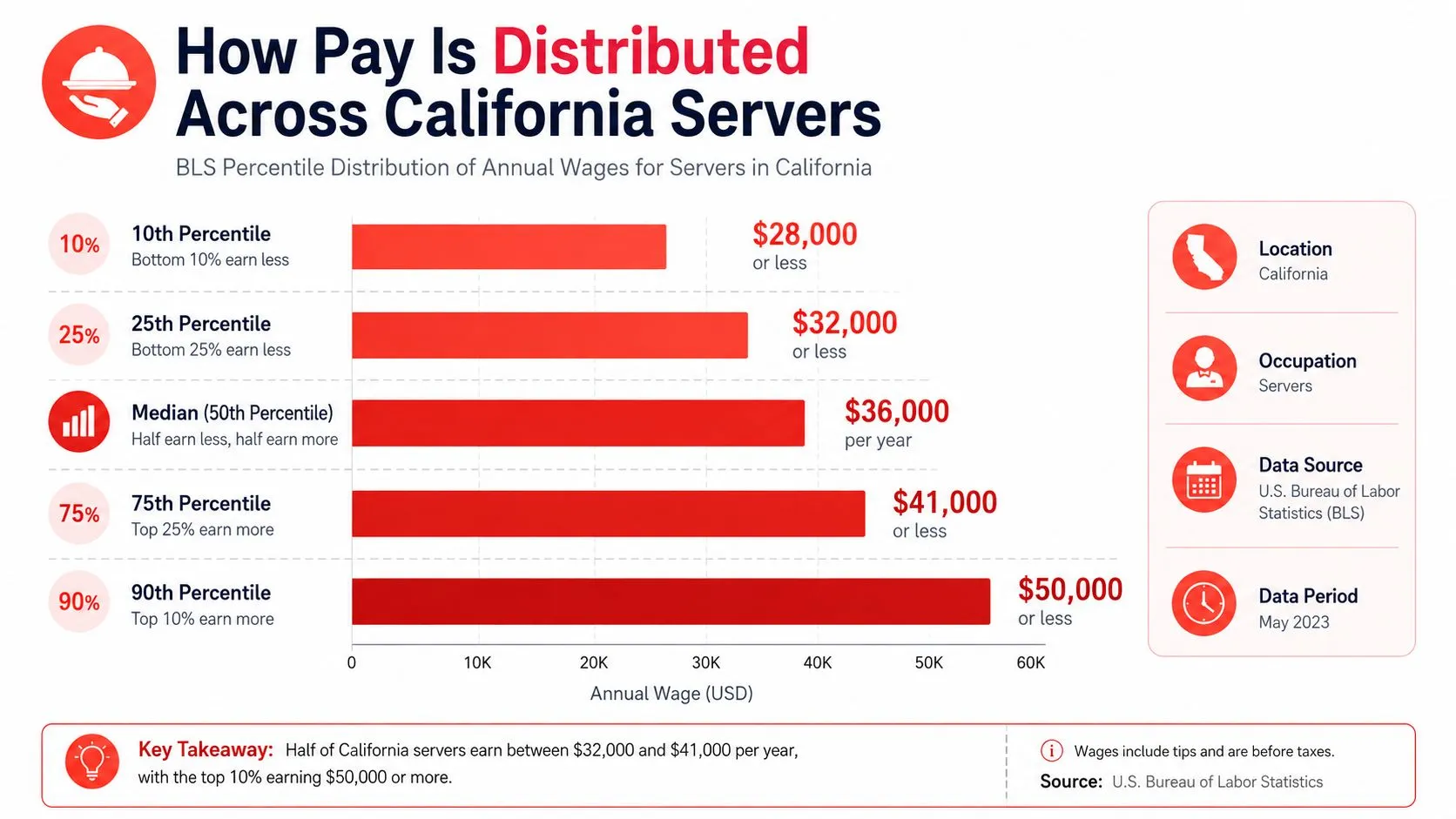
What those percentiles mean on the floor
A server near the lower end is often still learning section flow, menu knowledge, and table timing. A server around the middle usually has enough repetition to keep a room moving without slowing service. The higher end tends to belong to people in fuller sections, higher-check spots, or shifts where guest mix and ticket size support stronger tips.
That spread is why operators should not hire or forecast from one wage line. A new server easing into the job, a career server handling prime dinner turns, and a banquet server running group service live in different pay realities. If you are writing a job description or setting expectations, use bands instead of a single rate. A solid reference point for role design is the server job description guide, and for tip-flow expectations, this tip chart for restaurants gives a cleaner picture of how guest gratuity patterns can affect take-home pay.
| Percentile | Annual wage | What it usually signals |
|---|---|---|
| 10th | $18,600 | Early tenure, slower shifts, or weaker tip volume |
| Median | $31,940 | Established server in a steady full-service setting |
| 75th | $41,600 | Busy sections, stronger demand, better checks |
| 90th | $60,100 | High-volume or high-ticket service, often with stronger tip flow |
A California server can look inexpensive on the wage line and still cost more than expected once overtime, payroll taxes, and tip-driven scheduling are part of the picture. For operators, that is the number that matters.
Base Wage, Tips, and Tip Pooling Under California Law
California’s wage structure makes the math more honest than it is in states with a tipped subminimum. The $16.90 state minimum wage applies before tips, so tips add to base pay rather than replacing it. That changes both payroll planning and the way staff think about take-home income. The California Department of Industrial Relations also sets the statewide minimum wage at $16.90 per hour effective January 1, 2026, and fast-food restaurant employees covered by a separate law must be paid $20.00 per hour starting April 1, 2024. California minimum wage rules
How the shift math works
Take a server who works a 6-hour lunch-and-dinner split at $16.90 an hour and earns $80 in tips. Gross pay before taxes is $181.40, which comes from base pay plus tips. On a stronger 8-hour closing shift with the same base wage and $140 in tips, the math changes fast because the tip component becomes a much bigger piece of the total.
That’s the key variable in California. A server’s paycheck is shaped by the section, the night, and the guest mix, not just the scheduled hours. Tip pooling can smooth that out, but only among employees who customarily receive tips. Managers need to keep the pool clean and limited to eligible staff, because sloppy pooling turns into a payroll and compliance headache.
Practical rule: if a position depends on tip volume, don’t treat every hour as equal. A quiet midweek lunch is not the same labor event as a packed Friday close.
Service charges and tips are not interchangeable. If you’re writing payroll policy or guest-facing menu language, keep those buckets separate so staff know what actually counts as a tip. A useful explainer on the distinction is service charge vs tip.
For operators, the point isn’t just legal compliance. It’s clarity. When staff understand that the base wage is real wage and tips are upside, scheduling and morale both get easier to manage.
Why Different Sources Report Very Different Numbers
The confusion around how much does a waiter make in California starts with the way each source defines pay. The BLS lists $43,200 across 225,040 workers, which comes from a large employer-based occupational dataset. Salary.com puts the average at $24,802 a year with a typical range of $21,702 to $28,102. ZipRecruiter reports $32,425 a year on average, with most salaries between $23,700 and $34,500, and a $43,423 90th percentile. Salary.com California waiter pay ZipRecruiter California waiter salaries
Why the estimates drift
Each source answers a different question. BLS is the cleanest statewide anchor because it comes from broad labor-market reporting. Salary.com relies more on modeled pay data, and ZipRecruiter reflects a mix of marketplace postings and self-reported market signals. The numbers do not line up because they are not measuring the same slice of the job.
For operators, that gap is useful. It shows there is no single California waiter number to plan around. There is a lower-band reality, a middle-market reality, and a higher-volume reality, depending on the room, the city, and the shift mix. For labor planning, I use restaurant labor cost calculator guidance as a starting point, then layer in payroll taxes, overtime, and tip economics.
| Source | Average annual wage | Typical range | Sample notes |
|---|---|---|---|
| BLS | $43,200 | Not stated as a salary band | 225,040 workers statewide |
| Salary.com | $24,802 | $21,702 to $28,102 | Modeled market estimate |
| ZipRecruiter | $32,425 | $23,700 to $34,500 | Marketplace-driven estimate, $43,423 at the 90th percentile |
The operator move is to treat BLS as the foundation, then use the other sources as a reality check for local hiring pressure. If your restaurant competes for better servers, local market pay will usually matter more than the statewide average. A clear server job description also helps you line up the role, the wage, and the tip structure before you start hiring.
How City, Venue, and Role Change the Number
California is not one labor market, and server pay shows it. Coastal metros and inland markets behave differently, and the venue matters just as much as the zip code. In practice, servers in San Francisco or Los Angeles usually sit closer to the upper end of the range because check averages and tip opportunity are often stronger, while inland markets such as Fresno or Bakersfield usually track closer to the middle. That is a staffing reality, not a theory.
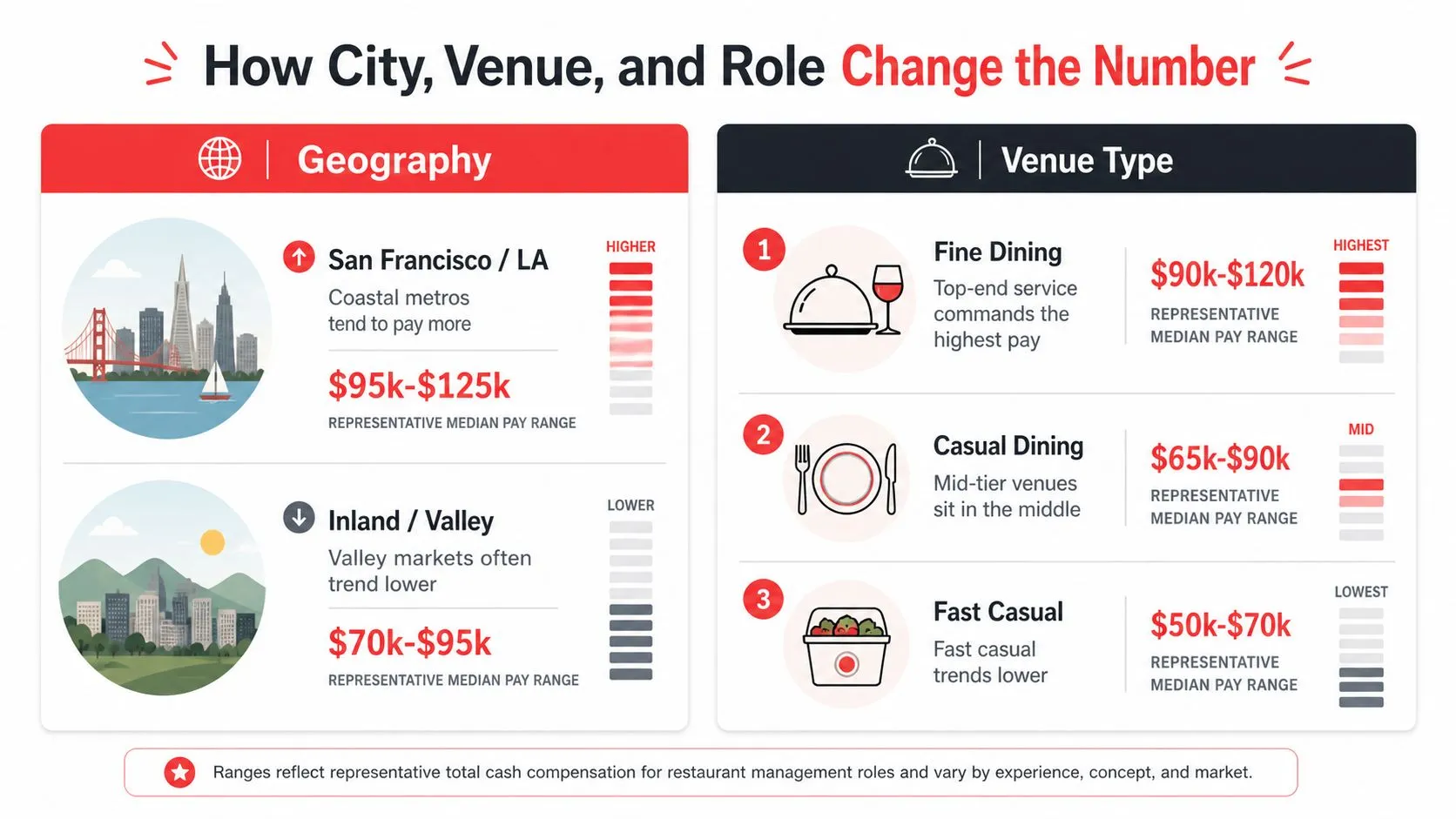
Geography and venue type both matter
Fine dining servers can push toward the higher end because the pace, menu price point, and wine service leave more room for larger tips. Casual full-service spots usually sit in the middle, where volume matters more than high-ticket checks. Fast casual staff often follow a different pay pattern, with more weight on base wage and less tip upside.
Role mix changes the number too. Bartenders can out-earn servers on a strong night because bar tip-outs add another layer to compensation. That does not mean the role is always better paid, only that the economics shift by station and guest flow. If you are writing staffing plans, the right question is not “What do servers make?” It is “What does this room, in this zip code, on this shift, pay?”
When you spell out duties and pay expectations, a clear server job description keeps the conversation tied to the actual work, not just the title.
For managers, the useful habit is local benchmarking. Statewide averages help you orient, but they will not tell you whether your offer is strong enough to recruit the floor talent your restaurant needs. If payroll gets tight or you are running multiple locations, California PEO compliance also comes into the conversation because labor rules, taxes, and leave obligations still apply when the dining room is busy.
What a Server Really Costs a Restaurant Owner
The wage number is only the starting point. If you pay a server $16.90 an hour for 40 hours, the gross wage alone is $703.20 for the week. On top of that, the employer still pays Social Security and Medicare taxes at 7.65 percent, California State Disability Insurance, unemployment insurance, and any paid leave or benefits you choose to offer. For a useful starting point on the math, see this restaurant labor cost calculator.
Why the true cost climbs faster than the wage
A full-time server in California rarely costs the same as the posted hourly wage. Once employer payroll taxes are added, the all-in cost often lands in the low-to-mid $20s per hour, and overtime can push it up fast on a sixth or seventh workday. The mistake I see most often is budgeting wages in isolation and forgetting the employer burden behind every paid hour.
Compliance and scheduling discipline matter just as much. If you are using a third-party employer platform or trying to keep payroll clean across a multi-site operation, California PEO compliance belongs in the conversation because labor rules, taxes, and leave obligations still apply when the dining room is busy. The cost structure has to be handled deliberately, not guessed at.
Operator reality: labor is not just a pay rate, it is a stack of wage, tax, and schedule decisions that all hit the P&L at once.
Most full-service operators still try to keep labor near a practical share of revenue rather than letting it drift. That is the right lens for server pay. A server who works well, turns tables, and keeps service clean can be worth every dollar, but the hourly model still has to make sense against the room’s sales pattern.
The clean way to think about it is simple. Server compensation is not a standalone expense line. It sits inside a broader labor system that includes wages, payroll taxes, overtime, and scheduling discipline.
Cutting Manual Work So Servers Spend More Time on the Floor
The fastest way to protect server labor is to stop spending paid hours on clerical work. When a team has to re-key DoorDash, Uber Eats, and Grubhub orders from separate tablets into a Clover or Square POS, that time comes out of the same labor pool as service. It is admin work, not tipped floor work, and it drags the room down.
Direct delivery-to-POS integration solves that problem at the source. OrderOut maps each marketplace menu to a normalized POS schema, then injects third-party orders straight into the POS so the restaurant does not need extra tablets or manual re-entry. The payoff is fewer order-entry errors, cleaner ticket flow, and fewer moments where the front of house gets pulled off the floor to babysit a device.
For operators, the labor equation changes without changing the menu. Staff spend less time fixing orders and more time serving guests, which is where the tips live. If you’re using Clover, the Clover delivery integration is the most direct starting point, and the broader 3rd-party order engine shows how the menu-to-POS flow works across channels.
A cleaner service floor helps managers hold down the hidden labor that creeps in when online orders live on a separate island. It also gives servers more time where it counts, on the floor instead of in the weeds. For operators looking at the operational side of labor, restaurant automation in practice is the right place to examine where manual steps can be cut without hurting service.
Frequently Asked Questions
Do California servers really get the full minimum wage before tips?
Yes. California requires tipped employees to receive the full state minimum wage before tips, unlike the federal tipped wage system. That’s the biggest legal reason waiter pay in California looks different from many other states.
Is tip pooling legal in California?
Yes, but only among employees who customarily receive tips. That means the pool has to stay within the right group, and managers need to keep the rules clear.
Why does the BLS number look higher than what many servers say they make?
Because the BLS is measuring statewide occupational wages across a large worker base, while other salary sites use different methods. California waiter pay varies a lot by venue, city, hours, and tip volume, so the average can hide a wide spread.
Do delivery tips count the same way as dine-in tips?
Guests can tip on third-party delivery, but those orders create extra work if they aren’t flowing cleanly into the POS. Restaurants usually want those tickets handled in one system so staff aren’t re-keying orders while the dining room is busy.
Does OrderOut work with Clover?
Yes, OrderOut is built to inject third-party delivery orders into Clover without extra tablets or manual re-keying. It’s also free to install on the Clover App Market.
If you’re trying to keep California labor under control, don’t stop at the wage headline. OrderOut helps restaurants move Uber Eats, DoorDash, and Grubhub orders straight into the POS so the front of house spends less time on manual entry and more time serving guests. Visit OrderOut to see how cleaner order flow can support a tighter, less wasteful operation, then start onboarding at dashboard.orderout.co.