
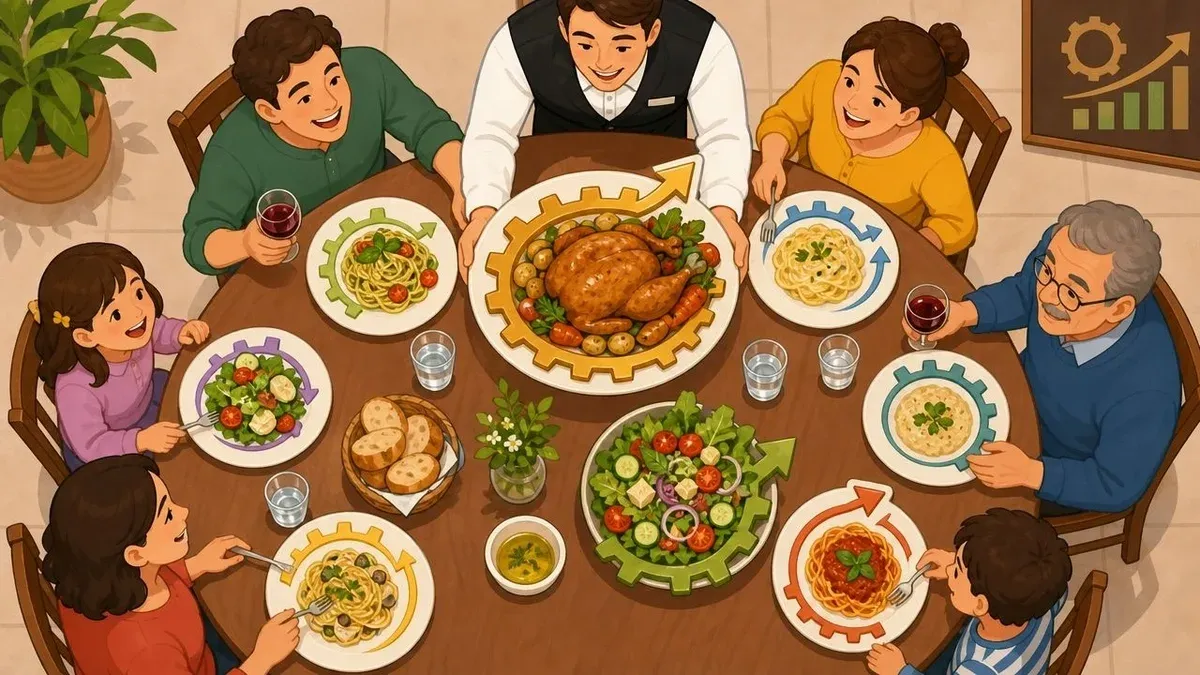
A lot of restaurants arrive at the same point. The menu keeps growing, online orders keep getting messier, and the kitchen spends service juggling too many one-off modifications for too many individual plates. The result isn’t just stress. It shows up in ticket mistakes, slower handoff times, and weak average checks on parties that should be spending more.
A family style menu can fix that, but only if you treat it as an operating system, not a marketing idea. Shared platters, bundled courses, and simpler ordering logic can make service easier on the line and clearer for guests. The full benefit emerges when you connect menu design, portioning, POS setup, and delivery mapping so the whole program runs cleanly.
Why Your Restaurant Needs a Family Style Menu Strategy
Most operators don’t need another concept. They need fewer moving parts during rush.
If your dining room fills with groups but your kitchen still fires every guest as a separate order, you’re carrying unnecessary complexity. A family style menu changes the unit of sale. Instead of selling six separate entrees, three sides, and a pile of modifications, you sell one structured shared meal with predictable components and predictable prep.

That matters because guest behavior already supports the format. One study cited by Maryann Jacobsen on family-style meals reports that 29% of families already use family-style service at home, with 11% using a mixed format. The same source notes that only about 30% of families manage to eat together regularly, and the research discussed identifies five meals per week as a common tipping point for many of the benefits. For restaurants, that means shared dining is familiar to many guests, but still valuable because regular at-home family meals are hard to pull off.
Why operators benefit first
The guest experience is easy to understand. Shared food feels generous, social, and easier for groups.
The operator upside is bigger. A well-built family style menu can:
- Reduce order complexity by limiting choice sets to a small number of curated combinations.
- Increase perceived value because platters look abundant and encourage add-ons like drinks and dessert.
- Stabilize production because the kitchen builds from standardized platter yields instead of individual plate assembly.
- Support restaurant delivery because bundled meals are easier to package and easier to map in ordering systems.
Practical rule: If your biggest tables create the most kitchen friction, they are strong candidates for a family style format.
This also aligns with how guests choose restaurants for group occasions. If you’re studying how diners search for shared dinner options in major markets, a resource like this Guide to family dining in NYC is useful because it reflects how consumers think. They’re not only looking for food. They’re looking for a format that makes gathering easier.
Defining the Family Style Menu Model
A family style menu is simple at the table. The restaurant sends large-format dishes to the group, guests serve themselves, and the meal is built around sharing rather than individual plating.
That sounds obvious, but operators often blur it with other formats. It isn’t a buffet because guests aren’t walking to a service station. It isn’t tapas because the goal isn’t a stream of small individual dishes. It isn’t standard catering dropped onto a dine-in table. Family style dining is a large-format sharing model designed for table service, and industry descriptions note that it’s often sold as a fixed-price or prix-fixe experience that reduces menu complexity and can support higher check averages. One example cited by US Foods described a family-style four-dish to-go menu priced at $35 per person, while another family-meal format was offered at $30 per person in a separate example from the same piece on family-style restaurant operations.

It started as an operational ritual
The most useful thing to know about family style dining is that it didn’t begin as a guest-facing menu trend. According to Poached Jobs’ history of restaurant family meal, the broader roots of the practice sit in the 19th century alongside the rise of the modern restaurant industry and haute cuisine. The same source notes that the first documented use of the modern restaurant-world meaning of family meal appeared in Thomas Keller’s The French Laundry Cookbook, followed one year later by a book from David Waltuck of Chanterelle devoted entirely to the concept.
That history matters because it explains the model’s DNA. Family meal started as an efficient way to feed restaurant staff before service. It was built around batch cooking, shared dishes, and practical use of kitchen labor.
Family style works in modern service for the same reason family meal worked in restaurant back rooms. It simplifies production.
What that means in today’s restaurant operations
For dine-in, a family style menu should feel intentional, not improvised. For online ordering and catering, it should behave like a product SKU with a clear yield, defined components, and simple modifier logic.
If you need a basic consumer-facing explanation to compare with your operational setup, this overview of what family-style dining means is a useful reference point. The key for operators is to keep the guest-facing experience warm and flexible while the back-end structure stays tightly controlled.
Menu Design and Engineering for Shared Plates
The most common mistake is turning your existing menu into bigger portions and calling it family style. That usually creates bad holds, inconsistent yields, and pricing problems.
A profitable family style menu starts with dish selection. You need items that plate well in volume, hold temperature reasonably well, and can be built by the line without delicate last-second finishing. Crisp fried food with a short quality window often struggles. Braises, roasted vegetables, composed salads that don’t collapse immediately, rice dishes, pasta bakes, and sliced proteins usually perform better.
Choose dishes by service behavior
Ask four questions before an item makes the cut:
- Does it hold on a platter? If it degrades fast, it will disappoint in dine-in pacing and restaurant delivery.
- Can the kitchen portion it consistently? Family style only works when every platter follows the same build.
- Does it travel cleanly? Delivery and pickup need dishes that survive packaging and short transit.
- Can FOH explain it in one sentence? If servers need a script to decode the format, the offer is too complicated.
A strong menu usually mixes one premium anchor with lower-cost supporting dishes. That could mean a roast chicken or steak centerpiece paired with vegetables, rice, potatoes, or pasta that add abundance without making the plate cost spiral. Guests remember generosity. They don’t audit your exact side-dish economics if the meal feels complete.
Build from bundles, not open-ended choice
A good family style menu is curated. A bad one becomes a choose-everything matrix that creates POS chaos.
Use a structure like this:
- Starter choice with a small set of options that share prep ingredients.
- Main selection built around proteins the kitchen already executes well in batches.
- Supporting sides chosen for yield stability and easy replenishment.
- Optional upgrades like dessert packs, beverage bundles, or premium protein swaps.
Keep the combinations tight enough that inventory stays predictable. The best operators write these menus backward from prep sheets, not forward from creative ambition.
Design the platter first. Then write the menu language. Not the other way around.
If you’re building the item set digitally, menu architecture matters as much as the food. This guide to restaurant menu design software is useful because it pushes the same discipline you need for family style: clean categories, clear modifier logic, and items that behave correctly across ordering channels.
Smart Portioning and Pricing for Restaurant Profitability
Pricing a family style menu gets messy when operators rely on instinct. They often either underprice because the platter looks simple, or overbuild the meal because they fear guests won’t see the value.
The better approach is to treat every platter like a yield-controlled package. You’re not pricing four separate entrees. You’re pricing a defined shared experience with a known production pattern.
Start with total yield, not plate count
A helpful analogy comes from regulated child care meal service. In USDA CACFP family-style settings, staff must place the full required portions of each meal component on the table for everyone participating. The planning method is straightforward: multiply the age-group minimum by the number of children, then sum totals. The USDA example shows that 0.125 cup of diced peaches for 6 children equals 0.75 cup, and 0.25 cup for 6 children equals 1.5 cups in the CACFP family-style operator booklet.
Restaurants can apply the same principle without copying the regulation itself. Build for total table yield. Don’t think in terms of “four entrees.” Think in terms of “one protein platter that feeds four with our target serving level, plus sides at a fixed total yield.”
That shift improves consistency fast.
What pricing should account for
A family style menu price needs to reflect more than ingredient cost. It also has to absorb serviceware, packaging for off-premise orders, labor saved through batching, and the reduced complexity created by fewer individual tickets.
Use these decision points:
- Per-person pricing works when your concept already sells prix-fixe or group packages.
- Minimum-party pricing works for larger-format dining rooms and events.
- Tiered bundles work when you need separate packages for smaller households, dine-in groups, and catering orders.
One issue operators miss is whether the offer is economical for smaller groups. Public menus often attach per-person or minimum-party pricing that starts at 8–10 guests, sometimes with room fees or timed windows, as seen in this family-style brunch menu example. That’s why you need to model small-party behavior, not just banquet-style demand.
For a practical outside reference on the fundamentals of setting profitable prices, it’s helpful to compare your family style package against your normal menu economics and not rely on surface-level “value” language.
Cost Comparison for À La Carte vs. Family Style for a Party of 4
Item À La Carte Price Family Style Equivalent Shared starter Sum the individual starter orders your group typically buys One included starter built into the package price Main courses Sum of individual entrees ordered across four guests One bundled main selection priced per person or per package Side dishes Separate add-on sides, often ordered unevenly Fixed side set included with the meal Dessert Optional and often skipped Easier to attach as a package upgrade Final bill logic Variable, harder for guests to predict More predictable for both guest and operator
The table doesn’t include exact dollar comparisons because those depend on your menu. The point is operational. Bundles give you tighter cost control and a cleaner sales story.
If you want to test family style pricing by daypart or party size, this breakdown of dynamic pricing strategies for restaurants is a good framework for deciding where a set menu belongs and when to push it hardest.
Aligning Kitchen and FOH for Family Style Service
A family style menu fails when the kitchen treats it like catering and the floor treats it like regular à la carte. Both teams need a shared service rhythm.
The kitchen should see fewer fragmented tickets and more repeatable builds. FOH should see easier ordering conversations and cleaner pacing. When those two views don’t line up, platters hit the table too early, too late, or with the wrong expectation set.
What the kitchen needs
The back of house usually benefits first. Prep lists become clearer because production shifts toward batch-ready components, sauces held for multiple menu paths, and standardized garnish sets. Expo also gets relief because the team is releasing coordinated platters instead of managing a tangle of single-plate fire times.
Train BOH around these points:
- Platter builds: Write exact platter specs with vessel, portions, garnish, and handoff notes.
- Pickup sequence: Decide what gets assembled first and what waits for the final minute.
- Refire discipline: If a platter component misses, know whether to replace the item or rebuild the whole set.
- Packaging standards: Off-premise family meals need different containers than dine-in platters.
If your managers need a refresher on role clarity, this explanation of what BOH means in a restaurant is a useful baseline for assigning ownership correctly.
A family style ticket should read like a build sheet, not a puzzle.
What FOH needs
Servers need a tight explanation and a few smart prompts. They shouldn’t deliver a lecture.
Train FOH to cover three things naturally:
- How the meal is structured. Guests need to know what’s included and what can be added.
- How pacing works. Shared meals feel better when courses land with intent instead of all at once.
- What pairs well. Beverage bundles and dessert add-ons are easier to sell when the package is already framed.
The floor also needs to manage tableware correctly. Extra serving spoons, share plates, and replacement utensils matter more in this format than operators often assume. Small misses here create friction that guests notice immediately.
POS Integration and Food Tech for Your Family Style Menu
Many family style programs break. The menu makes sense in the dining room, but it falls apart online because delivery apps, POS categories, and kitchen tickets all describe the same meal differently.
A guest sees “Family Meal for 4.” A delivery marketplace may break that into nested choices. Your POS may need separate modifier groups. The kitchen just wants one clean production ticket. If staff has to translate that order by hand, you lose the operational advantage you built everywhere else.

The manual-entry problem
Take a common restaurant delivery scenario. A customer orders through Uber Eats or DoorDash. The family package includes one salad choice, two mains, two sides, and optional dessert. If that order doesn’t flow into your POS cleanly, someone has to re-enter it into Clover or Square by hand.
That creates three problems fast:
- Time loss at the host stand or expo station.
- Modifier errors when staff pick the wrong nested option.
- Messy kitchen tickets that force cooks to interpret instead of execute.
Square and Clover are both practical environments for this if your item architecture is clean. Restaurants using Square can review app connections through the Square App Marketplace listing, and Clover users can look at the Clover App Market listing when evaluating how delivery orders move into the POS.
Build one POS item, map the details behind it
The cleaner setup is to create a single POS product such as “Family Meal for 4” and then map marketplace choices to that item and its modifier logic. Your kitchen sees one understandable ticket. Guests still get flexibility upstream.
Integration’s importance cannot be overstated. A connector such as OrderOut can route delivery app orders from platforms like Uber Eats, DoorDash, and Grubhub into POS systems including Clover and Square, reducing manual re-entry and consolidating order flow. For family style menus, that matters because the product is bundled by nature. The technology has to preserve that bundle instead of exploding it into chaos.
If your staff has to retype a family meal order, your technology stack is undoing your menu strategy.
For operators who need the basics before they start mapping complex bundles, this guide to POS meaning in restaurant operations is a good primer. The main takeaway is simple. Your family style menu should exist as a controlled product across every channel, not as a different logic tree in each app.
Your Next Steps to Launch a Family Style Menu
Most restaurants shouldn’t launch with a full menu conversion. Start with one package that solves a real service problem. A dinner bundle for groups, a weekend brunch spread, or an off-premise meal for households is usually enough to test demand and workflow.
Use this rollout checklist
- Audit your current menu. Identify dishes that hold well, batch well, and travel well. Remove anything that needs fragile plating or immediate consumption.
- Set the package structure. Decide what’s fixed, what’s optional, and where modifiers stop. Tight boundaries protect kitchen speed.
- Write platter specs. Standardize vessel, garnish, serving utensils, sides, and packaging notes for pickup and restaurant delivery.
- Model your pricing. Compare the package against your current party spending patterns and make sure the bundle improves predictability.
- Train both teams. BOH needs build sheets. FOH needs a short explanation, pacing guidance, and upsell prompts.
- Configure the POS. Build the item cleanly in Square or Clover so the family meal behaves like a single sellable unit with controlled options.
- Test the online ordering path. Run trial orders from delivery marketplaces and confirm that the ticket arriving in the kitchen is easy to read and easy to execute.
Start narrow, then expand
Don’t launch five family style packages at once. Launch one. Watch where errors happen. Fix modifier logic, vessel choices, and packing flow before you add more bundles.
The operators who make this work aren’t the ones with the most creative menu copy. They’re the ones who treat the family style menu like a systems project across menu engineering, restaurant operations, restaurant delivery, and food tech.
If you’re ready to put the pieces together, start by cleaning up your menu structure in the POS, testing one bundled offer, and making sure delivery orders map correctly from day one.
If you’re setting up a family style menu and want delivery orders to flow cleanly into your POS, you can start onboarding in a few clicks through the OrderOut dashboard.