
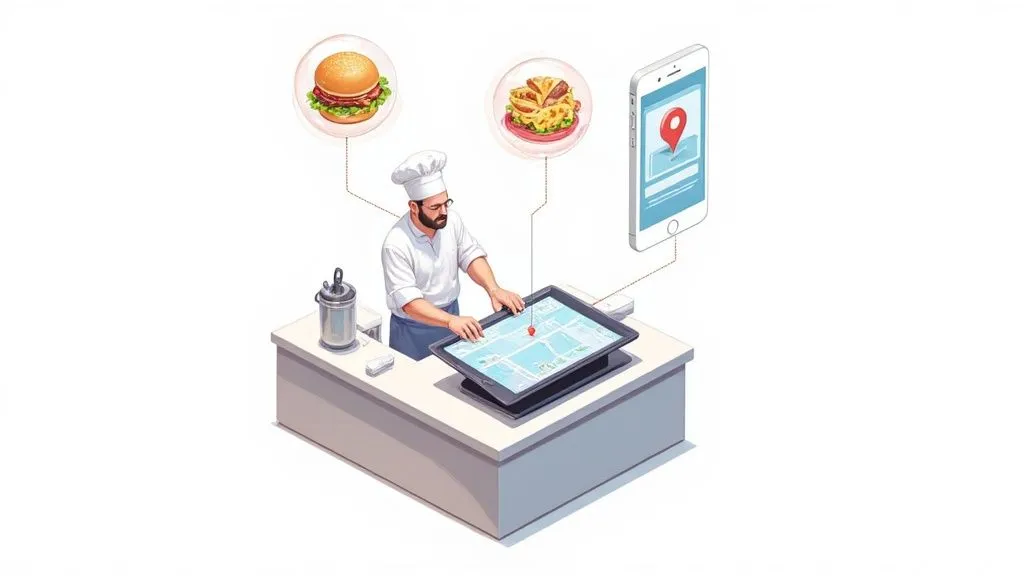
A DoorDash virtual brand is a delivery-only restaurant concept that operates from an existing kitchen and appears as its own storefront in the app. The simplest way to think about it: one kitchen, one team, one address — but a separate delivery identity built for a specific menu and customer need.
For operators, the opportunity is straightforward. You use existing labor, equipment, and inventory to test a focused concept without signing a new lease or building a second dining room. The main appeal is not novelty, but the ability to add sales with less startup friction than opening another physical location.
How We Evaluated DoorDash Virtual Brands for Restaurant Operators
We assessed DoorDash virtual brands using six practical criteria: spare kitchen capacity, menu travel quality, ingredient overlap with the core operation, margin after commissions and packaging, POS integration readiness, and how easily the team could fulfill added tickets during peak periods.
What stood out to us is that a virtual brand is rarely a branding problem first. It is usually an operations problem first. A concept can look smart on paper and still fail if the kitchen is already maxed out at dinner, the food dies in transit, or staff have to re-enter every order by hand.
We also weighted platform fit. DoorDash’s own merchant rules matter here because eligibility is not just about making a second menu. Its published guidance says a virtual brand must be meaningfully distinct, including at least 50% differentiation in main menu items from other menus at the same address, at least 8 food items, at least 50% hot or prepared food, and quality thresholds such as a 4.0+ lifetime customer rating and under 5% merchant cancellations according to DoorDash’s virtual brand requirements.
What Are DoorDash Virtual Brands and How Do They Work for Restaurant Delivery?
A DoorDash virtual brand is a delivery-only brand that runs from a restaurant’s existing kitchen and is sold through DoorDash as a separate concept. If you have asked what is a DoorDash virtual brand or what does virtual brand mean on DoorDash, the plain-English answer is this: it is a second delivery-facing restaurant identity built inside an operation you already run.
Operator-facing, the definition is more precise. DoorDash describes virtual restaurants as concepts that use an existing restaurant’s space, staff, and equipment rather than a new storefront, and its merchant guidance makes clear that the concept should be operationally distinct instead of a renamed copy of another menu, as explained in DoorDash’s virtual restaurant overview and its official quality requirements.
Here is the useful breakdown:
- What it is: a delivery-only concept marketed under its own name inside DoorDash.
- What it is not: automatically a separate legal company or separate kitchen facility.
- What it is not: the same thing as a ghost kitchen.
- What it is not: just duplicating your existing menu under a different name.
That last point matters. DoorDash’s standards require meaningful menu differentiation, so a doordash virtual brand meaningfully needs its own offer, positioning, and customer reason to exist. In our review, the strongest examples were focused around a clear use case — wings late night, desserts after dinner, bowls for lunch — rather than “everything your main restaurant already sells, again.”
A restaurant also needs a few basics in place before launching one successfully: a menu concept built for delivery, packaging that protects quality in transit, a prep flow that will not disrupt the core business, and the ability to complete DoorDash onboarding and approval. Those details determine whether the brand feels like easy incremental revenue or a stream of messy, low-rated tickets.
The Customer and Order Workflow and Why POS Integration Matters
The whole process is designed to minimize disruption for your kitchen. Here’s a quick look at how an order gets from a customer’s phone to your pass:
- Customer Discovery: A hungry customer scrolls through DoorDash and finds your virtual brand, which looks and feels completely separate from your main restaurant.
- Order Placement: They pick their items and place an order through the app, just like they would from any other spot.
- Order Transmission: DoorDash beams the order details straight to your restaurant.
- Kitchen Preparation: Your team gets cooking, using the same equipment and ingredients you already have on hand.
- Dasher Pickup & Delivery: A DoorDash driver (Dasher) swings by, grabs the packaged order, and zips it off to the customer.
Why it matters: This workflow is designed for speed, but its real power is unlocked only when orders flow directly into your POS. Having to manually punch in orders from a separate tablet is a surefire way to cause errors and bottlenecks, which costs you time and money. Integrating DoorDash with a system like Square means every virtual brand order pops up on your kitchen display system instantly, just like an in-house ticket. This automation is what keeps your kitchen running at peak efficiency, preventing costly mistakes and improving staff productivity.
Virtual Brands vs. Ghost Kitchens
It’s easy to get “virtual brand” and “ghost kitchen” mixed up, but they aren’t the same. Understanding the difference is key to seeing the opportunity for your existing restaurant.
A virtual kitchen is a delivery-only brand that operates out of an existing restaurant’s kitchen—often using the same staff, space, and equipment. A ghost kitchen, on the other hand, typically operates out of a dedicated commercial facility with no dine-in space.
This is a critical distinction. Virtual brands are an add-on strategy for established restaurants, not a separate venture that requires you to lease a new commercial space. You can dive deeper into this with our guide on what are ghost kitchens. And if you want a DoorDash-specific explainer on delivery-only restaurant models, DoorDash’s delivery-only restaurant guide is also useful.
The operational differences are usually where the decision gets clearer:
- Facility model: a virtual brand shares an existing restaurant kitchen; a ghost kitchen typically runs from a dedicated off-premise facility.
- Staffing: virtual brands usually use the current team and schedule; ghost kitchens may require separate staffing plans or a standalone operating model.
- Startup cost: a virtual brand can launch with packaging, menu setup, and systems work; a ghost kitchen often adds lease, equipment, and facility costs.
- Brand ownership: a virtual brand is often created by the restaurant itself, while ghost kitchen facilities may host multiple third-party concepts under one roof.
Industry coverage from the National Restaurant Association has consistently framed off-premise growth as an operational capability question, not just a marketing one. This aligns with industry findings: the more a concept depends on new labor, new equipment, or a separate buildout, the less it behaves like a true virtual brand, and the more it starts drifting toward a different business model.
DoorDash virtual brands give you a practical path to growth. They turn your kitchen’s quiet hours and existing inventory into a powerful engine for new sales.
Boosting Your Revenue and Improving Restaurant Operations
Let’s cut to the chase: the biggest win with a DoorDash virtual brand is its power to create a new revenue stream using the assets you already pay for—your kitchen, your team, and your inventory. These are fixed costs. A virtual brand puts them to work overtime, turning downtime into profit.
For example, maybe your dinner rush dies down after 8 PM. By launching a virtual dessert shop on DoorDash, you suddenly start pulling in orders from a new crowd. Your kitchen stays fired up, your staff stays productive, and those once-quiet hours start making money. This is a direct shot in the arm for your order volume and labor efficiency, maximizing the return on your biggest expenses.
Lowering Costs and Maximizing Profit Margins
What makes DoorDash virtual brands so appealing is how little it costs to launch one. Forget signing a new lease, dealing with contractors, or hiring a new front-of-house crew. You’re launching a new business without the massive financial risk.
Why it matters: This lean model is great for your profit margins. Since you’re using the same kitchen space and, ideally, many of the same ingredients, your cost of goods sold (COGS) stays under control. Your main new costs are commission fees and marketing—both directly tied to the new sales you’re making. This turns your operation from a cost center during slow periods into a non-stop revenue generator, improving your restaurant’s financial health without a big upfront investment.
A virtual brand allows you to sweat your assets harder. Every piece of equipment and every staff hour has the potential to generate more income, fundamentally changing your restaurant’s financial equation without requiring massive capital investment.
When you nail the execution, this strategy can give your overall profitability a significant boost.
A Low-Risk Lab for Menu Innovation
Beyond immediate cash flow, a virtual brand is the perfect, low-risk playground for testing new food ideas. Ever wanted to experiment with a niche concept—like gourmet grilled cheese or plant-based comfort food—but worried about confusing your main brand or sinking cash into a full menu overhaul?
A virtual brand is your answer. You can launch a super-focused, trendy concept on DoorDash and get instant, real-world feedback.
- Test Niche Cuisines: Want to see if vegan tacos have a following in your neighborhood? Spin up a virtual brand and find out.
- Analyze Performance Data: DoorDash provides sales data. See what’s selling, when it’s selling, and who’s buying.
- Adapt Quickly: If an idea is a flop, pull the plug with almost no financial damage. If it’s a hit, double down or even add it to your main menu.
This agility provides a major advantage. For example, a sports bar could launch a virtual brand on Uber Eats called “Melt Down” that sells nothing but epic grilled cheese sandwiches. If it becomes a local favorite, they’ve just proven a new concept works without ever disrupting their primary restaurant. It’s one of the smartest ways to increase sales at a restaurant by tapping directly into what delivery customers crave.
Practical Takeaway
Ultimately, DoorDash virtual brands offer a smart way to grow your business. You boost revenue, make your kitchen more efficient, and create a safe space to innovate. By turning fixed costs into active income streams, you build a more resilient and profitable business.
Planning Your Virtual Brand: A Guide for Restaurant Operations
A strong launch usually follows a simple sequence. First, validate that your kitchen has spare capacity by daypart, station, and labor role, not just a general sense that it feels slow after lunch. Then choose a menu designed for delivery, confirm it meets DoorDash’s merchant requirements, use a basic market research process to validate local demand, set prep times and packaging standards, map the menu correctly in your POS, test live order flow, and soft-launch in one daypart before widening hours.
In our review, this section was where many articles stayed too theoretical. Operators do not just need encouragement; they need a go-live path that reduces avoidable mistakes.
1) Validate Excess Kitchen Capacity
Start with the line, not the logo. Look at ticket volume by hour, average prep time, and which stations already bottleneck during rushes. If fryers are maxed out from 6 to 8 PM, a fried-chicken virtual concept may only work at lunch or late night. The best launches usually fit into underused production windows instead of fighting the core menu for the same labor and equipment.
Why It Matters: Overloading your kitchen doesn’t just slow things down; it kills staff morale and skyrockets order errors. This sabotages your core business and your new venture. Nailing this new volume is a huge part of successful on-demand delivery, ensuring every customer gets what they paid for, on time.
2) Build a Menu for Delivery, Not for Dine-In
Some dishes sell well in-house and travel terribly. Prioritize items with strong hold time, simple assembly, and packaging that protects texture. Fries that steam into mush, towering burgers that collapse, and dishes that separate after 15 minutes in a car are weak candidates.
DoorDash’s published standards are useful guardrails here: virtual brands must be operationally distinct and meet specific menu requirements, including at least 8 food items and meaningful differentiation from menus at the same address under DoorDash merchant guidance. What stood out to us is that these rules push restaurants toward building a real concept rather than a thinly disguised duplicate.
3) Use Ingredient Overlap Without Creating Customer Confusion
One of the best ways to make a virtual brand profitable is to build your menu around ingredients you already have. This “cross-utilization” greatly reduces food waste and keeps your supply chain simple, which directly impacts your bottom line.
Think about it: a steakhouse already has high-quality beef, potatoes, and onions on hand. They could easily launch a DoorDash brand focused on cheesesteaks or loaded fries. The main ingredients are already in the cooler. This means minimal new inventory costs and a much lower risk of food spoilage. It’s all about keeping your food costs down and your operation lean.
- Actionable Step: Start by listing your most-used, high-volume ingredients. Brainstorm a focused menu concept that leans heavily on those core items. A simple, easy-to-execute menu is your best friend for maintaining speed and consistency.
4) Set Prep Times, Packaging Standards, and Menu Mapping
Before going live, define expected prep times by item, select packaging for heat retention and leak prevention, and make sure each item is mapped correctly in your POS and kitchen workflows. This sounds basic, but it is where many early failures start: modifiers print incorrectly, combo items route to the wrong station, or packaging adds too much assembly time.
A direct POS integration with a system like Clover or Square helps here because the menu structure, modifiers, and order flow can be tested before volume ramps up.
5) Soft-Launch One Daypart First
Do not open seven days a week from 11 AM to midnight on day one. Launch in a narrow window where you have labor room and a clear delivery use case — for example, late-night wings or weekday lunch bowls. Review ratings, cancellations, prep times, and item mix after the first week, then expand gradually.
DoorDash’s merchant tools are part of the appeal because operators can monitor sales, top items, and repeat ordering patterns inside the platform, which makes testing and adjustment much faster than a traditional storefront rollout, as noted in DoorDash’s merchant materials.
Red Flags That Should Stop a Launch
Some concepts should not go live yet. Common disqualifiers include poor delivery hold time, heavy menu overlap that confuses customers and weakens both brands, unresolved packaging problems, and staffing plans that cannot absorb incremental tickets. If your team is already drowning during peak hours, a virtual brand does not create efficiency; it exposes the lack of it.
Pricing is another frequent blind spot. You cannot just copy dine-in prices and hope the math works. Use a simple check: after food cost, packaging, DoorDash commission, promo spend, and extra prep complexity, is there still enough contribution margin left to justify the operational load? If not, the concept needs work before launch.
Why POS Integration Is the Secret to Virtual Brand Success
Launching a DoorDash virtual brand is a smart move, but its success often hinges on one piece of food tech: POS integration. Without it, you’re inviting chaos into your kitchen.
In simple terms, without integration, every delivery order comes through a separate tablet that beeps and flashes for attention. Your staff has to stop what they’re doing and manually punch every single detail into your main Point of Sale (POS) system. This is often called “tablet hell.”
Technically, this manual process is a major operational bottleneck. It’s slow, clunky, and a magnet for expensive mistakes. One typo can send the wrong meal to a customer, leading to angry calls, refunds, and a nasty one-star review. It slows down your entire kitchen and puts your team under unnecessary stress. This isn’t just a minor headache; it’s a direct threat to your profits and your ability to scale.
The Solution: Direct POS Integration
The solution is direct POS integration. It is a digital bridge connecting DoorDash straight to your restaurant’s brain, the POS system. When an order for your DoorDash virtual brand comes in, it doesn’t just ping a tablet, it flows automatically and instantly into your POS.
From there, it’s sent straight to your kitchen printers or Kitchen Display System (KDS), looking just like any other order. No manual entry. No tablet juggling. No room for human error. For your kitchen team, it’s just another ticket in the queue.
Why This Matters: This automation is the key to making a virtual brand profitable. It eliminates the single biggest point of failure—manual order entry. By automating this step, you reduce errors, save time, and free up your team to focus on cooking great food. This directly improves staff productivity and protects your profit margins on every single order.
This visual breaks down the key planning stages for a virtual brand.
Each of these steps adds complexity to your kitchen’s workflow, which is why an integrated system is essential for managing it all successfully.
How POS Integration Improves Restaurant Operations
Let’s look at a real-world example. Say you run a family diner and launch “Wing Zone” as your DoorDash virtual brand. A customer orders a 20-piece wing combo.
- Without Integration: The DoorDash tablet chimes. A server rushes over, reads the order, then walks to your Clover POS terminal and manually types in “20 wings, extra blue cheese, large fries.”
- With Integration: The order just appears on the cook’s KDS screen. No one touches a tablet or types a single character.
The difference is night and day. The immediate payoffs for your restaurant are clear:
- Drastically Fewer Errors: Automated orders are 100% accurate, eliminating costly mistakes from manual entry.
- Faster Service: Orders hit the kitchen seconds after being placed, slashing ticket times and allowing you to handle more volume.
- Happier, More Productive Staff: Your team isn’t stuck doing data entry. They can focus on food quality and taking care of in-house guests, boosting morale and efficiency.
For a deeper look, check out our guide on the benefits of POS software integration and how it completely changes restaurant operations.
Practical Takeaway
For any restaurant serious about making DoorDash virtual brands a profitable, long-term part of their business, POS integration isn’t a luxury—it’s foundational. It ensures this new revenue stream adds to your bottom line without destroying your operational sanity.
How the DoorDash Ecosystem Fuels Your Growth
When you launch a DoorDash virtual brand, you’re not just adding a menu to an app. You’re plugging your kitchen into a massive marketing and logistics machine that is constantly finding new customers for you.
Think of it as gaining access to a built-in customer acquisition platform. DoorDash is aggressively expanding its reach beyond just restaurants with concepts like DashMart, its own virtual convenience store. This constant expansion pulls new users onto the platform, creating a bigger, more diverse audience ready to discover your brand.
Tapping Into a Growing and Diverse Customer Base
DoorDash’s push into broader local commerce has major implications for its restaurant partners. This strategy has turned it into the fastest-growing brand in America, boasting a 6.39 percentage-point increase in purchase consideration. This isn’t just the same crowd ordering more often, it’s unlocking new customer segments, from college students needing late-night snacks to busy families ordering groceries. See this impressive brand growth for more detail.
What does this mean for your virtual brand? You can reach customers who would have never found you otherwise. DoorDash is now the top delivery choice for men and for households earning between $50K and $99.9K. It has also become the second-fastest-growing brand among Baby Boomers—a demographic with serious spending power.
Why It Matters: This isn’t just about more people on an app; it’s about getting in front of valuable customers without spending a ton on advertising. DoorDash does the heavy lifting to bring these high-value segments to the platform, giving you a powerful, ready-made marketing channel that saves you time and money.
Leveraging Built-In Loyalty with DashPass
Beyond bringing new users in the door, DoorDash is a master at keeping them with its DashPass subscription. This program creates a super-loyal base of frequent, high-spending customers who are always looking for ways to get the most out of their membership.
When you launch a virtual brand, you get a direct line to this pre-built audience of hungry, engaged diners. DashPass members are far more likely to try something new and become repeat customers.
Here’s how this directly boosts your restaurant operations and bottom line:
- More Consistent Orders: The steady flow of orders from DashPass members can turn your kitchen’s quietest hours into productive ones.
- Bigger Checks: Subscribers often spend more per order to maximize the value of the service.
- Zero Marketing Effort: You get to piggyback on one of the most successful loyalty programs out there without building one from scratch.
Understanding how to play within this ecosystem is key. For more practical advice, check out our top tips for maximizing your DoorDash presence and make sure you’re squeezing every drop of value from the platform.
Practical Takeaway
Partnering with DoorDash for a virtual brand isn’t just a delivery contract. It’s a strategic move to tap into a huge ecosystem that is actively spending money to find your future customers. By plugging into its growing user base and powerful loyalty program, you can accelerate your growth with less risk and a much higher chance of success.
Your Next Step: A Solid Food Tech Foundation
DoorDash virtual brands are a fantastic, low-risk way to add a new revenue stream to your restaurant. But success comes down to operations. The single biggest thing that trips up restaurants and eats into profits is the operational headache of manually managing orders from multiple sources.
The answer is automation through integration. Before you launch that new menu, your first and most critical move should be solving the order management puzzle. By plugging DoorDash directly into your POS system, you’re building a solid, scalable foundation from day one.
Building for Scalability and Efficiency
A DoorDash virtual brand only works if you can handle volume efficiently. Without automation, a new delivery concept can stretch your kitchen staff thin, leading to expensive mistakes and slower service for all your customers. That hurts staff morale and your bottom line.
Why it matters: The goal isn’t just to get more orders; it’s to process them profitably. A direct POS integration makes sure every virtual brand order is as simple and error-free as one taken at the counter. This protects your margins, reduces staff stress, and maintains your restaurant’s reputation for quality service.
This integration is what makes scaling possible. For example, connecting your virtual brand to a system like Square means orders pop up on your kitchen display screen instantly. No more manual entry means faster ticket times and a team that can handle more orders without the stress.
Tapping Into the DoorDash Ecosystem
Getting your operations sorted is critical because you’re plugging into a massive growth engine. DoorDash is constantly expanding with services like DashMart and DoorDash Drive, which pulls in new users all the time.
With over 22 million mobile app downloads in the US, the platform gives you access to a huge built-in audience. You just have to be ready for it. Success stories like Rosenberg’s Bagels in Denver, where a staggering 40% of total sales now come from DoorDash, show the potential. You can find more details on DoorDash’s growth strategy on 42signals.com.
By making sure your restaurant’s workflow is smooth from day one, you put yourself in the best position to capture a piece of that pie. Connecting DoorDash to your POS is the single most important step you can take.
Your Practical Next Step
Ready to streamline your restaurant delivery operations and prepare for growth? The first step is to eliminate manual order entry. Start onboarding for Free in a few clicks.
Your Top Virtual Brand Questions, Answered
What does virtual brand mean in DoorDash?
It means a delivery-only restaurant identity that appears on DoorDash under its own name but operates from an existing kitchen. In practice, the kitchen, staff, and equipment may be shared with your main restaurant, while the menu, branding, and customer positioning are distinct.
What is a virtual brand on DoorDash not supposed to be?
It is not just your current menu reposted under a different logo. DoorDash’s merchant guidance requires meaningful differentiation in the menu, plus baseline quality standards around ratings and cancellations under its official policy. That policy is one of the clearest answers to the common question around doordash brands and what qualifies as a legitimate virtual concept.
Are virtual brands on DoorDash good?
They can be very good when they solve a real operational opportunity: spare kitchen capacity, a menu that travels well, and a concept customers can understand quickly. They are usually a bad fit when they overload peak periods, cannibalize the main menu, or rely on food that degrades in transit. What stood out to us is that the best outcomes came from focused menus with tight execution, not from trying to create a second full restaurant overnight.
How do you become a virtual brand on DoorDash?
The practical path is: confirm excess capacity, design a differentiated delivery-friendly menu, make sure it meets DoorDash’s requirements, set packaging and prep standards, connect menu items correctly through your POS, test order flow, and launch in one daypart first. A restaurant that treats launch like an operational checklist usually moves faster than one that starts with branding and hopes the kitchen figures it out later.
Do I need a separate kitchen or separate company?
Usually no. Most virtual brands run from the same physical kitchen as the core restaurant, and they are not automatically separate businesses in the legal or facility sense. The separation customers see is mostly menu, branding, and marketplace presentation.
Can you actually make money after commissions?
Yes, but only if the unit economics survive a simple rule-of-thumb check. Start with menu price, then subtract food cost, packaging, DoorDash commission, any promo discount you plan to run, and the extra labor or prep complexity tied to the item. If the remaining contribution margin is thin, the concept is not fixed by more volume — it just scales weak economics faster.
In our review, profitable concepts usually had four things working together: moderate ingredient overlap, packaging that did not add too much cost, prep steps that fit existing stations, and direct integration so staff were not wasting time re-entering orders. Whether you’re running on Clover or Square, the mission is identical: process every order cleanly enough that the margin on paper survives in real service.
Ready to streamline your operations and generate new revenue with a virtual brand? With OrderOut, you can connect DoorDash directly to your POS and eliminate manual order entry for good. Start onboarding for Free in a few clicks.