
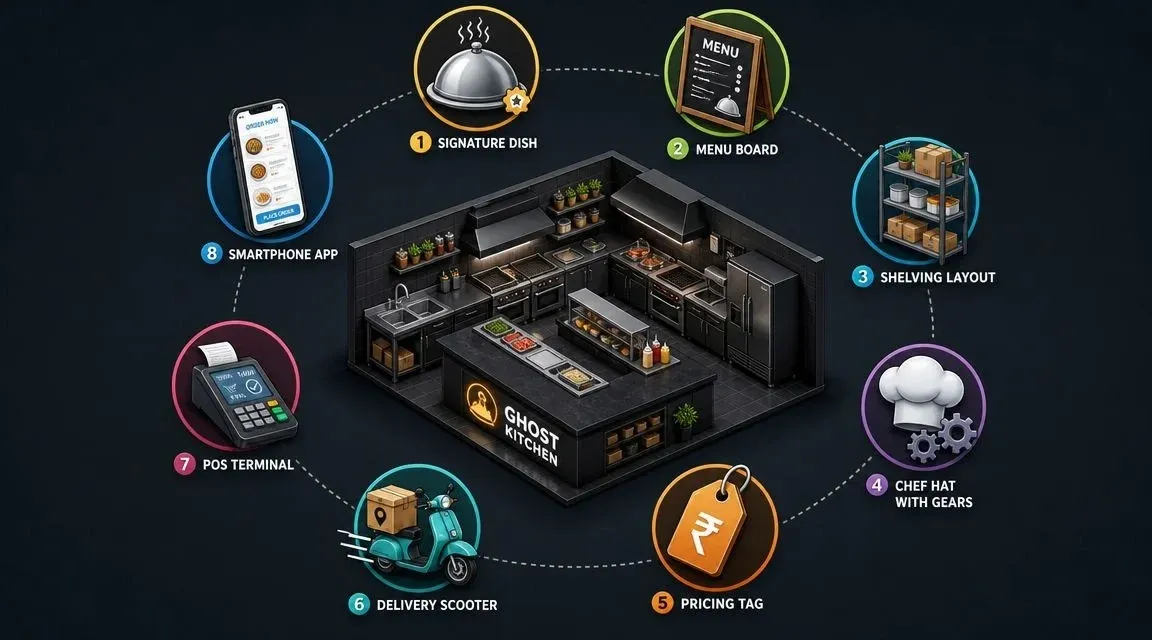
Dark kitchens moved fast from a niche operating model into a serious part of restaurant infrastructure. One global market estimate put the category at about USD 72.06 billion in 2024, up from USD 39.38 billion in 2018, with a projection of USD 184.04 billion by 2032. That kind of expansion explains why so many operators are searching for dark kitchens ideas right now.
But growth alone doesn’t make a kitchen profitable. A delivery-only restaurant wins when the concept fits the kitchen, the menu fits delivery, and the tech stack keeps orders moving without staff bouncing between tablets. That’s where a lot of launches go sideways. Owners spend too much time on branding and not enough on prep flow, order routing, packaging, and POS integration.
The practical version is simple. Pick a model you can run cleanly on a busy Friday night, not one that only looks good in a pitch deck. If your team can’t see tickets clearly, batch prep correctly, and push orders from Uber Eats and DoorDash into one workflow, your margins get eaten by mistakes and remakes.
These eight dark kitchens ideas are built for operators who care about throughput, consistency, and clean execution. Each one includes the business logic behind it, what tends to work, what usually doesn’t, and how to connect it back to restaurant delivery, POS integration, and day-one operational control.
1. Multi-Brand Dark Kitchen Model
A well-run multi-brand dark kitchen can raise sales from the same rent, labor pool, and equipment. It can also wreck service if the brands share a ZIP code but not a prep system.
The model is simple. One kitchen runs several storefronts on delivery apps, each aimed at a different customer need. A burger brand handles dinner, a wings brand catches game-night demand, and a loaded-fries concept picks up late-night orders. The customer sees choice. The kitchen should see one production logic, one ticket flow, and a controlled inventory position.
That last part decides whether this idea makes money.
Start with one operating core
Build the kitchen around shared ingredients first, then shape the brands around them. Chicken can carry tenders, wraps, rice bowls, sandwiches, and fries-based items across more than one concept. Sauces, seasoning profiles, and bundle structure create enough separation for the customer without forcing the line to run three different businesses at once.
I usually advise operators to test this model with one anchor brand and one add-on brand, not four launches at once. The trade-off is obvious. Fewer brands limit top-line experimentation, but they protect execution, food cost control, and ticket times while the team learns the flow.
A weak setup usually has one common problem. The menus look different in the apps, but the kitchen has no common build logic behind them.
- Share prep aggressively: Proteins, starches, fryer items, sauces, and packaging formats should work across brands.
- Differentiate at the menu layer: Brand names, item descriptions, photos, and combo logic should target distinct occasions and customer intent.
- Run each brand like its own business unit: Track sales mix, refund rate, prep burden, food cost, and contribution margin by brand, not just by kitchen.
Practical rule: If your expo has to stop and explain which station owns a ticket, you have too many brands or the wrong menu mix.
Brand strategy matters, but kitchen math matters more
A second brand should answer a specific demand gap. Late-night, family bundles, snackable sides, value meals, or a flavor profile your core brand does not cover cleanly. If the new concept just steals orders from the original storefront, you added design work and app fees without adding meaningful revenue.
That is why smart operators study how virtual brands are positioned on DoorDash before they spend time on logos and packaging. Positioning affects click-through and conversion, but the kitchen still has to fulfill the promise at speed.
The tech stack has to support that reality from day one. Marketplace orders need to land in one clear workflow tied back to the POS, whether the shop runs Clover or Square. Order aggregation only matters if it cuts tablet chaos, reduces manual entry, and gives the line one version of the truth during peak periods. Otherwise the team spends service bouncing between screens, missing modifiers, and remaking food that was never rung correctly.
A practical example makes the point. A burger kitchen can add wings and loaded fries with modest strain because the fryer, sauces, sides, and packaging already overlap. A burger brand plus sushi plus breakfast tacos from one small line usually creates prep sprawl, longer ticket times, and a training problem that shows up on a busy Friday night.
Used correctly, the multi-brand model is less about launching more concepts and more about getting more sales from a kitchen that already knows how to cook the food.
2. Cuisine-Focused Niche Specialization
Some of the best dark kitchens ideas are the least flashy. One cuisine, one point of view, one kitchen rhythm. A focused Korean, Indian, Mediterranean, ramen, or kebab concept often runs better than a menu trying to satisfy every possible app search.
Specialization creates discipline. Your prep list gets tighter, your suppliers get more predictable, and your cooks repeat the same standards often enough to get fast without getting sloppy. For restaurant operations, that’s a huge advantage because consistency is easier to protect when the menu speaks one language.
Depth beats variety
A niche kitchen should feel deep, not broad. That means a sharp core menu, a few profitable side items, and seasonal variation only where it doesn’t disrupt prep. A ramen kitchen can rotate specials while keeping broth, noodles, proteins, and toppings stable. A Mediterranean concept can add limited bowls or platters without rebuilding the line.
What doesn’t work is using “niche” as a branding label while serving an unfocused menu. Customers can tell when a concept is generic. So can your kitchen.
Customers don’t reward a confused menu. They reward a kitchen that gets one thing right every time.
Operational edge in restaurant delivery
Cuisine-focused brands also tend to perform better in delivery when the food travels well or can be packaged intelligently. Rice bowls, curries, wraps, and noodle dishes generally give you more control than fragile plated items. That matters because your guest experiences the product after a drive, a lobby wait, and a bag handoff, not at your pass.
Use your POS integration to track complaints by item, not just by order. If one biryani or noodle bowl keeps generating refund issues, remove it, repackage it, or rebuild it. A connected setup through OrderOut and a POS like Clover or Square gives you one operational record instead of app-by-app guesswork.
A real-world example is a delivery-only sushi or ramen brand listed on Uber Eats. These concepts work best when operators narrow the offer to items they can reproduce exactly, every shift. The menu should help the kitchen stay fast. It shouldn’t challenge the kitchen to prove range.
3. Delivery-First Optimization Strategy
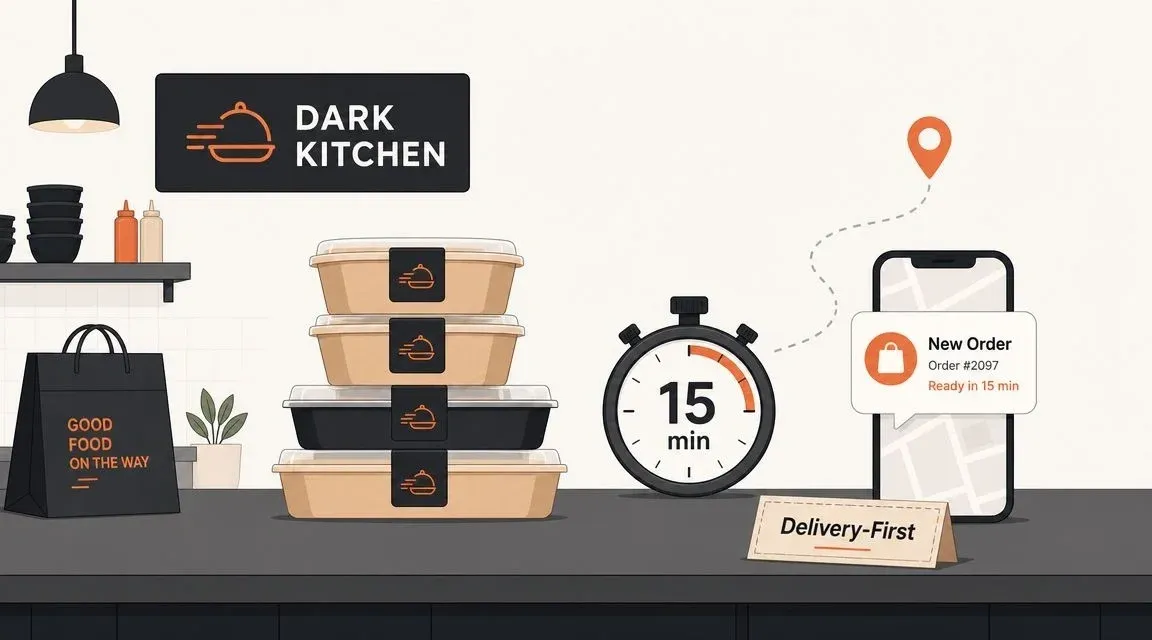
A lot of operators say they’re built for delivery when they’re really serving dine-in food in takeout boxes. Those are different businesses. A delivery-first kitchen designs menu, timing, packaging, and handoff around transit from the start.
That’s important because dark kitchens grew with app-based fulfillment, convenience, and cost efficiency, and one aggressive U.S. forecast projects the segment from USD 159.71 billion in 2026 to USD 4,778.51 billion by 2033. Treat that projection cautiously. The practical takeaway is still valid. Operators and investors expect delivery demand to remain central.
Engineer for the car ride
A delivery-first menu should survive the trip and still eat well. Fried food needs vented packaging or it steams itself into disappointment. Sauced items need containment. Hot and cold items should be split if they clash in the same bag.
Test your own routes. Order your own food from Uber Eats or DoorDash to homes and offices in your actual radius. Check texture, heat retention, leakage, and how the bag looks on arrival.
- Design for hold time: Build dishes that still taste right after a normal delivery window.
- Simplify assembly: Reduce garnish-heavy finishing that breaks down in transit.
- Control the handoff: Label bags clearly and make pickup staging obvious for drivers.
Route orders into one system
The delivery-first model breaks down when cooks still rely on multiple app tablets. Tablet chaos creates missed tickets, duplicate prep, and late pickups. Order routing has to be immediate and unified, especially during rushes.
OrderOut’s guide to a system of delivery gets at the core issue. Your restaurant delivery business needs one operational flow from app to POS to kitchen display to handoff. That’s the difference between a delivery concept and a delivery mess.
Use a practical setup. Uber Eats and DoorDash feed into one KDS, the POS updates inventory, and the expo sees one queue. That’s cleaner for staff and better for throughput. It’s also a lot easier to train.
4. Co-Kitchen Shared Space Model
A co-kitchen works for operators who need speed to market more than private control of a full facility. You share licensed space, some equipment, and often a common infrastructure, while keeping separate brands and separate customer demand. It can be a strong entry point for first-time dark kitchen operators and a flexible expansion path for existing restaurants testing a new neighborhood.
The upside is obvious. Lower startup friction and less capital tied up in a standalone build. The downside shows up in daily operations. Shared kitchens punish vague rules.
Shared space needs hard boundaries
You can’t run a co-kitchen on good intentions. You need written prep windows, receiving rules, cleaning assignments, dry storage boundaries, and equipment priority when two operators need the same station at once. Without that, the model gets political fast.
The strongest shared spaces treat time and equipment like inventory. They’re scheduled, assigned, and documented.
- Set operator-specific workflows: Orders, prep, labeling, and pickup staging should be clearly separated.
- Define sanitation responsibility: Every station needs a reset standard before the next operator takes over.
- Use operator-level reporting: Each business needs its own order accuracy and fulfillment view.
POS integration keeps operators independent
Here, food tech matters more than floor space. If two brands share a kitchen but not a clean order-routing system, one operator’s confusion spills into the other operator’s service times. A unified intake tool like OrderOut can segregate orders by operator while still keeping kitchen displays manageable.
A practical example is a local shared kitchen where one tenant runs salads for lunch and another runs wings at night. With proper scheduling and separate KDS alerts, the facility stays productive. Without integration, both operators end up checking tablets and arguing over staging shelves.
This model works best when the kitchen manager acts like an airport controller. Every movement is planned. Every reset is visible. Every operator knows where their tickets, bags, and ingredients belong.
5. Hyperlocal Micro-Fulfillment Center Model
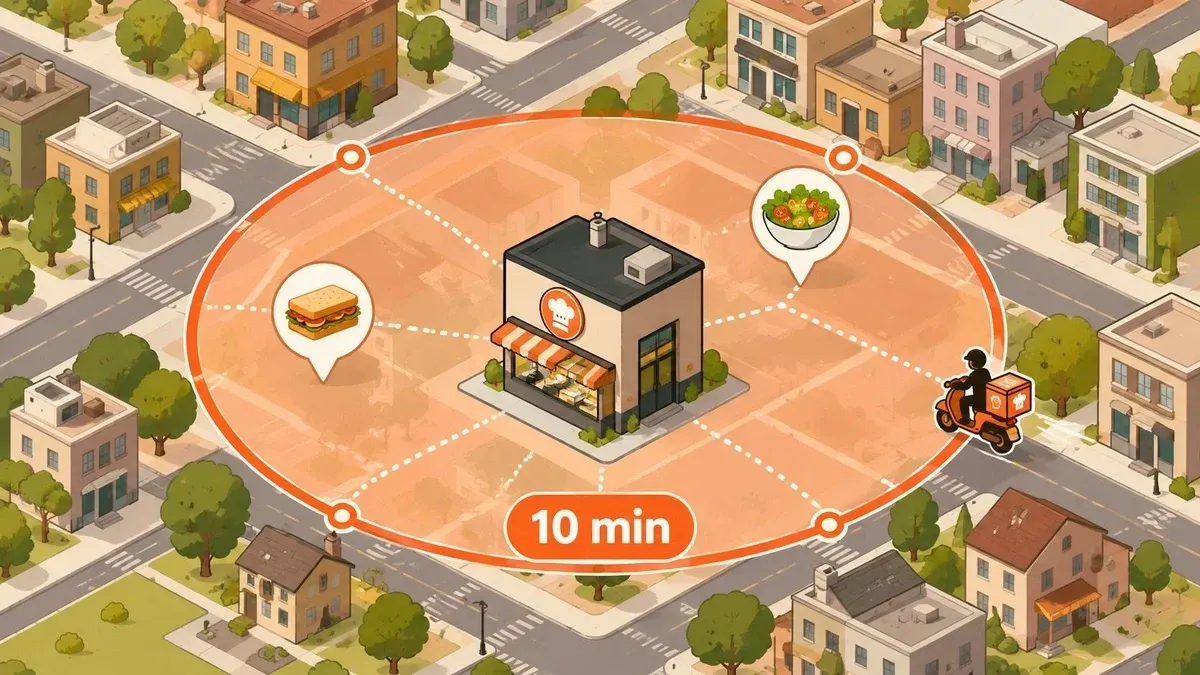
Some dark kitchens ideas only make sense in dense neighborhoods. The hyperlocal micro-fulfillment model is one of them. This is a tiny kitchen footprint built for speed, not range. Fewer items, shorter routes, faster handoff.
The business logic is straightforward. Dense urban areas favor delivery-only formats because the economics improve when kitchens optimize for throughput and dispatch instead of dine-in experience, a pattern also reflected in projections for China’s dark kitchen market from US$8.53 billion in 2026 to US$43.70 billion by 2033. That doesn’t mean every operator should go tiny. It means dense zones reward focused execution.
Keep the menu brutally short
Micro-fulfillment kitchens don’t need menu theater. They need speed and repeatability. Sandwiches, bowls, wraps, salads, and simple fried items can work. Anything with too many finishing steps usually won’t.
The mistake I see most often is trying to fit a full restaurant menu into a tiny delivery pod. That kills the whole reason to run small.
Small kitchens don’t forgive extra SKUs. Every extra item consumes storage, prep time, and attention.
Use technology to preserve speed
The biggest advantage in hyperlocal delivery is not just short distance. It’s the ability to keep the whole order cycle tight. Orders should enter the POS instantly, hit the kitchen display cleanly, and move to a clearly marked pickup shelf with no manual re-entry.
A real-world example is a compact sandwich or salad concept operating through DoorDash and Uber Eats in a downtown neighborhood. If the menu is focused and the line is set for fast assembly, that format can feel very efficient. If the kitchen adds too many modifiers and too many custom builds, the short radius won’t save it.
This is a model where Square or Clover paired with OrderOut helps because speed depends on clarity. Your team shouldn’t waste motion reading multiple screens when the whole point is fast neighborhood fulfillment.
6. Aggregator Restaurant Network Strategy
The aggregator restaurant network approach is one of the smartest low-risk dark kitchen ideas for existing operators. Instead of opening a fresh facility, you use spare capacity in an operating restaurant to run a delivery-only virtual brand. The kitchen is already licensed, staffed, and buying inventory. You’re layering in a second revenue stream using hours or stations that aren’t fully utilized.
This works especially well for restaurants with a lunch-heavy or dinner-heavy pattern, where part of the day has idle labor and unused prep capacity. The trap is assuming spare space equals spare system capacity. It doesn’t.
Match the virtual brand to the host kitchen
The best virtual brands fit the host restaurant’s inventory and production rhythm. A wing, wrap, or bowl concept can piggyback on an existing fryer or grill line. A dessert-only concept can work if the kitchen already handles packaged finishing cleanly. A pizza kitchen trying to add sushi usually creates friction, not profit.
Use overlap intelligently. Shared ingredients reduce purchasing complexity. Shared equipment reduces capital needs. Shared labor only works if workflows don’t collide.
- Protect the core brand first: If the virtual concept slows the main restaurant, it’s the wrong concept.
- Create separate menu logic: Pricing, packaging, and app positioning should fit delivery, not dine-in assumptions.
- Measure it separately: A virtual brand should earn the right to stay on the line.
Route orders with clear separation
Your cooks need immediate visual separation between house orders and virtual brand orders. That’s where integrations matter. If your team has to manually sort app orders, the virtual brand becomes a nuisance instead of a margin tool.
This is exactly why operators should understand what changes when they change order integration. Better routing doesn’t just save time. It reduces the mental load on the kitchen.
A practical example is a casual chicken restaurant adding a late-night tenders concept on DoorDash. With one KDS view and one POS-connected workflow, the team can stage both menus cleanly. Without that setup, the extra concept usually creates missed mods and delayed pickups.
7. Data-Driven Menu Engineering for Delivery
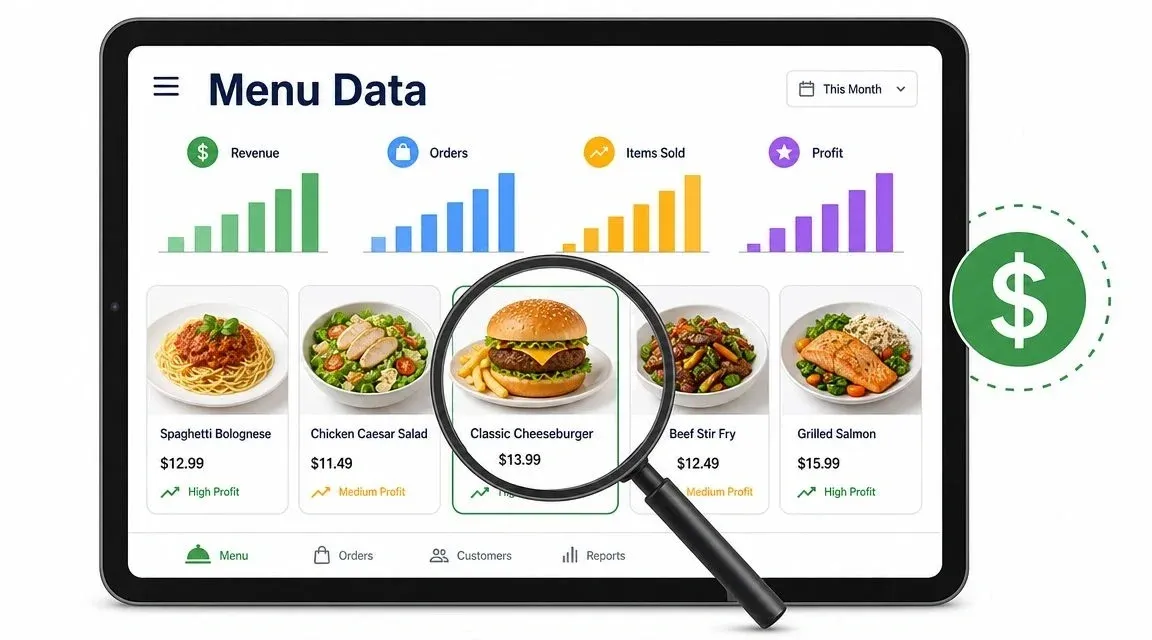
Most dark kitchen menus launch too large and stay unchanged for too long. That’s expensive. Delivery data should shape the menu continuously. Keep the items customers reorder. Fix the items that cause complaints. Cut the items that slow the line without paying their way.
This matters even more because consumer trust is still fragile in this category. In one academic survey, only 24.7% had heard of dark kitchens, 9.1% had knowingly purchased from one, and 54.9% said they would purchase after seeing a definition. The same study found strong concern around hygiene and transparency. Your menu and your ops both need to build confidence.
Read the menu through an operations lens
Don’t just ask what’s popular. Ask what travels well, what creates refunds, what causes bottlenecks, and what can be executed perfectly by your current team. A dish that sells but drags down service might still be a bad delivery item.
Data-driven menu engineering is really a restaurant operations discipline. You’re deciding which menu items deserve scarce line time.
- Keep item-level visibility: Track sales, complaints, remakes, and prep friction by item.
- Watch packaging failures: If a dish leaks or degrades often, it’s an operations issue, not just a recipe issue.
- Use transparency in the listing: Clear descriptions, allergy notes, and brand honesty help trust.
Field note: In delivery, the “best” dish isn’t the one chefs love most. It’s the one customers reorder and the kitchen executes cleanly every shift.
Pull data into one dashboard
A menu can’t be optimized if the evidence lives in separate app portals. Pulling restaurant delivery data into one place gives managers a much cleaner weekly review. That’s the practical value behind guides like this one on data analytics for restaurants.
A real-world example is a bowl concept selling on Uber Eats and DoorDash. If one protein add-on leads to repeated delays or errors, the answer might be to pre-batch it, reword it, charge differently, or remove it. Good data shortens that decision cycle.
8. Automated Kitchen Operations and Order-to-Fulfillment Optimization
Automation in dark kitchens doesn’t have to mean robots. Most operators should start with boring automation first. Automatic order injection into the POS. One kitchen display instead of several tablets. Simple batching rules. Inventory syncing. Clear station prioritization. That’s where the first real gains usually come from.
The pressure behind this is operational, not aesthetic. A lot of dark kitchen content ignores the fact that modern restaurants often juggle orders from multiple platforms while trying to keep the kitchen uncluttered and the front-of-house readable. This tension between style and workflow is part of the broader challenge described in this discussion of dark kitchen workflow and digital-order clutter.
Automate the repetitive failures first
If staff are re-entering app orders by hand, that’s the first problem to remove. Manual entry creates avoidable mistakes, slows ticket flow, and keeps your best people doing admin work. Get rid of the task before you buy more hardware.
You can also look at complementary tools and ideas around implementing AI automation, but the kitchen doesn’t need fancy language to benefit from practical automation. It needs cleaner handoffs and fewer preventable errors.
Here is a useful demo of how kitchen automation can look in practice:
Build one visible flow
OrderOut is designed for this. Integrating DoorDash, Uber Eats, and other channels into the POS removes one of the biggest points of friction in a delivery-heavy operation. If you’re evaluating the software side, this overview of food delivery management software is the right place to start.
A practical real-world setup could be Square plus DoorDash plus Uber Eats feeding one kitchen display through OrderOut. Clover can support the same idea. The point isn’t the logo lineup. The point is one stream of orders, one source of truth, and one team that knows what to make next.
8-Point Dark Kitchen Ideas Comparison
A bad model choice usually shows up first in labor, ticket flow, and refund rates. The best dark kitchen idea is the one your team can run cleanly with the equipment, menu mix, and order system you have.
Use this comparison as an operating screen, not just an idea list. Each model only works if the concept, kitchen flow, and POS setup fit together from day one. For example, a multi-brand kitchen needs clean brand routing inside Square or Clover with an integration layer like OrderOut. A niche cuisine concept needs tighter inventory control and fewer menu exceptions. The trade-off is always the same. More revenue paths usually mean more operational complexity.
Model Implementation Complexity 🔄 Resource Requirements ⚡ Expected Outcomes 📊⭐ Ideal Use Cases 💡 Key Advantages ⭐ Multi-Brand Dark Kitchen Model 🔄🔄🔄 Brand routing, menu control, and staff training get complicated fast ⚡⚡⚡ Shared equipment, distinct packaging, and a POS setup that can separate brands clearly 📊 Better equipment utilization and broader marketplace coverage; ⭐ stronger margin potential when prep overlaps across brands 💡 Operators scaling multiple concepts from one kitchen footprint ⭐ Makes better use of rent and labor; tests new concepts without opening another site Cuisine-Focused Niche Specialization 🔄🔄 Tighter workflow, but less menu chaos ⚡⚡ Specialty ingredients, some dedicated equipment, and cooks who can execute consistently 📊 Better repeat business and more pricing power if the food travels well 💡 Operators building loyalty around a clear cuisine identity ⭐ Clear market position; simpler purchasing; easier quality control Delivery-First Optimization Strategy 🔄🔄 Requires redesigning prep, expo, packaging, and dispatch timing ⚡⚡ Lower front-of-house needs, but more spend on packaging and order integrations 📊 Faster handoff, better customer reviews, and stronger order volume per square foot 💡 Markets where third-party delivery drives most demand ⭐ Built for speed; easier to copy into new zones once the line is dialed in Co-Kitchen Shared Space Model 🔄🔄🔄 Scheduling, storage rules, and accountability need close management ⚡⚡ Lower upfront cost per operator with shared rent, utilities, and core equipment 📊 Lower fixed costs and more flexibility while testing demand 💡 Startups and small operators entering the market without a full buildout ⭐ Lowest barrier to entry; flexible growth; less capital at risk Hyperlocal Micro-Fulfillment Center Model 🔄🔄 Small footprint keeps the line simple, but site selection matters ⚡⚡ Compact kitchens, limited storage, and multiple sites if you want real coverage 📊 Shorter delivery times and better local retention when the menu stays tight 💡 Dense neighborhoods, campuses, and office clusters ⭐ Fast delivery radius; local demand capture; backup capacity across nearby zones Aggregator Restaurant Network (ARN) Strategy 🔄🔄 Needs clear menu routing, production rules, and staff coordination across channels ⚡⚡ Uses existing kitchen capacity and staff with limited additional capital spend 📊 More revenue during slower periods and better use of underused labor hours 💡 Existing restaurants with off-peak slack and a kitchen that can absorb more tickets ⭐ Adds sales without a new location; builds on existing ops Data-Driven Menu Engineering for Delivery 🔄🔄🔄 Requires clean reporting, disciplined testing, and reliable platform integrations ⚡⚡⚡ Analytics tools, POS connectors, and someone who can act on the numbers 📊 Better margins, fewer weak sellers, and faster menu decisions 💡 Operators trying to improve conversion, margin, and kitchen throughput ⭐ Cuts low-value items; improves contribution margin; supports smarter purchasing Automated Kitchen Operations & Order-to-Fulfillment Optimization 🔄🔄🔄🔄 High setup effort across software, hardware, training, and vendor coordination ⚡⚡⚡⚡ Meaningful tech spend, usually including KDS, printer logic, and workflow automation 📊 Shorter prep times, fewer errors, and better labor output at higher volumes 💡 High-volume kitchens that need consistency before adding more demand ⭐ Supports scale; reduces manual mistakes; gives managers tighter control over throughput
One practical filter helps here. If a model adds menu complexity faster than your POS and kitchen display can organize it, profit usually disappears into remakes, slower tickets, and overtime. Choose the model your systems can support cleanly, then expand.
Your Next Step From Idea to Integration
Operators rarely get in trouble because the concept was bad on paper. The margin usually breaks in the handoff between the delivery apps, the POS, and the line.
That handoff decides whether a dark kitchen idea stays a side project or becomes a real operating model. I have seen strong concepts fail because the kitchen added brands faster than it could route tickets, track modifiers, or read item-level margin by daypart. I have also seen simple setups win because the team kept the menu tight, the workflow clear, and the reporting clean from the first week.
Start with the system, not the branding.
If orders still get typed in by hand from tablets, fix that first. Manual entry creates slow starts on every ticket, modifier mistakes, late fires, and messy reporting. It also hides the truth. A brand can look busy in the apps while losing money once labor, remakes, and packaging are counted correctly.
The better test is straightforward. Can the team run a busy Friday service with one queue, clean tickets, and no workarounds at the expo station? If the answer is no, adding another virtual brand will usually add noise before it adds profit.
That is why the best next step is usually narrower than operators want. Connect the delivery channels into the POS you already run. Clean up ticket routing. Set printer or KDS logic by station. Confirm prep times, packaging, and hold quality on a focused menu. Then review sales mix and contribution by item before expanding the concept.
For Clover or Square operators, that integration layer matters on day one because it ties the business plan to actual kitchen behavior. You are not just collecting orders faster. You are getting one production flow, cleaner reporting, and a clearer view of which menu items deserve more demand and which ones should be cut.
If you want to tighten that operation, OrderOut is a practical option. It routes delivery orders from apps like Uber Eats, DoorDash, and Grubhub into POS systems including Clover, Square, Pecan POS, and others, which helps reduce re-entry errors and gives managers cleaner numbers to work from.
Profitable dark kitchens are usually built on disciplined basics: accurate modifiers, controlled menu complexity, dependable prep times, and reporting the manager can trust without stitching together three dashboards at midnight.