
You’re probably in one of two places right now. You either love barbecue and want to turn that skill into a business, or you already run a truck and you’re realizing that great brisket alone doesn’t guarantee a profitable week.
That’s the hard truth of a BBQ food truck. The food can be outstanding and the business can still struggle if the menu is too broad, the pit setup slows service, permits drag on, or delivery orders create chaos at the window. BBQ is a strong category, but it’s also demanding. In a 2026 food truck survey, 15.3% of operators said BBQ was one of their top menu types, making it the most common cuisine category in that dataset. That tells you two things at once. Demand is real, and competition is real too.
The operators who last usually treat the truck like a compact production system, not a passion project on wheels. They build around speed, consistency, packaging, and clean restaurant operations from day one. That includes the less glamorous parts like prep flow, order handling, staff routines, and delivery app control.
Crafting Your Winning BBQ Concept and Menu
Most new owners start with meats they’re proud of. That’s understandable, but a BBQ food truck needs a sharper filter than “people like this.” Your concept has to answer three questions fast: what kind of barbecue you serve, why customers should remember you, and whether the line can move during a rush.
Pick a lane customers can repeat
“BBQ” is too broad to be a brand. A truck that says Texas-style brisket and beef ribs feels different from one built around Carolina pulled pork or a fusion concept with smoked meat tacos and bowls. The point isn’t to be exotic. The point is to be clear.
A useful test is simple. If a customer tells a friend about your truck in one sentence, what do they say?
- Regional identity: “That’s the truck with Central Texas-style brisket.”
- Format identity: “That’s the BBQ sandwich truck with fast lunch service.”
- Fusion identity: “That’s the truck doing smoked meat rice bowls and loaded sides.”
If you can’t state the idea cleanly, your menu is probably trying to do too much.
Build the menu for speed, not just flavor
A food truck menu fails when every ticket requires too many decisions, too much assembly, or too much pit inventory. BBQ makes that worse because smoked meats take time to produce and don’t forgive overproduction.
Start with a core set of items that share product and labor. Brisket can become a sandwich, plate, slider, or loaded potato. Pulled pork can cover sandwiches, platters, nachos, and catering pans. That’s how you create variety without creating chaos.
Practical rule: Every item should earn its place by doing at least two jobs. It should sell well, or it should make another item easier to sell.
Use a menu mix like this:
- Anchor items that define the brand. Brisket, pulled pork, ribs, smoked sausage.
- Fast sellers that move lines. Sandwiches, combo plates, bowls.
- High-margin add-ons that lift checks without slowing service. Drinks, chips, slaw, beans, cornbread.
- One signature item people photograph and post. Keep it operationally simple.
If you need a practical structure for laying this out, this food truck menu template is a good starting point.
Design for hold quality and delivery quality
Not every great BBQ item belongs on a truck menu. Some meats dry out quickly. Some sides collapse in a takeout box. Some plated ideas look great for ten seconds and then turn into a mess.
That means your best menu often isn’t your most ambitious one.
Good truck items usually have these traits:
- They hold well: Pulled pork, sausage, chopped brisket, sturdy mac and cheese, baked beans.
- They travel better than expected: Sandwiches, bowls, platters with separated sauce.
- They plate quickly: Limited modifiers, limited garnish, simple packaging.
- They batch cleanly: Prep once, serve repeatedly.
What doesn’t work as well? Fragile bark-heavy presentations that steam in the box, overloaded fries that sog out immediately, or giant menus with multiple meats that all require different slicing and finishing steps during a rush.
Designing Your Mobile Kitchen and Sourcing Equipment
A BBQ truck lives or dies by layout. If the smoker is wrong, holding is weak, or staff have to cross each other all service long, your line slows down before the lunch crowd even arrives.
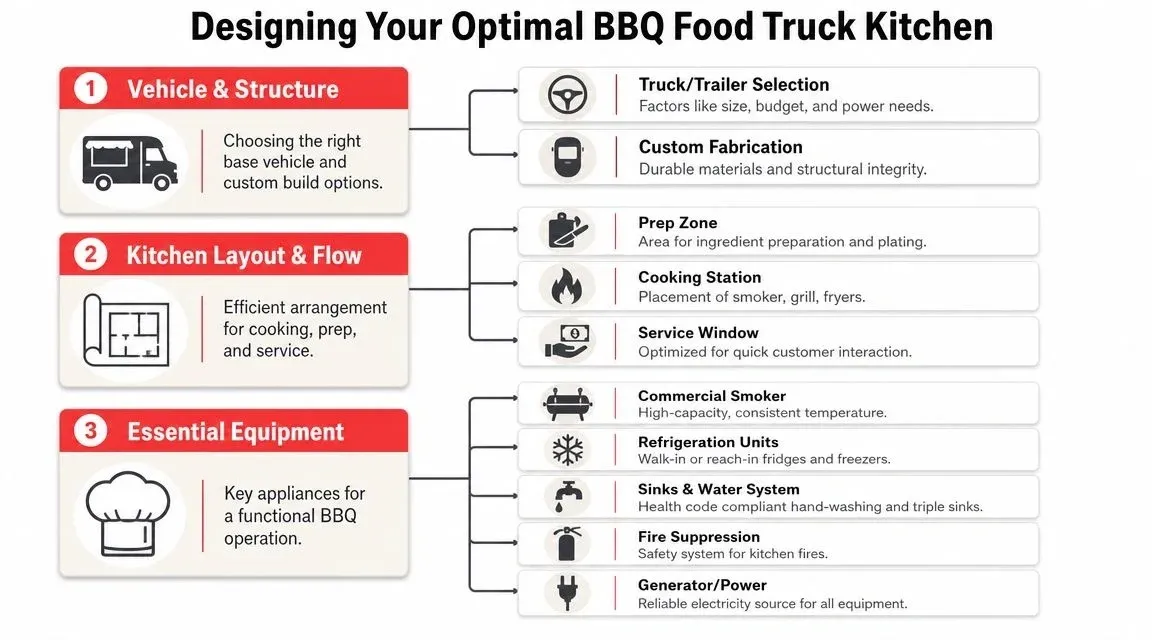
Choose equipment around workflow
The smoker gets the attention, but the complete system includes prep, hot holding, cold storage, handwashing, cleaning, packaging, and power. In a tight truck, one bad placement creates friction all day.
Think in zones instead of appliances:
Zone What needs to happen there Common mistake Prep Trim, portion, assemble sides, build orders Too little counter space Cook Smoke, reheat, finish, sear if needed Smoker blocks movement Hold Keep meat safe and service-ready Holding cabinet too small Service Receive orders, bag, hand off Pickup area mixes with prep Clean Hand sink, warewashing access, sanitation Sink placement interrupts line
A lot of owners focus on how much equipment they can fit. Better operators focus on how few steps staff need to take.
If you’re planning the customer-facing side as carefully as the kitchen side, this guide to food truck windows helps with layout thinking around service flow.
Smoker choices for a mobile setup
There’s no perfect smoker for every truck. There is only the right fit for your production style.
- Pellet smokers are easier to run consistently and can be practical for operators who value temperature control and repeatability.
- Offset smokers can produce a style many pit-focused brands want, but they demand more attention and can be tougher in a mobile workflow.
- Gravity-fed units often appeal to operators who want a balance between consistency and a more traditional fuel approach.
The right question isn’t “Which one is best?” It’s “Which one can my team run consistently on a busy week with limited labor?”
This walkthrough is worth watching before you commit to a build or retrofit:
New, used, or leased equipment
Each option has trade-offs.
New equipment gives you cleaner warranties and fewer unknowns. That matters when a refrigeration failure can wipe out prep and a service day.
Used equipment can make sense if you inspect carefully and budget for repair risk. Cheap equipment isn’t cheap when it fails during an event.
Leasing can preserve cash early, especially if you’re trying to keep working capital available for meat, payroll, packaging, permits, and fuel.
Don’t buy equipment because it looks impressive on social media. Buy equipment your crew can clean, maintain, and work around in a twelve-hour day.
A practical mobile kitchen for BBQ usually needs dependable hot holding more than flashy extras. Consistency at service beats complexity every time.
Navigating Permits Compliance and Financial Realities
A lot of BBQ trucks hit the same wall before the first paid service. The pit plan is solid, the branding is done, deposits are out, and then the main constraints show up. Health approval takes longer than expected, the fire inspector wants changes, commissary terms are tighter than planned, and the opening date slips while fixed costs keep running.
Permits are local, layered, and tied to your build
You will usually need several approvals before you can sell legally. The list often includes health permits, business licensing, fire inspection, vehicle registration, food handler certifications, and a commissary agreement. In many markets, those approvals overlap. One missing item can stall everything else.
If you need a practical overview of mobile kitchen permits, that resource is useful because it reflects how owners experience the process. As a stack of connected requirements, not a single application. For a broader operating checklist, review this guide on regulations for a food truck before you finalize your opening timeline.
The operational mistake is usually sequencing. Operators buy a truck, wrap it, and book events before confirming local code details on sinks, ventilation, fire suppression, hot holding, or commissary access. Then they pay twice. Once for the original build, and again for modifications.
That delay affects more than launch dates. It also burns cash.
Your margin is smaller than your sales line suggests
BBQ can produce strong top-line sales and weak take-home profit at the same time. Meat yield, trimming loss, long cook cycles, holding risk, packaging, labor, and fuel all add pressure fast. A truck with a line out the window can still have poor unit economics if pricing, prep volume, and labor deployment are off.
According to food truck profitability benchmarks, employee-run trucks often net only 6% to 9%, and a truck doing $346,000 in annual revenue may take home as little as $24,000 if operations are not tight. The same source also notes that food cost, labor, fuel, and maintenance can consume a large share of revenue, and that about 60% of food trucks fail in their first year.
That is why serious operators build the financial model before they build the hype.
For a BBQ truck, that model should include tech from day one. A connected POS, item-level reporting, digital payment tracking, and delivery app integration help you see which meats, combo plates, sides, and event packages make money. Without that data, owners tend to price from instinct and prep from optimism. Both get expensive.
Sample BBQ food truck cost breakdown
Use this as a planning frame, not a substitute for your own numbers.
Expense Category Typical % of Revenue Food 25% to 35% Labor 20% to 30% Fuel and maintenance 5% to 10%
Those categories alone can consume 50% to 75% of revenue. BBQ operators feel this early because a forecasting miss creates waste, while a slow day still eats labor, fuel, and holding costs.
Where new BBQ trucks usually get squeezed
- Protein overproduction: Brisket and pork cooked for projected volume become margin loss if turnout is soft.
- Underpriced event work: Revenue looks strong on paper, but travel, setup, service time, and extra labor erase the gain.
- Too many SKUs: More proteins, sides, desserts, and sauce options usually mean more spoilage and slower service.
- Ignored fixed costs: Commissary rent, insurance, permits, packaging, software, and generator upkeep keep hitting whether sales are strong or weak.
- Disconnected sales channels: Walk-up orders, catering deposits, and delivery app sales tracked in separate places make it hard to see true food cost and labor performance.
A packed line does not prove profitability. Item-level margin, accurate prep forecasting, and tight reporting do.
The operators who last treat compliance and numbers as operating systems, not paperwork. They know which events deserve the truck, which menu items carry the business, and which software stack gives them clean reporting early enough to fix problems before cash gets tight.
Optimize Restaurant Operations with POS Integration
Manual order entry is one of the fastest ways to create friction in a BBQ food truck. It steals time, creates ticket mistakes, and jams up a small team that’s already dealing with long cook times, hot holding, packaging, and customer pickup.
Why restaurant operations break at the tablet pile
A lot of trucks start with one POS and separate delivery tablets. It feels manageable at first. Then lunch gets busy, one staff member is shouting a walk-up order, another is checking app orders, and someone has to re-enter everything by hand.
That setup creates three predictable problems:
- Order errors when staff mistype modifiers or miss items.
- Service delays because one person becomes the bottleneck.
- Bad data because sales and item counts live in different places.
For a category like BBQ, where labor and fuel pressure are already high, that extra friction matters. One industry summary focused on BBQ truck operations notes that long cook times and fuel usage already make the model demanding, while restaurant labor shortages remain a top pressure. That’s why tech-driven efficiency matters so much in this format, as discussed in this industry commentary on BBQ truck operations.
POS integration is not optional for delivery-heavy service
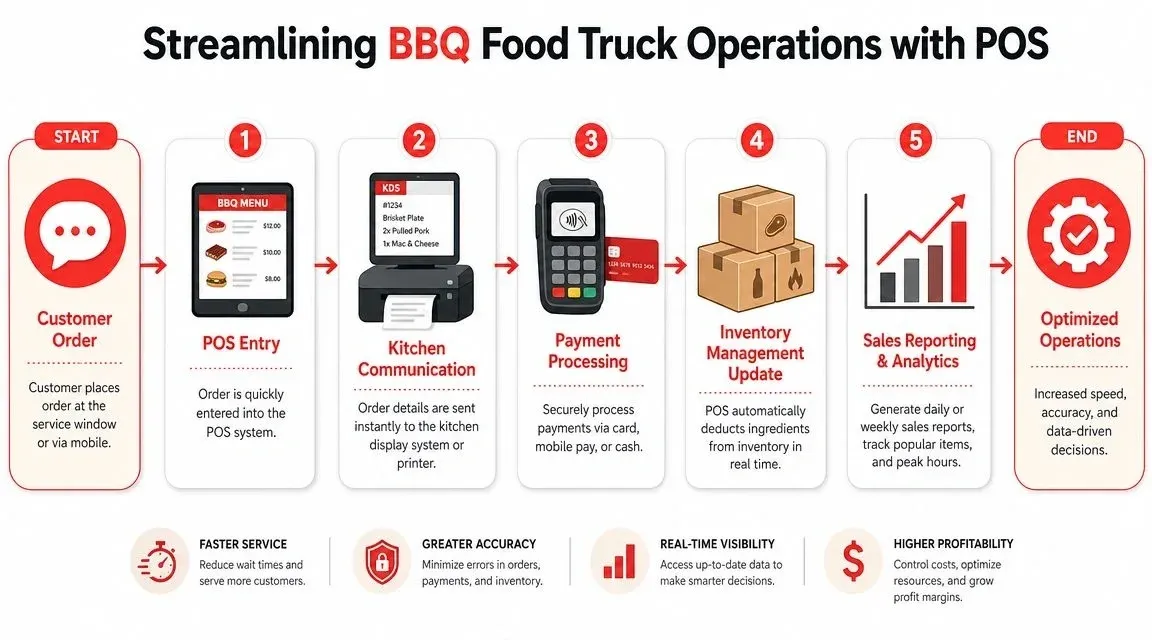
Plain-language version first. If an order comes in from DoorDash or Uber Eats, it should go directly into the system your truck already uses to run service. No retyping. No second-guessing. No missed brisket add-on because someone was also handling a line out the window.
That’s what POS integration does. It connects your ordering channels to your restaurant operations so the kitchen works from one stream of tickets.
Real examples matter here. If you run on Clover or Square, integrated ordering is a cleaner setup than juggling disconnected tablets. Staff can focus on prep, handoff, and guest service instead of copy-pasting orders between systems.
If you want a technical overview of how this category of setup works, this article on POS connections for restaurant delivery workflows explains the operational logic well, even if your truck uses a different POS.
What gets better when systems talk to each other
A good integration setup improves daily work in practical ways:
- The kitchen sees orders faster. Tickets arrive where production happens.
- Cashiers stay at the window. They don’t bounce between customer service and re-entry work.
- Reporting gets cleaner. You can spot item demand and peak periods more clearly.
- Training gets simpler. New staff learn one system, not four disconnected ones.
The best food tech is boring during service. Orders appear where they should, staff trust the ticket, and nobody has to stop the line to fix preventable mistakes.
For a BBQ food truck, that kind of boring is profitable.
Building Your Team and Streamlining Daily Workflows
A truck is a small box with real pressure inside it. Hiring the wrong person hurts faster in a truck than in a larger restaurant because there’s nowhere to hide weak habits. Every shift depends on pace, cleanliness, communication, and calm under pressure.
Hire for truck behavior, not resume prestige
Fine-dining experience can help, but it doesn’t guarantee success in mobile service. A strong BBQ food truck employee usually has better truck instincts than fancy credentials.
Look for people who can:
- Move with discipline: Fast without getting sloppy.
- Handle repetition well: Build the same sandwich correctly every time.
- Communicate briefly: Clear callouts matter in a tight line.
- Stay steady with customers nearby: Truck service is visible and immediate.
The industry has grown from what the U.S. Chamber of Commerce Foundation described as “relative nonexistence in 2008” into a channel with over 92,000 businesses and nearly $2.8 billion in 2025 industry revenue, based on the same food truck industry overview. That professionalization changes guest expectations. Customers expect reliable service, not startup chaos.
Build daily workflows before opening week
You do not want your process living in one owner’s head. Put it on paper and train from it.
A solid truck routine usually includes three operational checklists.
Opening checklist
- Equipment check: Smoker status, hot hold temps, refrigeration, POS login, printer paper.
- Stock check: Meats, buns, sides, sauces, packaging, drinks.
- Site readiness: Cash float if needed, signage, service window setup.
Service checklist
- Line roles: One person takes orders, one plates, one handles finishing or handoff when possible.
- Temperature discipline: Log hot and cold holding on schedule.
- Ticket control: Call modifiers clearly and mark sold-out items immediately.
Closing checklist
- Waste review: What ran out, what was overprepped, what held poorly.
- Cleaning: Surfaces, utensils, grease management, sinks, storage.
- Next-day notes: Product needs, staffing issues, event adjustments.
Use restaurant operations data to schedule smarter
A good POS helps beyond payments. It can show when sales cluster, which items surge first, and which shifts create bottlenecks. That helps you schedule prep labor where it matters and avoid overstaffing quiet windows.
If one person always gets crushed at the register during app pickup and walk-up overlap, that isn’t a staffing mystery. It’s a workflow issue. Tight restaurant operations solve it with clearer roles, faster handoff, and cleaner ticket flow.
Marketing Catering and Scaling Your BBQ Business
Street service builds visibility. Catering builds stability. Delivery expands reach. The best BBQ food truck businesses don’t rely on only one of those channels.
Market the truck like a local event, not a random vendor
People buy BBQ with their eyes first and their schedule second. They want to know what’s smoking, where you’ll be, and whether it’s worth making the trip.
Your marketing should stay simple:
- Post location clearly: Don’t make followers hunt for your truck.
- Show the product: Brisket slices, pulled pork sandwiches, plated combos, catering trays.
- Create routine: Weekly office stop, brewery night, school event, Saturday lunch.
- Use social proof carefully: Real customer photos and repeat event appearances beat hype.
If you need ideas for turning attention into actual orders, these proven social selling strategies are useful because they focus on moving from posting to selling. For truck-specific outreach, this guide on marketing for food truck operators is a practical companion.
Catering is where many BBQ trucks get stronger
BBQ travels well in bulk when you plan it correctly. That makes catering attractive for corporate lunches, weddings, school events, and private parties. It also lets you produce around a known headcount instead of guessing street demand.
What works in catering:
- Limited package structures: Keep choices controlled.
- Clear service format: Drop-off, buffet setup, or full-service truck appearance.
- Simple add-ons: Sides, drinks, desserts, boxed options when appropriate.
- Defined timing: Arrival, service window, and holding plan written in advance.
What doesn’t work is customizing every inquiry into a unique menu. That burns admin time and creates production complexity.
A profitable catering menu is usually narrower than your public menu. Clients want confidence more than endless options.
Delivery can help, but BBQ quality has to lead
Off-premise sales remain a major part of restaurant traffic, but BBQ is especially vulnerable to hold time and packaging. That challenge is outlined well in this discussion of off-premise BBQ quality issues. Bark softens. Fries steam. Sauce placement changes texture. A plate that looks great at the pass may arrive tired.
So be selective.
Choose delivery items that survive the trip:
- Sandwiches with sturdy bread
- Bowls that separate wet and dry components
- Plates with sauce on the side
- Sides that reheat or hold cleanly
Avoid items that depend on immediate texture or tableside presentation. Also consider restricting certain menu items or delivery availability to time windows when the kitchen can support it without hurting walk-up service.
The BBQ food truck owners who scale well don’t try to be everything. They build one reliable street-service model, one controlled catering model, and one delivery model that respects product quality.
A BBQ food truck works when the business side is as disciplined as the pit. Keep the menu tight, build the truck for flow, control costs, and make restaurant delivery and POS integration part of your setup from day one. If you want to simplify delivery order handling and get started quickly, you can begin onboarding for free with OrderOut.