
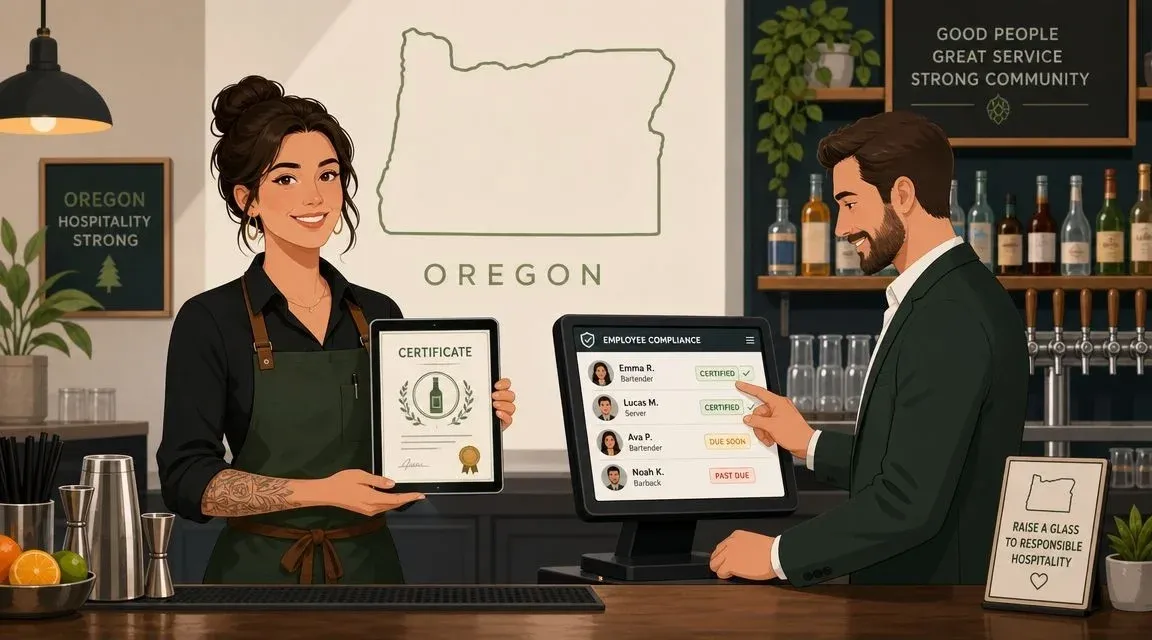
In Oregon, there isn’t a generic bartending license. The required credential is the OLCC Alcohol Server Permit, and it costs $23.00, stays valid for 5 years, and is required for employees who serve, mix, or sell alcohol.
That detail matters more than most new managers expect. If you hire for a busy Friday, put someone on the floor, and then learn they aren’t cleared to handle alcohol, you don’t just have a paperwork issue. You have a staffing problem, a service problem, and a compliance problem at the same time.
Most restaurants treat alcohol permits like employee paperwork. That’s a mistake. In Oregon, this belongs inside your hiring workflow, shift assignment rules, and manager checklists. The permit affects who can touch alcohol, who can supervise service, and how quickly a new hire can become useful on the floor.
If you’re searching for “bartending license Oregon,” think of it as an operations question, not a career question. The right answer protects your liquor program, keeps schedules clean, and prevents the kind of last-minute scramble that wrecks a dinner rush.
Your Guide to Oregon Alcohol Service Compliance
A new hire can clear orientation, finish menu training, and still be unusable on a Friday night if permit status was never verified. In Oregon, that mistake creates two problems at once. You expose the business to compliance risk, and you tie up labor in a role the employee cannot fully perform.
The required credential is the OLCC Alcohol Server Permit, which Oregon uses for staff who handle alcohol service. As noted earlier, the permit has a state-set fee, a multi-year validity period, and testing requirements for initial issuance and renewal. For managers, the bigger issue is not the application itself. It is building a process that keeps unpermitted staff out of alcohol-facing shifts before the schedule is published.
That is an operations control.
Restaurants that handle this well do not leave permit tracking to a text thread or a manager’s memory. They build it into hiring and daily execution. HR collects and stores permit status during onboarding. Scheduling rules in the POS or labor system limit alcohol service shifts to cleared employees. Floor managers can then make staffing decisions from a live roster instead of stopping service to verify paperwork.
Why this affects daily service
Permit compliance changes who can be assigned, cross-trained, or moved during a rush. A manager may hire one person for “server” and another for “bartender,” but the core staffing question is simpler: who is currently cleared to sell, serve, or mix alcohol, and who is not?
If that answer is unclear, the problems show up fast:
- Schedules break late: An employee can appear fully trained and still be ineligible for a section with alcohol sales.
- Training time gets wasted: Leads spend hours teaching bar or floor procedures to someone who cannot yet work those positions as intended.
- Service slows down: Drink orders get funneled through a smaller group of permitted staff, which creates avoidable bottlenecks.
Use permit status the same way you use wage rate, position code, and food handler status. It belongs in the same operating system.
Many operators keep a single reference for licenses, permits, and certifications so nothing gets missed during hiring or expansion. A practical starting point is this guide to permits for a restaurant business, especially if you are cleaning up process across multiple locations or roles.
What a workable system looks like
The cleanest approach is simple. Add permit verification to the offer checklist. Add a permit field in the employee record. Require manager sign-off before assigning any alcohol-related shift code in the POS or scheduling platform.
That setup prevents the common failure point. Someone gets hired, trained, and placed on the floor before anyone confirms legal clearance.
What does not work is informal confirmation. “They already took the class” is not documentation. A screenshot in a personal phone is not an audit trail. If your GM cannot confirm permit status in under a minute, the process is too loose.
Good compliance systems also make service easier. Managers spend less time reworking sections, bartenders are not forced to cover for preventable staffing gaps, and HR has a clear handoff into operations. That is the core value of handling OLCC permits like a management system instead of an employee errand.
Who Really Needs an OLCC Permit in Your Restaurant
The biggest confusion around bartending license Oregon searches isn’t the permit name. It’s role coverage. Managers usually know bartenders need the permit. They’re less certain about hosts, food runners, shift leads, and managers who jump into service during a rush.

Oregon’s OLCC says a service permit is required for anyone who mixes, serves, or sells alcohol on licensed premises, including managers who supervise those employees, and it can also apply to staff who only occasionally deliver drinks or refill beer or wine. By contrast, table setup staff, kitchen employees, and security generally don’t need one unless they also handle alcohol, as explained on the OLCC alcohol service permit requirements page.
The gray-area roles that create risk
These are the positions that often get overlooked:
- Host who runs drinks during a rush: If that host delivers alcoholic beverages, permit status matters.
- Food runner covering patio service: If the tray includes wine, beer, or cocktails, the role may move into permit territory.
- Manager stepping behind the bar: Supervision and direct alcohol service both raise compliance questions.
- Server assistant topping off wine: Even occasional alcohol handling can trigger the requirement.
The problem isn’t the job title. The problem is task creep.
A lot of restaurants use flexible labor well. Cross-training helps when someone calls out, when events hit all at once, or when one area gets slammed. But flexibility only works if your compliance map reflects reality, not the original job description.
That’s why I tell managers to audit tasks, not titles.
Build a permit matrix, not a guessing game
Start with every front-of-house and management role. Then write down whether that role ever mixes, sells, serves, delivers, refills, or supervises alcohol service. If the answer is yes, that role should be reviewed for permit requirements before you schedule it that way.
A simple matrix often includes:
Role Alcohol touchpoint Permit review needed Bartender Mixes and serves Yes Server Sells and serves Yes Manager on duty Supervises alcohol service Yes Host Only if delivering drinks Depends on duties Food runner Only if delivering alcohol Depends on duties Cook No alcohol handling Usually no
If you’re updating role documents anyway, it helps to compare alcohol duties against your broader server job description in a restaurant. That keeps hiring, training, and compliance aligned.
If an employee might touch alcohol “just once in a while,” that’s exactly the kind of role managers should review first.
The cleanest restaurants don’t leave this to shift-by-shift judgment. They decide in advance who is cleared for what, then schedule accordingly.
Navigating the Official Oregon Alcohol Server Permit Process
Managers need a repeatable workflow here. If the process lives only in a verbal explanation from one experienced supervisor, it will break as soon as that person is off, busy, or gone.
In Oregon, the workflow is now a two-stage process. An applicant must complete an OLCC-approved Alcohol Server Education course, then take the OLCC final exam in CAMP before serving. CAMP is the state’s centralized portal for applications and exam access, and the permit application fee shown in the guide is $23, according to this Oregon OLCC service permit process guide.

The process in plain language
Here’s the simplest way to think about it. Your employee doesn’t just take a class and call it done. They complete approved training, then they still need to pass the official exam through the state system.
That means a manager should build onboarding around these steps:
-
Assign an approved course early
Do this right after hire, not after orientation week. -
Make CAMP setup part of onboarding
If the employee struggles with account access, don’t let that delay surface on their first scheduled alcohol shift. -
Require exam completion before floor placement
The employee should be cleared before they touch a bar station, cocktail section, or any role involving alcohol sales. -
Record proof centrally
Keep the permit status where managers can find it fast.
The part many managers miss
The permit is a pre-service gate. It isn’t something to clean up after a new hire starts serving drinks.
That changes the whole sequence of onboarding. In practice, restaurants need to stop thinking “hire, schedule, then finish compliance.” The stronger workflow is “hire, complete alcohol compliance, then assign alcohol duties.”
Oregon’s current system also allows applicants to receive a temporary service permit immediately after completing approved training and passing the OLCC exam under the system implemented on March 31, 2025, while the full permit is issued after final review, typically within 14 days, as described in this Oregon alcohol permit FAQ.
The best onboarding systems treat alcohol clearance like a shift prerequisite, not an HR afterthought.
How to operationalize it for new hires
A practical manager workflow looks like this:
- Day of hire: Send training instructions and explain that alcohol shifts depend on completion.
- Before first alcohol-related shift: Confirm training and exam are done.
- Before publishing the schedule: Verify who is legally assignable to bar, cocktail, and alcohol-running roles.
- After approval: Store the employee’s status where managers and schedulers can see it.
For operators juggling multiple compliance items, it can help to compare alcohol permitting against other state-by-state licensing obligations, such as this overview of an alcohol license workflow in South Carolina. The legal details differ, but the process lesson is the same. Compliance belongs upstream in onboarding.
What works is front-loading the task. What doesn’t work is assuming the employee will handle it “sometime this week.”
Integrating Compliance into Your Restaurant Operations and POS
A Friday dinner rush is the worst time to find out a server should not be ringing alcohol. By then, the schedule is posted, the floor is full, and the manager is choosing between pulling a staff member off the line or accepting avoidable risk. Oregon permit compliance works better when it is built into the same systems you already use to hire, schedule, and control register access.
If an employee can sell, serve, deliver, or supervise alcohol service, their permit status should be visible in the same workflow as job codes, shift assignments, and POS permissions. As noted in this Oregon alcohol server permit overview for restaurant staffing, permit requirements reach beyond the bartender role. The operational question is simple. Can your closing manager confirm clearance in seconds, without checking email or texting HR?

Build permit status into the tools managers already touch
Small restaurants do not need a new platform to clean this up. They need one visible source of truth.
In Square, for example, a manager can use the employee profile to record OLCC status and check it against schedule templates or station assignments. If a staff member is not cleared, keep them out of sections where alcohol sales are part of the normal ticket mix. The same rule should carry into your checkout flow, comp permissions, and any role settings tied to alcohol transactions.
If you are reviewing broader system setup, this guide to Toast POS for restaurants is useful because it frames POS decisions around staffing controls and daily operations, not just payment processing.
Training delivery matters too. If your onboarding includes short policy refreshers on IDs, refusals, or escalation steps, video can help managers keep the message consistent across locations. VideoLearningAI on compliance videos covers that side of the process well.
A manager workflow that actually holds up
The goal is to remove memory from the process. Use a repeatable sequence your opening and closing managers can follow without interpretation:
- Add one permit field to the employee record: Use the same field for status and expiration tracking across every location.
- Tie scheduling to that status: Bar shifts, cocktail sections, alcohol running, and manager-on-duty coverage should only go to cleared staff.
- Match POS permissions to real duties: Staff who are not cleared should not have alcohol-related access if your system allows role controls.
- Run a weekly exception check: Review the next schedule against permit status before shifts are locked.
- Keep an audit backup: A shared folder or spreadsheet works if managers can access it quickly during a shift.
This setup also helps with off-premise orders. If your restaurant handles alcohol with delivery or pickup, the handoff point creates its own compliance risk. The staff member packing, checking, or releasing that order should fit the same internal rule set as the bartender or server. Good operators treat alcohol permissions as a job access issue, not as loose paperwork sitting somewhere in HR.
The trade-off is straightforward. Entering permit data in two places can feel repetitive, but it is cheaper than fixing a scheduling mistake on a Saturday night. I usually recommend storing the official record in HR and mirroring the status inside the POS or scheduling system managers use every day. That split keeps records clean while giving floor leaders fast answers.
The strongest process puts permit status inside the restaurant’s operating rhythm. Once managers can see clearance at scheduling, clock-in, and register-access points, staffing decisions get cleaner and alcohol compliance gets easier to enforce.
Employer Responsibilities Beyond the Permit Itself
A valid permit protects the employee’s ability to serve. It does not replace management.
Restaurants get into trouble when owners assume that once a staff member holds the permit, the business has done its part. That’s too narrow. Managers still need records, house policies, supervision, and consistent enforcement on the floor.

The OLCC permit is the employee’s ticket to serve; your internal policies and record-keeping are the restaurant’s shield against liability.
What responsible operators actually document
At minimum, your business should be able to answer these questions quickly:
- Who currently handles alcohol: Not just bartenders. Include hybrid roles and supervisors.
- Where permit records are stored: Managers should be able to access them without searching email threads.
- What staff are told to do in edge cases: Refusing service, checking IDs, escalating concerns, and calling a manager.
- Who owns the follow-up: One person should be accountable for tracking permit status and renewal timing.
That’s why I prefer a written alcohol service policy, even in small restaurants. It doesn’t need to be long. It needs to be clear, accessible, and used during onboarding and manager training.
For teams trying to make training more memorable, short-format examples and scenario-based content often work better than static handouts. That’s where resources like VideoLearningAI on compliance videos can be useful. The value isn’t novelty. It’s helping staff remember what to do under pressure.
Culture matters more than paperwork
A restaurant with weak floor leadership can still create risk even when every employee technically has the right permit. Managers have to watch service patterns, back up refusals, and stop shortcuts before they become routine.
That includes:
- Backing staff decisions: If a server refuses service appropriately, management has to support that call.
- Correcting workarounds fast: Don’t let an uncleared host or runner “help just this once.”
- Keeping compliance visible: Discuss alcohol service expectations in pre-shift, not only at hiring.
- Reviewing records regularly: Permit files should stay current, organized, and easy to produce.
If you already manage food safety certifications, use the same discipline here. This guide to food handler certification costs is a useful reminder that restaurants rarely deal with only one compliance track at a time. The operators who stay out of trouble build repeatable habits across all of them.
A permit is necessary. It is not self-enforcing.
Frequently Asked Questions for Oregon Restaurant Managers
Friday at 4:30 p.m., a new hire clocks in, the bar printer is already firing, and your shift lead realizes nobody confirmed whether that employee can legally handle alcohol in Oregon. That is not a training problem. It is a workflow failure, and it usually shows up at the worst possible time.
Oregon OLCC permit at a glance
Requirement Details Core credential OLCC Alcohol Server Permit Fee $23.00 Validity period 5 years Initial exam score 70% or better Renewal exam score 80% or better
As noted earlier, these are the baseline permit standards managers need to track in hiring and scheduling.
Does Oregon have a bartending license?
Oregon managers should track the OLCC Alcohol Server Permit. That is the credential that matters for bartenders, servers, and other staff involved in alcohol service.
The search term “bartending license Oregon” is common, but using the right permit name matters in job postings, onboarding checklists, and manager training. It reduces confusion and helps applicants complete the correct step before their first alcohol-related shift.
Can I hire someone with out-of-state alcohol training and put them right on the floor?
Treat out-of-state training as background, not clearance to work alcohol service in Oregon. Before you assign bar, table service, or alcohol delivery duties, confirm they meet Oregon’s permit requirements.
In practice, this should sit inside your hiring workflow. HR collects the application, the manager verifies permit status, and the employee is not assigned alcohol-coded roles in the POS or schedule until that check is done.
What should I ask during hiring?
Ask one direct question. Does the applicant already hold a current OLCC Alcohol Server Permit?
Then verify it and record the result where your managers can find it quickly. If you rely on memory, text messages, or a paper note in the office, somebody will eventually schedule the wrong person for the wrong shift. A basic onboarding tracker in your HR system or shared manager file is usually enough if the process is consistent.
How should I handle renewal planning?
Start before the permit expires. Waiting until the week of expiration creates avoidable schedule gaps, especially if the employee misses the renewal exam threshold and has to retake steps before returning to alcohol service duties.
The cleanest system is simple. Store the expiration date in your HR record, set reminders well ahead of time, and review upcoming expirations in the same weekly admin check you already use for food safety cards, I-9 follow-up, and payroll exceptions.
How can my POS help enforce alcohol compliance?
Your POS should support the policy your managers already enforce. It can limit alcohol-related functions by job role, route exceptions to a supervisor, and add prompts that force a pause before an alcohol sale is completed.
That matters during a rush. If your host, cashier, bartender, and server permissions are set correctly, the system reduces preventable mistakes before they become an OLCC problem. Good operators connect permit status to POS access so the person without clearance never gets alcohol-selling privileges in the first place.
What about restaurant delivery orders with alcohol?
Handle alcohol delivery with the same discipline you use for dine-in service. Define who can accept the order, who can release it, and who is responsible for the final ID check.
Disconnected systems create risk. If delivery tablets, POS tickets, and staff assignments do not match, employees start improvising. A single order flow helps your team focus on age verification and release rules instead of re-entering tickets or guessing who owns the handoff.
How should I choose a training provider?
Choose an OLCC-approved provider your managers can explain quickly and your staff can finish without repeated follow-up. If the process is clumsy, onboarding slows down and open shifts stay open longer than they should.
Operational fit matters more than marketing language. A provider that works well on a phone, gives clear completion records, and creates fewer manager questions is usually the better choice for a busy restaurant.
If you want to tighten restaurant operations beyond compliance and reduce the manual work around delivery orders, menu flow, and POS sync, start with OrderOut. Restaurant owners can begin onboarding free in a few clicks.